
- Protect your neck before anything else: turn your chin in and pull their arm off your throat.
- Standing, the first goal is to stay on your feet: a wide, low base.
- On the ground, frames and a hip escape make the space you need.
- From behind, a headlock is closer to a choke: keep your chin tucked and pull down on the arm.
- Every escape ends with getting away and getting help.
Why a headlock is dangerous
A headlock is an arm wrapped around your head and neck, usually from the side. Done hard, it squeezes your neck and makes breathing difficult. It can also pull you off balance, so you fall with your head trapped, and on the ground it pins you under someone’s weight.
That’s why every escape starts the same way: protect your neck and stay on your feet. A strong grip doesn’t matter if you can breathe, keep your balance and make space.
How to escape a headlock standing
This is the side headlock: their arm around your head, your head at their hip, both of you standing.
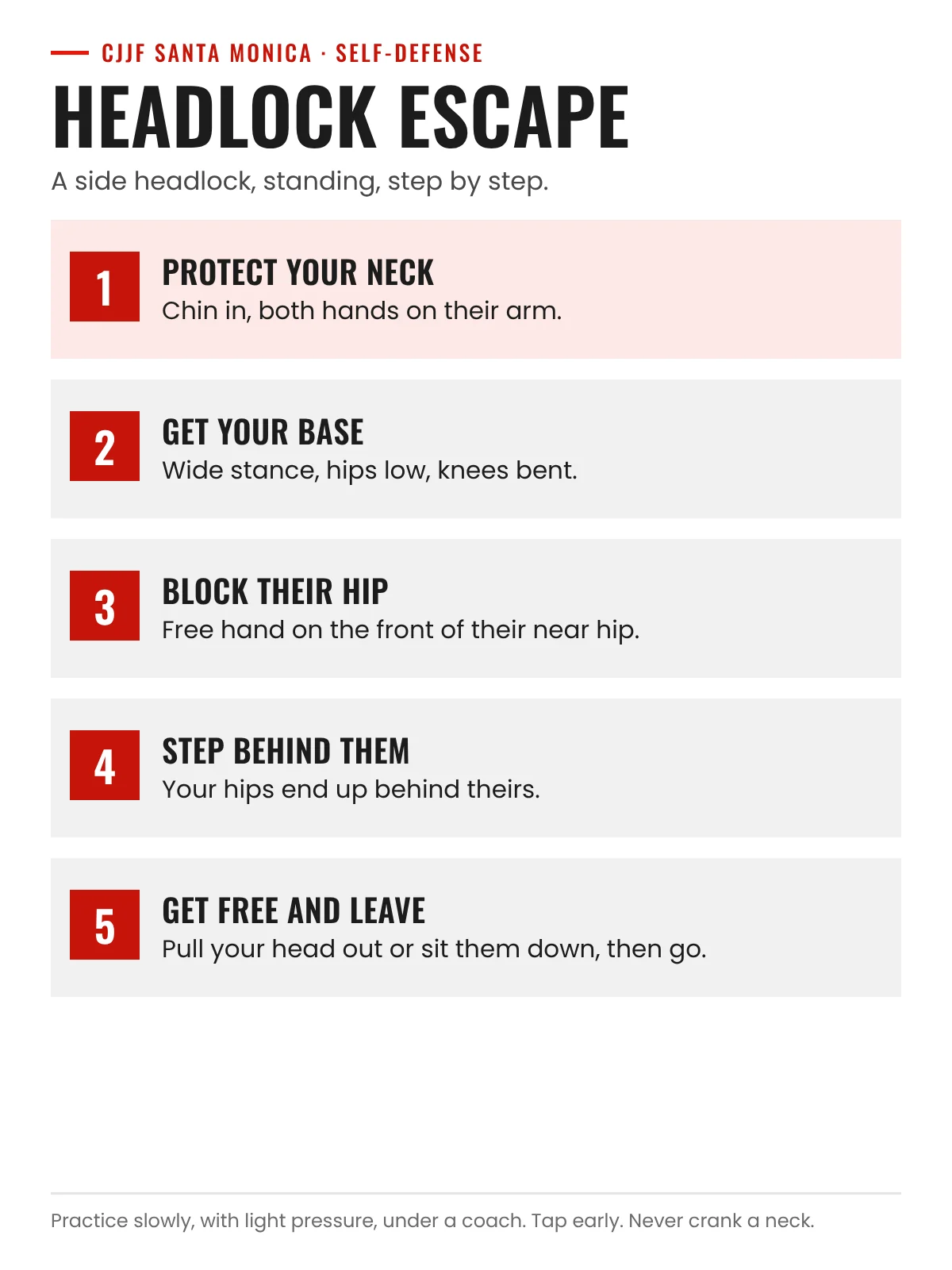
- Protect your neck. Turn your chin in toward their body and grab their wrist or forearm with both hands to take pressure off your throat.
- Get your base. Widen your stance and drop your hips, knees bent, so they can’t pull you down.
- Block their hip. Put your free hand on the front of their near hip, so they can’t turn and throw you.
- Step behind them. Step your near leg behind their legs, so your hips end up behind theirs.
- Get free and leave. Straighten up and pull your head out, or sit them down behind you, then step away and leave.
If they’re bigger and you can’t step behind them, keep your base, keep protecting your neck and wait for their grip to loosen. Avoid pulling straight back against a tight headlock: let your base and hips do the work.
Headlock escape on the ground
On the ground, the headlock usually comes from the side: they’re beside you or across your chest, with your head trapped under their arm.
- Protect your neck and breathe. Turn your chin in and get the hand on their side up, palm on their arm, to take pressure off your throat.
- Frame against their hip. Brace your other forearm against their near hip, so their weight can’t settle on you.
- Bridge into them. Drive your hips up toward them to lift their weight.
- Hip escape. As their weight lifts, turn on your side and push your hips away to make space.
- Get a knee in, then get up. Bring your knee into the space between you, free your head, and use the technical stand-up to get back to your feet.
These are the same frames and hip escapes that work in other bad positions on the ground, which is why jiu jitsu classes drill them. Our article on self-defense moves to learn first covers them.
From behind or from the front
- From behind: an arm around your neck from behind is closer to a choke, like the rear naked choke. Tuck your chin, pull down on their forearm with both hands to keep your airway clear, and drop your weight so you can’t be lifted. Then turn your chin toward their elbow, turn to face them, and step away.
- From the front: if your head is trapped under their arm while you face them, keep your head up and your chin tucked, protect your neck with your hands on their forearm, and keep your base so you can’t be pulled down. Step to the side, toward their arm, to free your head.
Both are hard to escape from an article alone. Practice them with a coach, with light pressure.
What to do after you escape
- Step back out of reach and keep your hands up.
- Leave: get toward other people and light.
- Call 911 and tell someone you trust.
- If your neck or head hurts, or you feel dizzy, get medical care.
How to practice it safely
Neck positions need care in practice. Practice with a partner, slowly, with light pressure, under a coach who can correct you. Tap early: in practice, tapping means stop, and your partner lets go at once. Never crank someone’s neck. In IBJJF competition, spinal locks without a choke, including cranking the neck, are illegal at every belt.
Headlock escapes are part of our self-defense classes, where you practice escapes, getting up and control without strikes. Your first class is free.
Self-defense classesBook a free class
Headlock escape questions
What do you do if someone puts you in a headlock?
Protect your neck first: turn your chin toward their body and grab their arm to take pressure off your throat. Then widen your stance so you stay on your feet, and work to step behind them or free your head. Once free, leave.
Is it possible to escape a headlock?
Yes. Protecting your neck, keeping your base and using your hips, not your arms, makes it possible even against someone stronger. It takes practice to do it under stress.
Can a smaller person escape a headlock?
Yes. Jiu jitsu is built on a smaller person using leverage and weight distribution instead of strength, and headlock escapes are a classic example: your base and hips do the work.
What if they also trap my arm?
Keep protecting your neck with your free hand, keep your base, and use your hips to make space. A trapped arm can come free once you step behind them or hip escape on the ground.
Should I hit someone who has me in a headlock?
We teach grappling, not strikes, so this page doesn’t cover strikes. Whatever you do, the goal is to get free and get away, using only what you need to get safe. Our guide explains California’s rules on self-defense.
Sources: Wikipedia, Brazilian jiu-jitsu: a smaller, weaker person defending against a bigger, stronger one with leverage and weight distribution. Wikipedia, Grappling hold: a headlock, “circling the opponent’s head with an arm, especially from the side”. IBJJF, Rules Book 6.1 (June 2024), Technical Fouls and Illegal Moves chart: spinal locks without a choke are illegal at every belt.