
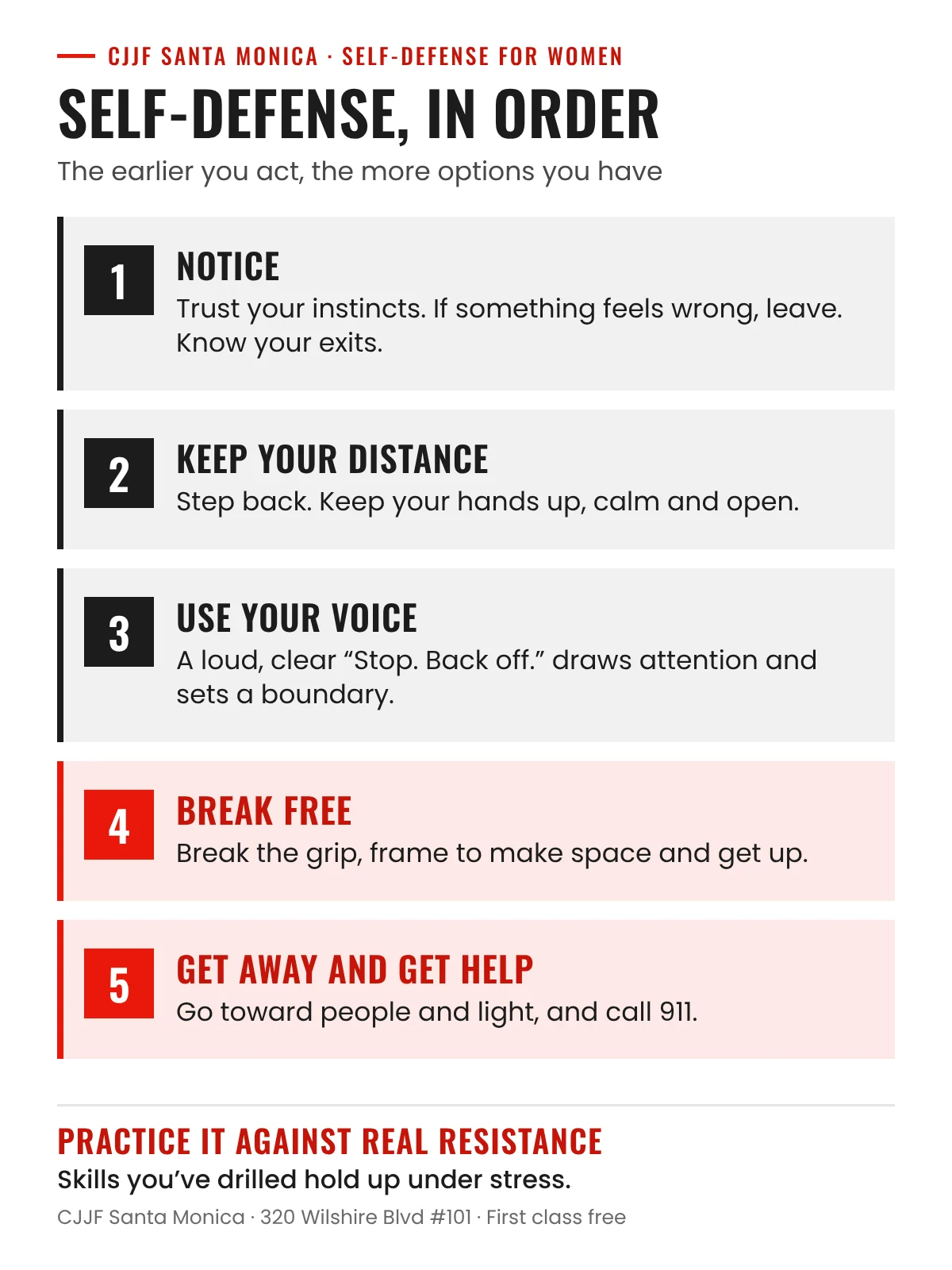
- Awareness, distance and your voice come before any technique.
- Leverage, frames and escapes give a smaller person a real chance to break free and get away.
- Practice against a partner who resists, so the skills hold up under stress.
- In two studies, women who trained were less likely to be sexually assaulted over the following year.
- Look for partner choice, clear contact rules and ongoing classes. Your first class at CJJF is free.
Self-defense tips for women, in order
Most dangerous situations start before anyone touches you. The earlier you act, the more options you have, so take these in order:
- Notice. Trust your instincts: if something feels wrong, act on it. You don’t need a reason to leave. Know your exits in parking lots, stairwells and buildings.
- Keep your distance. Step back from someone who’s crowding you, with your hands up in a calm, open position.
- Use your voice. A loud, clear “Stop. Back off.” draws attention and sets a boundary.
- Break free. If someone grabs you, break the grip, make space with your frames and get back to your feet.
- Get away and get help. Every technique ends with leaving. Go toward people and light, and call 911.
No one is ever to blame for being attacked. These are options that give you more control, not rules you have to follow.
Is women’s self-defense different?
The principles are the same for everyone: awareness, distance, your voice and skills you’ve practiced. A good class for women adds practice built around situations like a wrist or clothing grab, being pushed against a wall, someone heavier on top, or someone you know who won’t take no for an answer.
It also plans for a size difference, so technique, not strength, does the work. And it’s taught in a room where you choose your partners and can stop at any time.
How to defend yourself if you’re smaller or not as strong
An attacker is often bigger and stronger. Pretending otherwise doesn’t help. What helps is leverage: using your hips, your frames and the ground itself so you don’t have to match strength with strength. Brazilian Jiu Jitsu was developed around exactly this problem, which makes it a strong base for women’s self-defense.
Here’s how jiu jitsu uses leverage, step by step.
“I learned at least four techniques that I can use which would allow me to defend myself against someone even larger than my size, this has allowed me to feel safer when walking around.” Ashley V., Google review
Self-defense moves worth practicing
These moves don’t depend on strength:
- Breaking wrist grabs. Turn toward the gap between the thumb and fingers and pull through.
- Keeping your balance. A wide, low base makes you hard to drag or push down.
- Framing to make space. Forearms and hands braced against the attacker keep weight off you and create room to move.
- Escaping when pinned. The bridge-and-roll and the hip escape move a heavier person off you.
- Getting back up safely. The technical stand-up lets you rise while protecting yourself and keeping distance.
- Leaving. Every technique ends with getting away and getting help.
You won’t learn palm strikes or kicks with us: we teach jiu jitsu, which is grappling. Striking classes teach those, and our guide compares what each martial art teaches.

What’s the best self-defense for women?
There’s no single best martial art. The best self-defense for women is one you’ll keep practicing that covers awareness and boundaries, plus physical skills trained against a resisting partner. Grappling arts like Brazilian Jiu Jitsu fit well, because they teach you to break grips, escape when pinned and get up, using leverage instead of strength.
Striking classes and Krav Maga add tools for the standing fight, and some women train both. Our guide to the best martial art for self-defense matches arts to situations, including smaller people and women.
Why practicing against resistance matters
Under stress, your heart races, your vision narrows and fine motor skills fade. You fall back on what you’ve practiced. That’s why one-time demonstrations rarely stick, and why practice against a partner who resists, slowly at first and harder over time, builds skills you can actually use.
In jiu jitsu, tapping makes this safe: your partner can resist for real, and either of you can stop the moment you tap.
Does self-defense training work? What studies show
In a randomized trial of 893 first-year university women in Canada, women who took a 12-hour sexual assault resistance program (four 3-hour sessions of information and skills practice) had a 5.2% risk of completed rape over the next year, against 9.8% for women who got brochures: 46% lower. The risk of attempted rape was 3.4%, against 9.3%.
A study of a 10-week university self-defense class followed women for a year and compared them with similar women who hadn’t taken one. The women who trained were less likely to experience sexual assault, and more confident they could resist.
Neither study tested a jiu jitsu class, and no training guarantees safety. What they show is that practiced skills, and the confidence to use them, make a real difference.
What to look for in a self-defense class for women
- Partner choice. You decide who you train with.
- Clear rules on contact, explained before any drill.
- Gradual resistance, from slow drilling to live practice when you’re ready.
- Coaches who teach beginners well, with patience and clear explanations.
- Ongoing classes, not just a seminar. A one-day workshop is a good start, but skills fade without practice.
- A free trial, so you can see the room first.
How we teach it at CJJF Santa Monica
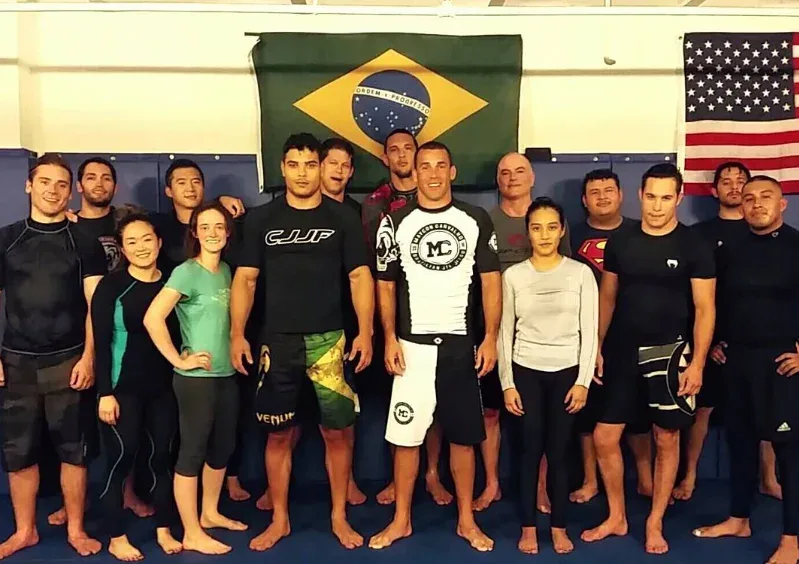
Women are welcome in every adult class. They train with other women when they’re on the mat, and otherwise with an instructor or a man close to their height and weight. Complete beginners start in Fundamentals, where escapes, frames and getting back up are core skills. There’s no women-only class: women train in the regular adult classes. The academy has also hosted free women’s self-defense seminars. Your first class is free.
“I attended a women’s self defense seminar with instructor Maycon. I was very nervous as I had never stepped foot into a Jiu Jitsu gym, but it was a FREE class so why not?” Sadie O., Google review
Women’s jiu jitsuSelf-defense classes
If you need support
If you’ve experienced violence or assault, RAINN’s National Sexual Assault Hotline is free, confidential and open 24/7: call 800-656-4673, text HOPE to 64673 or chat online. In an emergency, call 911.
Women’s self-defense questions
What is the best self-defense for women?
Awareness and boundaries first, then a grappling-based art like Brazilian Jiu Jitsu practiced against real resistance, so you can break free, get up and get away.
Can a smaller woman defend herself against a bigger man?
Size matters, and no technique guarantees safety. Leverage, frames and escapes give a smaller person a real chance to create space and get away, and practice is what makes them work under stress.
Can I try a self-defense class for free?
Yes. Your first class at CJJF is free, and the academy has also hosted free women’s self-defense seminars. Book your free class and we’ll confirm a time.
Are one-day self-defense workshops worth it?
They’re a good introduction. To keep the skills, you need regular practice, so look for ongoing classes too.
Do I need to be fit or flexible to start?
No. Beginner classes start from zero, and fitness comes with training.
Will I have to train with men?
Sometimes. At CJJF, women train with other women when they’re on the mat. Otherwise you partner with an instructor or with a man close to your height and weight, whatever his age.
What should I wear to my first class?
The same as everyone else: a sports bra under a fitted T-shirt or rashguard, and leggings or shorts. Here’s what women wear to jiu jitsu, in detail.
Should I try to hold an attacker down?
No. The goal is to get free and get away. Jiu jitsu teaches control so you can get up safely, and once you have space, you leave and get help.
Should I carry pepper spray?
It only helps if it’s in your hand in time, so it adds to training rather than replacing it. Under California’s Penal Code, a spray meant to cause temporary physical discomfort counts as tear gas (section 17240): adults may carry it solely for self-defense, in a container of 2.5 ounces or less, and minors and people with a felony or assault conviction may not (section 22810). This is general information, not legal advice.
When is it legal to defend yourself?
In California, you may use force when you reasonably believe you’re in imminent danger of being hurt and that force is needed right then, and only as much as is reasonably necessary. Our guide explains what California law says about self-defense. This is general information, not legal advice.
Sources: Senn CY, Eliasziw M, Barata PC, et al., Efficacy of a Sexual Assault Resistance Program for University Women, New England Journal of Medicine 373 (2015): 2326–2335: a randomized trial of 893 first-year women at three Canadian universities; 1-year risk of completed rape 5.2% vs 9.8%, attempted rape 3.4% vs 9.3%. Hollander JA, Does Self-Defense Training Prevent Sexual Violence Against Women?, Violence Against Women 20, no. 3 (2014): 252–269: a 10-week university self-defense class, compared with similar women over a 1-year follow-up. California Penal Code section 22810 (2025 code, via Justia) and section 17240 (via FindLaw): tear gas for self-defense, the 2.5-ounce limit and who may not carry it. RAINN, National Sexual Assault Hotline: call 800-656-4673, text HOPE to 64673 or chat; free, confidential, 24/7.