
- No martial art is best for everyone. The ones that hold up all train against a partner who resists.
- Grappling (BJJ, wrestling, judo) handles grabs, takedowns and the ground; striking (boxing, Muay Thai) handles distance and strikes.
- Smaller people get the most from leverage-based grappling, like BJJ and judo.
- Awareness and getting away come first. In California, force is lawful self-defense only against a danger you reasonably believe is immediate, and only as much as is reasonably necessary.
- Choose a school with live practice, a real beginner path and a free trial, then train regularly.
What self-defense actually requires
Most self-defense happens before anything gets physical: noticing trouble early, keeping your distance and leaving. When it does get physical, it’s usually close, fast and stressful. The skills that help most are:
- Awareness and avoidance: spotting trouble and getting away from it.
- Staying on your feet, or getting back up quickly if you fall.
- Breaking free from grabs, holds and pins.
- Controlling someone without having to hurt them.
- Staying calm while your heart is racing.
That last one is why pressure testing matters. A technique you’ve only seen demonstrated is hard to use under stress; practicing it against a resisting partner is how you find out what works for you.
How the main martial arts compare
| Martial art | What you learn | Strengths for self-defense | Keep in mind |
|---|---|---|---|
| Brazilian Jiu Jitsu | Control, escapes and submissions, mostly on the ground | Works against bigger people through leverage; lets you control without striking; trained against full resistance | Risky on the ground with more than one attacker; pair it with escapes and getting up |
| Wrestling | Takedowns, takedown defense and staying on top | Excellent balance and control; very hard to knock down | Adult classes can be hard to find; no striking or submissions |
| Judo | Throws, grips and falling safely | Throws and breakfalls work in a standing scuffle and protect you in a fall | Competition rules limit time on the ground, so ground escapes get less practice |
| Boxing | Punching, footwork and head movement | Fast to learn the basics; great for distance and defending strikes | No grappling or kicks |
| Muay Thai | Punches, kicks, knees, elbows and the clinch | Powerful striking and strong clinch work | Little ground work |
| Krav Maga | Scenario-based defense against grabs, strikes and weapons | Built around real-world situations and awareness | Training varies a lot between schools; look for live practice against resistance |
| Karate and taekwondo | Strikes, kicks and forms | Discipline, footwork and kicking range | Many schools use point sparring and little grappling |
| MMA | Striking and grappling combined | The most complete skill set | Higher-intensity training with more impact |
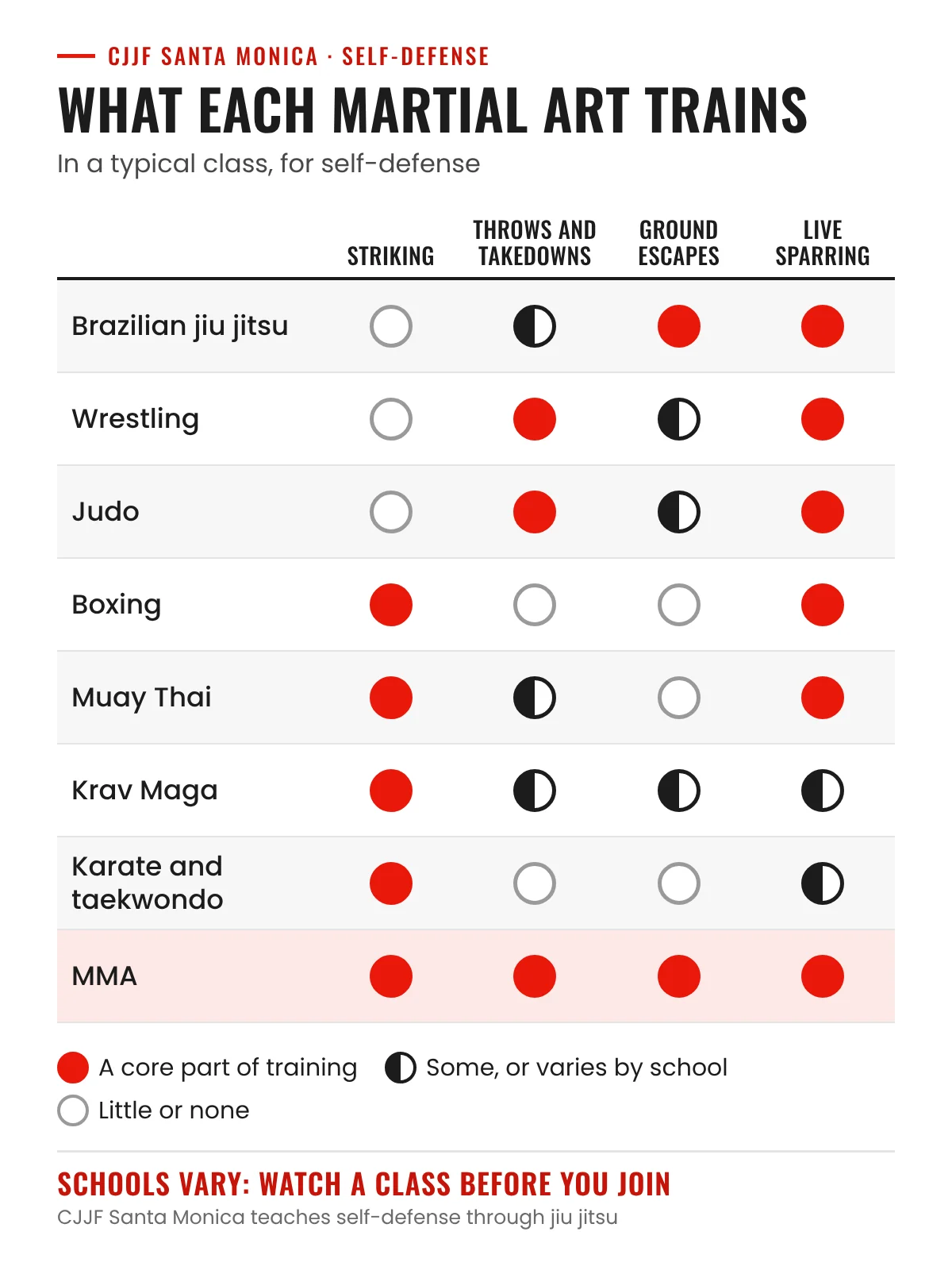
Notice the pattern: the arts that hold up best all include live practice against someone trying to stop you.
Is each martial art good for self-defense?
Short answers to the questions people ask most, art by art. For how each one compares with jiu jitsu in general, see our guide to jiu jitsu vs other martial arts.
Brazilian jiu jitsu
Yes, for grabs, holds and the ground. You learn to escape, defend takedowns, get back up and control someone without striking, and you practice it against full resistance. It doesn’t teach punches or kicks, and the ground is a bad place to be against more than one person. We answer is jiu jitsu good for self-defense in detail on our self-defense class page.
Wrestling
Yes, for deciding whether a fight goes to the ground. Wrestlers learn takedowns, takedown defense and how to stay on top, and live wrestling against a resisting partner is part of normal practice. There’s no striking or submissions, and adult classes can be hard to find. See how wrestling compares with jiu jitsu.
Judo
Yes, for throws, grips and falling safely. Judo practices throws against a resisting partner, which helps in a standing scuffle, and breakfalls protect you if you go down. There’s no striking, and competition rules limit time on the ground, so ground escapes get less practice. See jiu jitsu vs judo.
Boxing
Yes, for striking and distance. Boxing teaches punching, footwork and head movement, the basics come quickly, and sparring is a normal part of training. There are no kicks, no throws and no ground work. See how boxing compares with jiu jitsu.
Muay Thai
Yes, for the standing fight. Muay Thai trains punches, kicks, knees and elbows, plus the clinch, where you control and off-balance someone up close, with regular sparring. It has little ground work. See Muay Thai vs BJJ.
Krav Maga
It depends on the school. Krav Maga is built around real-world scenarios: grabs, strikes, weapons and awareness. Training varies a lot between schools, so ask whether students practice regularly against a resisting partner before you join.
Karate and taekwondo
Sometimes. Both teach strikes, kicks, footwork and discipline, and taekwondo is known for its kicking range. Many schools use point sparring and teach little grappling, so look for one that spars regularly, and add grappling later.
MMA
Yes, and it’s the most complete. MMA combines striking, the clinch, takedowns and ground work, trained against resistance. Training is more intense, with more impact, so many people start with one art and add others. See how MMA compares with jiu jitsu.
BJJ for self-defense: why we teach it through jiu jitsu
Brazilian Jiu Jitsu was refined by the Gracie family so a smaller person could defend against a bigger one using leverage and timing instead of strength. That’s still its biggest advantage. Here are the self-defense techniques that work for beginners.
It’s also how the art made its name. In 1993, Royce Gracie won UFC 1, an eight-man open-weight tournament, using submission grappling to beat larger, heavier opponents.
- You can train at full resistance safely. Tapping lets partners go hard without injuring each other, so you learn what works under pressure.
- You learn to control, not just hit. Control gives you options that fit the situation, which matters legally and ethically.
- You learn to escape bad positions. Being pinned, mounted or held against a wall are the situations people fear most, and jiu jitsu practices them every class, from being pinned to getting out of a headlock.
- You learn to stay calm. Weeks of working against a resisting partner teach you to breathe and think when things go wrong.
I attended a self-defense class and it was extremely informative. It was great to be able to learn from the instructor who was patient with us and simple to understand. I learned at least four techniques that I can use which would allow me to defend myself against someone even larger than my size, this has allowed me to feel safer when walking around.
Ashley V., Google review
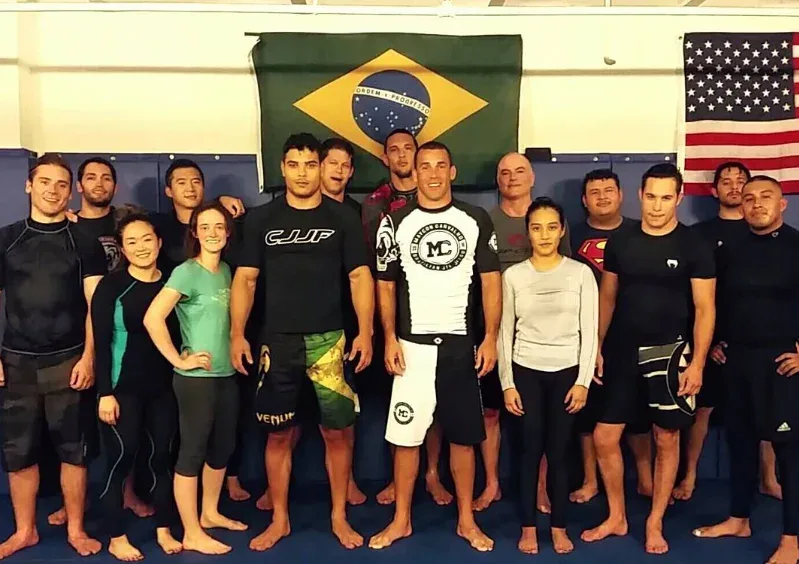
At CJJF Santa Monica, self-defense is part of every Fundamentals class, Monday to Friday evenings: escaping grabs, holds and pins, getting back to your feet, controlling someone without strikes, and posture and distance so you’re harder to take down. Here’s what our self-defense classes cover.
What jiu jitsu doesn’t cover
An honest guide should say it: jiu jitsu alone isn’t complete self-defense.
- Multiple attackers. The ground is the last place to be when there’s more than one person. In self-defense, the goal is to escape and get up, not to win on the ground.
- Weapons. No martial art makes facing a knife or a gun safe. Distance and leaving come first.
- Striking. Jiu jitsu classes don’t teach punching. Many students add boxing or Muay Thai later.
That’s why our self-defense training focuses on escapes, getting back to your feet and creating distance.
Which martial art fits you?
The best choice depends on who you are and what you want from training. Common starting points:
| If you’re | Look for | At CJJF |
|---|---|---|
| Brand new to martial arts | A real beginner path, with live practice introduced slowly | Fundamentals, Monday to Friday evenings |
| Smaller than most people you’d face | Leverage-based grappling, like BJJ or judo | Practice against a partner who resists at a safe pace, in every class |
| A woman | Women training partners, and escapes from grabs and holds | Women’s jiu jitsu: women pair with women when they can, size-matched partners otherwise |
| A teen, 13 to 17 | Coaches who supervise every round | Teen jiu jitsu: technique, confidence and control without strikes |
| Over 40 | Control over how hard you train | Light rounds are optional; see starting jiu jitsu after 40 |
| Training for fitness too | Full-body sessions you’ll enjoy | Every class is a full-body workout; see the workout jiu jitsu gives you |
| Thinking about competing | A competition class and coaches who compete | Competition training, Saturdays 10 to 11:30 am |
Women weighing their options can start with our guide to self-defense for women: what actually works, and how to find a class.
How to choose a class
- Live practice against resistance, introduced gradually and safely.
- Coaches who explain safety: how to tap, how to go light and when to stop.
- A real beginner path, so you aren’t thrown in with advanced students on day one.
- A free trial, so you can feel the room before you commit.
- A schedule you’ll keep. Skills come from months of regular practice, not one weekend.
Is self-defense legal? What California law says
In California, using force counts as lawful self-defense when three things are true, according to the state’s criminal jury instructions (CALCRIM No. 3470):
- You reasonably believed that you, or someone else, were in imminent danger of bodily injury.
- You reasonably believed that using force right then was necessary to defend against that danger.
- You used no more force than was reasonably necessary.
Fear of harm later isn’t enough: the danger has to be immediate. The same instruction says a person isn’t required to retreat, but getting away is still the safest way to end a threat, and it’s the first goal in our self-defense training.
Self-defense laws vary by state, and every situation is different. This guide is general information, not legal advice. For a legal question, ask a lawyer licensed in your state.
Self-defense classes in Santa MonicaBook a free class
Self-defense questions
Is jiu jitsu good for self-defense?
Yes. It teaches you to escape holds, control someone without striking and get back to your feet, all practiced against real resistance. It works best paired with awareness and the goal of getting away.
What is the best martial art for a smaller person?
Grappling arts built on leverage, like Brazilian Jiu Jitsu and judo, give smaller people the best tools to handle someone bigger.
How long does it take to learn self-defense?
You’ll pick up useful basics, like breaking grips and getting up safely, in your first few months of regular training. Staying calm under real pressure takes longer, and it keeps improving the more you train. Here’s what your first year of jiu jitsu looks like.
Is Krav Maga better than jiu jitsu for self-defense?
They train different things. Krav Maga focuses on scenarios, strikes and weapons awareness; jiu jitsu focuses on control and escapes against full resistance. Many people do both.
What martial art wins a street fight?
None reliably. Real fights have no rules and can involve more than one person or a weapon, so the best outcome is the one where you get away. The arts that prepare you best are trained against resistance: grappling like BJJ, wrestling and judo for grabs and the ground, and striking like boxing and Muay Thai for distance.
Is taekwondo or karate better for self-defense?
It depends more on the school than the style. Both are striking arts, and taekwondo puts more weight on kicks. Choose the school that spars regularly, and add grappling, since most schools teach little of it.
Which martial art is best for beginners?
One you can start from zero and keep doing: a school with a real beginner path, live practice introduced gradually and a free trial. At CJJF, beginners start in Fundamentals. See which martial art fits you.
Is aikido effective for self-defense?
It gives you less practice against resistance than most arts here. Aikido training is based mainly on two partners practicing pre-arranged forms rather than freestyle practice. If self-defense is your main goal, look for regular practice against a partner who resists.
Muay Thai or BJJ for self-defense?
They cover different ranges: Muay Thai the standing fight and the clinch, BJJ grabs, takedowns and the ground. Many people train one and add the other later.
What’s the best martial art for older adults?
One that lets you control the intensity. At CJJF, light rounds are optional, so you set the pace, and jiu jitsu relies on leverage more than strength. Here’s what starting after 40 looks like.
Sources: Judicial Council of California, CALCRIM No. 3470, Right to Self-Defense or Defense of Another (Non-Homicide) (2026 edition, via Justia): the three conditions for lawful self-defense, imminent danger and no duty to retreat. Wikipedia, Royce Gracie: UFC 1 in 1993, an eight-man open-weight tournament won with submission grappling. Wikipedia, Aikido techniques: how aikido is trained.