
- Most of self-defense happens before anyone touches you: awareness, distance and your voice.
- Learn moves that don’t depend on strength: base, frames, grip breaks, escapes and getting up.
- Practice against a partner who resists, slowly at first, so the moves hold up under stress.
- Every technique ends with leaving and getting help, not winning a fight.
- At CJJF we teach grappling, not strikes: escapes, control and getting up.
How to defend yourself: what comes before any move
The best self-defense move is the one you never need. Before anything physical:
- Notice. Trust your instincts. If something feels wrong, act on it, and know where your exits are.
- Keep your distance. Step back from someone crowding you, hands up in a calm, open position.
- Use your voice. A loud, clear “Stop. Back off.” sets a boundary and draws attention.
- Leave early. Walking away before things escalate is a win, not a loss.
If someone does grab you, the moves below take over. Each one is about getting free and getting away.
Basic self-defense moves anyone can learn
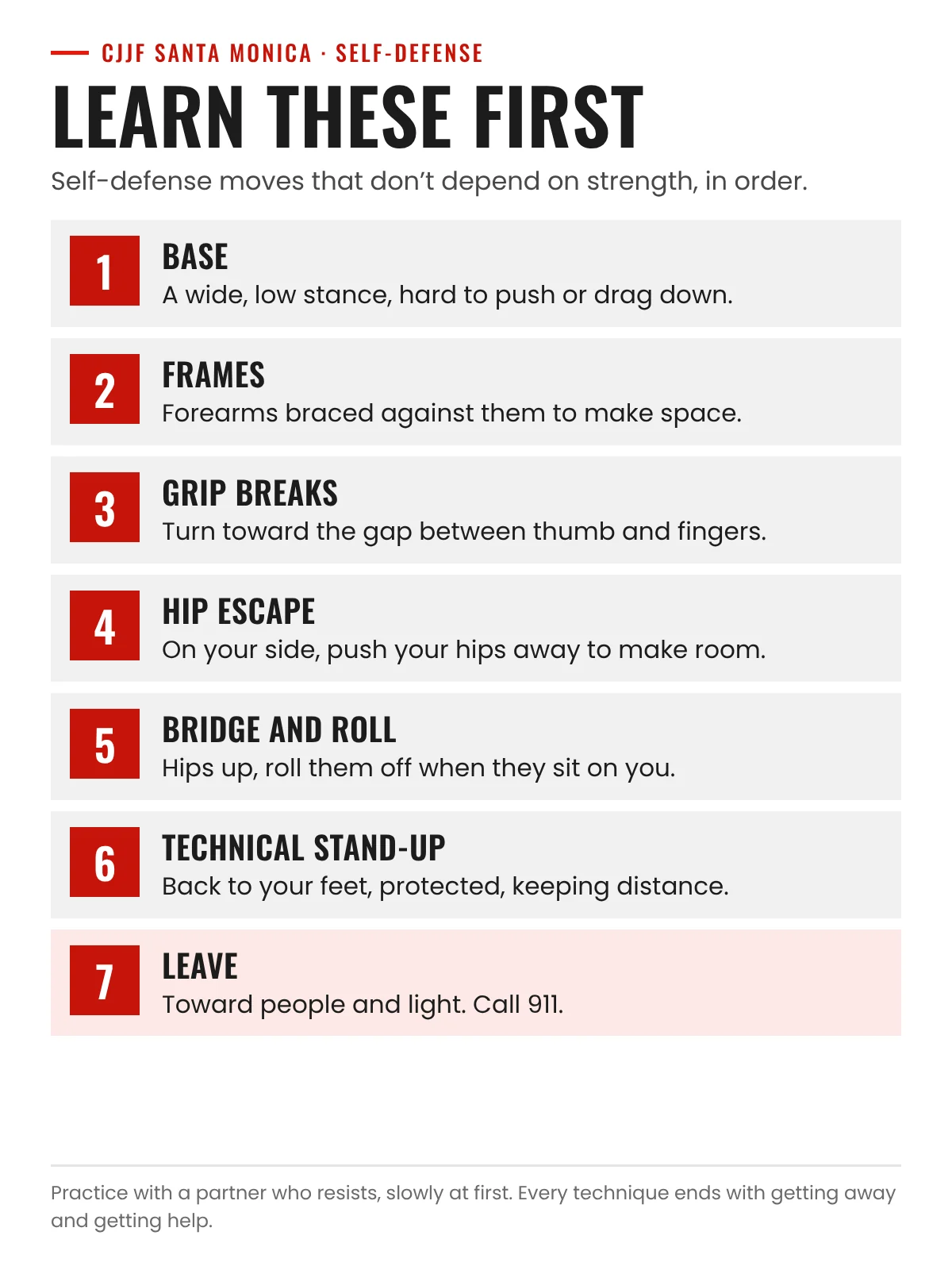
Our self-defense classes start with posture, distance, escapes and control. These are the moves to learn first, roughly in this order, since each builds on the last:
- Base. A wide, low stance, knees bent and weight centered, makes you hard to push, pull or drag down.
- Frames. Forearms and hands braced against someone, like a doorstop, keep their weight off you and create room to move.
- Grip breaks. Breaking a wrist or clothing grab by turning toward the gap between the thumb and fingers.
- Hip escape. Turning on your side and pushing your hips away to make space when someone is on top of you or next to you.
- Bridge and roll. Driving your hips up and rolling someone off you when they’re sitting on top of you.
- Technical stand-up. Getting back to your feet while protecting yourself and keeping distance.
- Leaving. Getting away, toward people and light, and calling 911.
Self-defense techniques that work, and why
The techniques that hold up have three things in common. They’re simple, so you can do them under stress. They use leverage instead of strength, so they work against someone bigger. And they’ve been practiced against resistance, so your body knows them.
Brazilian jiu jitsu was built around the second point: a smaller, weaker person defending against a bigger, stronger one by using leverage and weight distribution. That’s why the moves above come from it.
Practice matters as much as the move. A technique you’ve only watched, or done on a partner who doesn’t resist, is a step you’re trying to remember. A technique you’ve done hundreds of times against a partner who pushes back becomes a reflex. That’s why in our classes you practice slowly against light resistance first, then more realistic resistance over time.
What we don’t teach: punches, kicks and palm strikes. We teach jiu jitsu, which is grappling. Striking classes teach those, and our guide to the best martial art for self-defense compares what each art covers.
Escaping a grab: wrist, bear hug, headlock
Breaking a wrist grab
- Stay calm and keep your base. Don’t pull straight back against their grip.
- Find the gap between their thumb and fingers.
- Turn your wrist toward that gap and pull through it sharply, toward their thumb.
- Step back out of reach and leave.
Escaping a bear hug
- Drop your weight: bend your knees and widen your stance, so you’re hard to lift.
- Push your hips back to make space between you.
- Use your hands and forearms as frames against their arms or hips to widen the gap.
- Turn to face them or slip out, then step away and leave.
Escaping a headlock
A headlock squeezes your head and neck, so protecting your neck comes first. Our article on how to get out of a headlock takes you through the escapes standing and on the ground.
If you end up on the ground
Being on your back with someone on top of you is one of the hardest places to be, and a position jiu jitsu trains a lot.
- Protect yourself first. Keep your elbows in and your hands up, close to your face and neck.
- Frame. Brace your forearms against their hips or chest so their weight can’t settle on you.
- If they’re sitting on you: trap one of their arms and the foot on the same side, bridge your hips up, and roll them over that side.
- If they’re beside you: turn on your side and hip escape to make space, then get a knee between you.
- Get up safely. Use the technical stand-up: post one hand behind you, keep the other hand up, lift your hips and step back to your feet, facing them.
Then leave. Getting free and getting away is the goal, not staying to fight.
When you can’t avoid a fight
If you can’t leave, defend yourself with what you’ve practiced: keep your base, frame, protect your head and neck, and look for the first chance to get away. Use only what you need to get safe. When self-defense is legal is a question of state law; our guide explains what California law says about self-defense.
Afterward, get to a safe place, call 911, and tell someone you trust. If you were hurt, get medical care.
How to practice safely
- Find a partner and a coach. Self-defense is learned with a partner who resists, under someone who can correct you.
- Go slowly. Learn the steps at walking pace, then add resistance little by little.
- Tap early. In practice, tapping means stop: your partner lets go at once.
- Protect necks and joints. Never crank a neck or a joint in practice. Headlock and choke escapes are practiced with light pressure.
- Practice getting up. The technical stand-up is worth repeating until you do it without thinking.
At CJJF, our self-defense classes start with posture, distance, escapes and control before anything else, and your first class is free.
Self-defense classesBook a free class
Self-defense moves questions
What’s the best self-defense move?
There’s no single best move. The skills that matter most are noticing trouble early, keeping your distance, breaking free of a grab, getting up off the ground and leaving. All of them need practice to work under stress.
Is self-defense different for men?
The principles are the same for everyone: awareness, distance, your voice, and skills practiced against resistance. What changes is the situations people train for. Our guide to the martial art that fits your situation matches arts to different people and goals.
How long until I can defend myself?
The first skills, like breaking a grip and getting up safely, take a few classes to learn and much longer to make reliable. Steady practice, a couple of times a week, is what turns them into reflexes.
Can I learn self-defense from videos?
Videos help you learn the steps. They can’t give you a partner who resists, which is what makes a move work when you’re stressed. Use videos to review what you practice in class.
Do you teach punching and kicking?
No. We teach jiu jitsu, which is grappling: escapes, control and takedown defense.
Is self-defense training worth it for women?
Yes, and our article on what works in women’s self-defense covers it in depth, including what two studies of women’s self-defense programs found.
Sources: Wikipedia, Brazilian jiu-jitsu: a self-defense system, martial art and combat sport, based on a smaller, weaker person defending against a bigger, stronger one with leverage and weight distribution.