

- Adult and masters men have nine weight classes; women have eight. Both also have an open class.
- Every limit is a maximum, measured once, with your uniform on, right before your first match.
- No-gi limits are lower than gi limits. At no-gi events you weigh in wearing the no-gi uniform.
- Your age division is set by your birth year. Masters divisions start at 30.
- If you’re over your division’s limit at weigh-in, you’re disqualified, so check your weight in your gi.
IBJJF weight classes for men, gi and no-gi
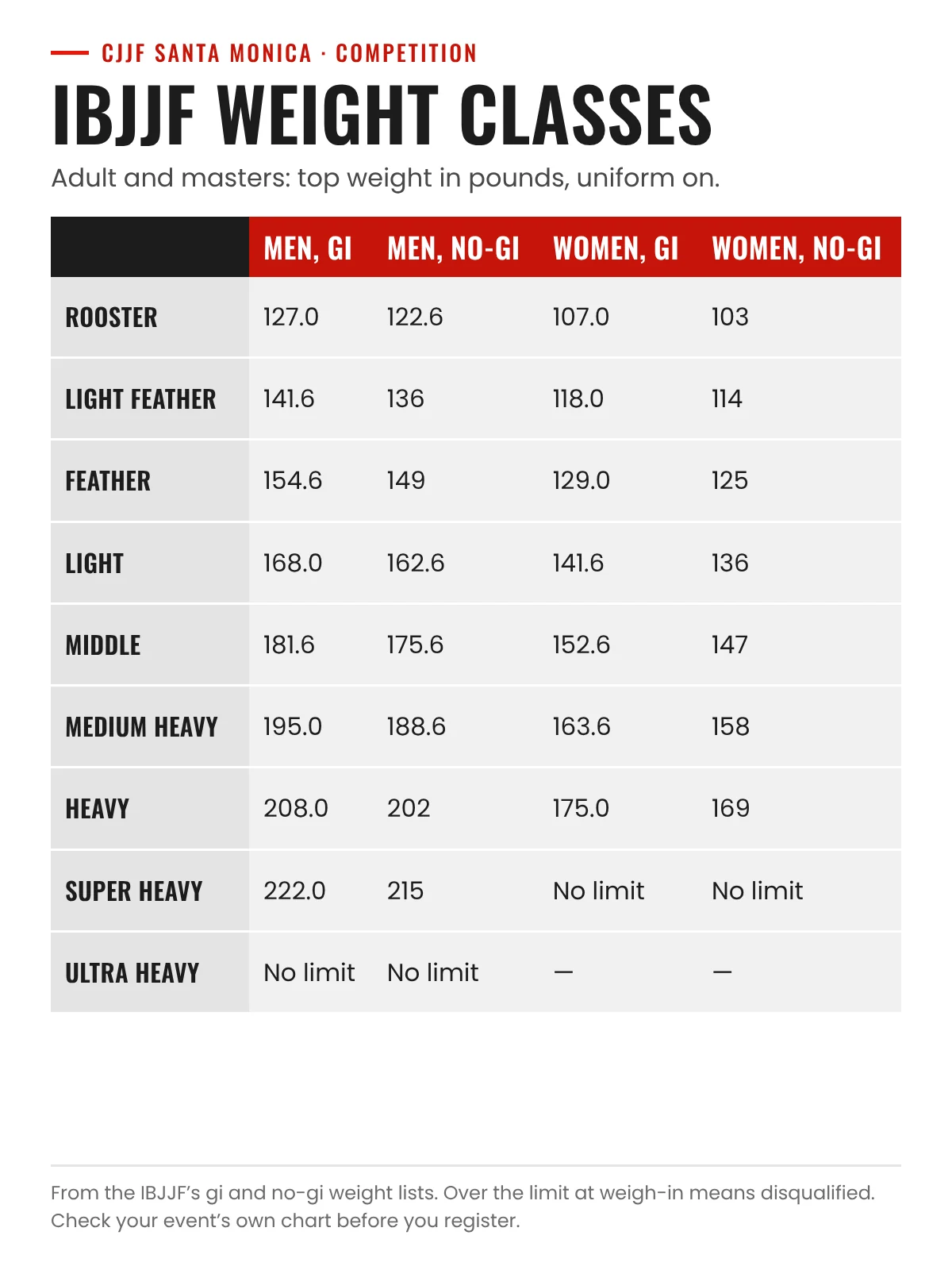
These are the IBJJF’s limits for adult and masters men, in pounds, from its own weight charts. The gi limits are with the gi on; the no-gi limits are with the no-gi uniform on.
| Weight class | Gi | No-gi |
|---|---|---|
| Rooster | up to 127.0 lb | up to 122.6 lb |
| Light feather | up to 141.6 lb | up to 136 lb |
| Feather | up to 154.6 lb | up to 149 lb |
| Light | up to 168.0 lb | up to 162.6 lb |
| Middle | up to 181.6 lb | up to 175.6 lb |
| Medium heavy | up to 195.0 lb | up to 188.6 lb |
| Heavy | up to 208.0 lb | up to 202 lb |
| Super heavy | up to 222.0 lb | up to 215 lb |
| Ultra heavy | no limit | no limit |
Professor Maycon Carvalho won his IBJJF No-Gi World title in 2009 in the medium heavy division, Master 1 black belt.
IBJJF weight classes for women
Women have eight weight classes. There’s no ultra heavy: super heavy has no maximum.
| Weight class | Gi | No-gi |
|---|---|---|
| Rooster | up to 107.0 lb | up to 103 lb |
| Light feather | up to 118.0 lb | up to 114 lb |
| Feather | up to 129.0 lb | up to 125 lb |
| Light | up to 141.6 lb | up to 136 lb |
| Middle | up to 152.6 lb | up to 147 lb |
| Medium heavy | up to 163.6 lb | up to 158 lb |
| Heavy | up to 175.0 lb | up to 169 lb |
| Super heavy | no limit | no limit |
Watch the conversions you find online: when we checked in October 2026, Google’s AI Overview showed a 56.5 kg division as 113.5 lb. In the IBJJF’s own chart, that division, women’s no-gi feather, goes up to 125 lb.
Find your division in pounds or kilograms
To find your weight class, weigh yourself in the uniform you’ll compete in, then pick the lightest division whose limit is above that number. The IBJJF publishes its charts in pounds for its US events and in kilograms elsewhere, and the two don’t always match to the decimal, so use the chart on your event’s page.
In kilograms, the gi limits for men are 57.5, 64, 70, 76, 82.3, 88.3, 94.3 and 100.5 kg, then no limit; for women, 48.5, 53.5, 58.5, 64, 69, 74 and 79.3 kg, then no limit. The no-gi limits for men are 55.5, 61.5, 67.5, 73.5, 79.5, 85.5, 91.5 and 97.5 kg; for women, 46.5, 51.5, 56.5, 61.5, 66.5, 71.5 and 76.5 kg.
A few examples, in the gi: a man who weighs 170 lb in his gi is a middle (up to 181.6 lb), not a light (up to 168.0). A woman who weighs 140 lb in her gi is a light (up to 141.6 lb). A gi adds weight, so weigh yourself in yours.
IBJJF age divisions
Your age division is set by the year you were born: subtract your birth year from the year of the event. A man born in 1995 is a Master 1 in 2026 (2026 minus 1995 is 31), even before his birthday. Masters can also enter a younger division, so a Master 2 can enter Master 2, Master 1 or adult, but not the other way around.
| Age division | Age in the year of the event | Match length |
|---|---|---|
| Juvenile 1 | 16 | 5 minutes |
| Juvenile 2 | 17 | 5 minutes |
| Adult | 18 and up | 5 to 10 minutes, by belt |
| Master 1 | 30 and up | 5 or 6 minutes, by belt |
| Master 2 | 36 and up | 5 minutes |
| Master 3 | 41 and up | 5 minutes |
| Master 4 | 46 and up | 5 minutes |
| Master 5 | 51 and up | 5 minutes |
| Master 6 | 56 and up | 5 minutes |
| Master 7 | 61 and up | 5 minutes |
Starting later in life? Our article on starting jiu jitsu after 40 covers competing in masters divisions after 40.
Kids and juvenile divisions
Kids compete by the age they turn in the year of the event: Mighty Mite (4 to 6), Pee Wee (7 to 9), Junior (10 to 12) and Teen (13 to 15), each split by single years, then Juvenile 1 and 2 at 16 and 17. Kids and juveniles can register only for the division of their birth year (unless they’re alone in it), and kids’ weight classes are on the IBJJF’s separate kids chart, on each event’s page.
Juveniles have their own weight chart too. A juvenile 2 boy’s rooster limit, for example, is 118 lb in the gi, and a juvenile girl’s is 98 lb.
How IBJJF weigh-ins work
At IBJJF events, you weigh in once, right before your first match:
- Staff call your division. There’s no check-in. Be ready an hour before your division’s start time.
- Your uniform is checked first. Fit, collar, patches and belt. You get up to three inspections to pass.
- You step on the scale once, in the uniform you’ll compete in, with no shoes. Knee and elbow braces can come off for the weigh-in, but you wear them for the uniform check.
- If you’re over the limit, you’re disqualified. There’s no second try.
- You keep that gi for your first match. After the first match you can ask to change gis, and the new one is checked again.
Since you weigh in right before you compete, plan to make weight on a normal day rather than by cutting: pick the division you’ll make in your gi. Our first tournament guide walks through the whole day.
The open class (absolute)
The open class, also called the absolute, has no weight limit. Who can enter it, and when, depends on the event, so check its page. If you get promoted during a tournament after your division is over, you can’t then compete in that event’s open class.
Do other tournaments use the same weight classes?
Yes, BJJ has weight classes in competition, but the limits aren’t universal. If you’re entering a Jiu-Jitsu World League event or any other non-IBJJF tournament, use that event’s own chart: don’t assume your IBJJF division carries over.
In class it’s different: there are no weight classes, and you’ll roll with people of every size. At CJJF, you can ask for a partner your size.
Competition trainingBook a free class
IBJJF weight class questions
What weight class am I if I weigh 170 lb in the gi?
For a man in the gi, 170 lb is the middle division, which goes up to 181.6 lb. Light stops at 168.0 lb. In no-gi, weighing 170 lb in your no-gi uniform also puts you in middle, which goes up to 175.6 lb.
Do you weigh in with the gi on?
Yes. At IBJJF gi events you weigh in wearing your gi, and the limits include it. At no-gi events you weigh in wearing your no-gi uniform. No shoes either way.
What happens if I miss weight?
You’re disqualified from your division. IBJJF athletes weigh in once, right before their first match, so there’s no second weigh-in later in the day.
How many weight classes are there in BJJ?
At IBJJF events, nine for adult and masters men (rooster to ultra heavy) and eight for women (rooster to super heavy), plus the open class. Other organizers set their own.
When do masters divisions start?
Master 1 starts in the year you turn 30. Then Master 2 at 36, Master 3 at 41, Master 4 at 46, Master 5 at 51, Master 6 at 56 and Master 7 at 61.
Can I compete in a heavier weight class?
The limits are maximums, so you can be lighter than your division’s limit. You register for one division per championship, so choose the one you’ll make on the day.
Sources: IBJJF, Weight List: Jiu-Jitsu (gi), in pounds (“Athlete with Gi on”) and Jiu-Jitsu No Gi, in pounds (“Athlete with Jiu-Jitsu No Gi Uniform”): adult, masters and juvenile limits. IBJJF, Rules Book 6.1 (June 2024): General Competition Guidelines, Article 1 (age divisions and match lengths) and rule 5.9 (the open class after a promotion); Rules Book 8.1.11 to 8.1.14 (uniform check and changing gis) and 8.3.1 to 8.3.3 (one weigh-in, braces, no shoes). IBJJF, My First Championship: age by birth year, masters entering younger divisions, kids and juveniles in their own division, one division per championship. IBJJF Help Desk, Championship questions: limits are maximums with the uniform on; disqualification over the limit. Wikipedia, Brazilian jiu-jitsu weight classes: the IBJJF’s limits in kilograms.