
- White belts have their own divisions at IBJJF events, so you don’t need years of training to enter.
- You weigh in once, in your gi, right before your first match. Over the limit means you’re disqualified.
- Adult white belt matches last five minutes, and the brackets are single elimination.
- Some moves allowed at higher belts are illegal for white belts, like jumping to closed guard and heel hooks.
- Ask your coach which event fits you, then practice the start of a match: standing up.
Can white belts compete in BJJ?
Yes. The IBJJF (International Brazilian Jiu-Jitsu Federation) has divisions for every belt, white belt included, split by age and weight. You compete against people of your own belt, age group and size, so a white belt with six months of training doesn’t face a purple belt.
There’s one limit worth knowing. Under IBJJF rule 5.5, people with a black belt in judo, wrestlers who competed in college, and anyone who has fought MMA, as a professional or an amateur, can’t enter as white belts. Other organizers set their own rules, so check the event’s page before you register.
You also need to be ready, and that’s a call to make with your coach. IBJJF events have divisions for white belts, so you don’t need years of training to enter, but you should be able to play a full round safely and know how to tap and when.
How BJJ tournaments work
A BJJ tournament is a day of matches grouped into divisions. At IBJJF events, your division is set by four things:
- Belt: the belt you’re registered under with the IBJJF.
- Age: set by your birth year, not your birthday. Adults are 18 and up; masters divisions start at 30, and masters can also enter younger divisions.
- Weight: each division has a maximum weight, measured with your uniform on. Our article on IBJJF weight classes lists every division in pounds.
- Gi or no-gi: the IBJJF runs separate gi and no-gi championships, with different weight limits.
You register for one division per championship. Each division is a single-elimination bracket: lose a match and you’re out, win and you move on. The only exception is a bracket of three, where the loser of the first match gets a second match against the third athlete. The winner of the final takes gold, the runner-up silver, and both losing semifinalists take bronze.
A match ends early when someone taps, the way it does in class. If time runs out, the athlete with more points wins; then more advantages; then fewer penalties; and if it’s still even, the referee decides who attacked more. Our guide to how BJJ points work walks through each one.
BJJ competition rules for white belts
Most of what you do in class is legal at a white belt tournament. These are the rules that catch beginners:
- Points: 2 for a takedown, a sweep or knee on belly; 3 for passing the guard; 4 for mount or back control. You have to hold the position for 3 seconds.
- No jumping to closed guard. In every white belt division, jumping to closed guard on a standing opponent, flying triangles and flying armbars included, is a foul, and the referee stands you both back up.
- Submissions by belt. White belts can use chokes, armlocks, shoulder locks and the straight ankle lock. Wrist locks start at blue belt, knee bars and toe holds at brown belt, and heel hooks are allowed only for brown and black belts in adult no-gi. Our glossary has the submissions allowed at each belt in one chart.
- Never allowed: slams, scissor takedowns, and spinal locks without a choke, at any belt.
- Your uniform: a gi has to pass the IBJJF’s check for fit, collar, patches and belt before you weigh in. The IBJJF gi rules are in our gi size chart.
How long is a BJJ match?
At IBJJF events, an adult white belt match lasts five minutes. Matches get longer as belts go up, and masters and younger athletes have shorter matches:
| Division | Age | Match length |
|---|---|---|
| Adult, white belt | 18 and up | 5 minutes |
| Adult, blue belt | 18 and up | 6 minutes |
| Adult, purple belt | 18 and up | 7 minutes |
| Adult, brown belt | 18 and up | 8 minutes |
| Adult, black belt | 18 and up | 10 minutes |
| Master 1 | 30 and up | 5 minutes (white and blue); 6 (purple to black) |
| Master 2 to Master 7 | 36 and up | 5 minutes |
| Juvenile | 16 and 17 | 5 minutes |
| Teen | 13 to 15 | 4 minutes |
Between matches you get at least as long as a match to rest, and twice as long before a final. Five minutes sounds short until you’re in it, which is why it pays to practice full-length rounds.
Tournament day, step by step
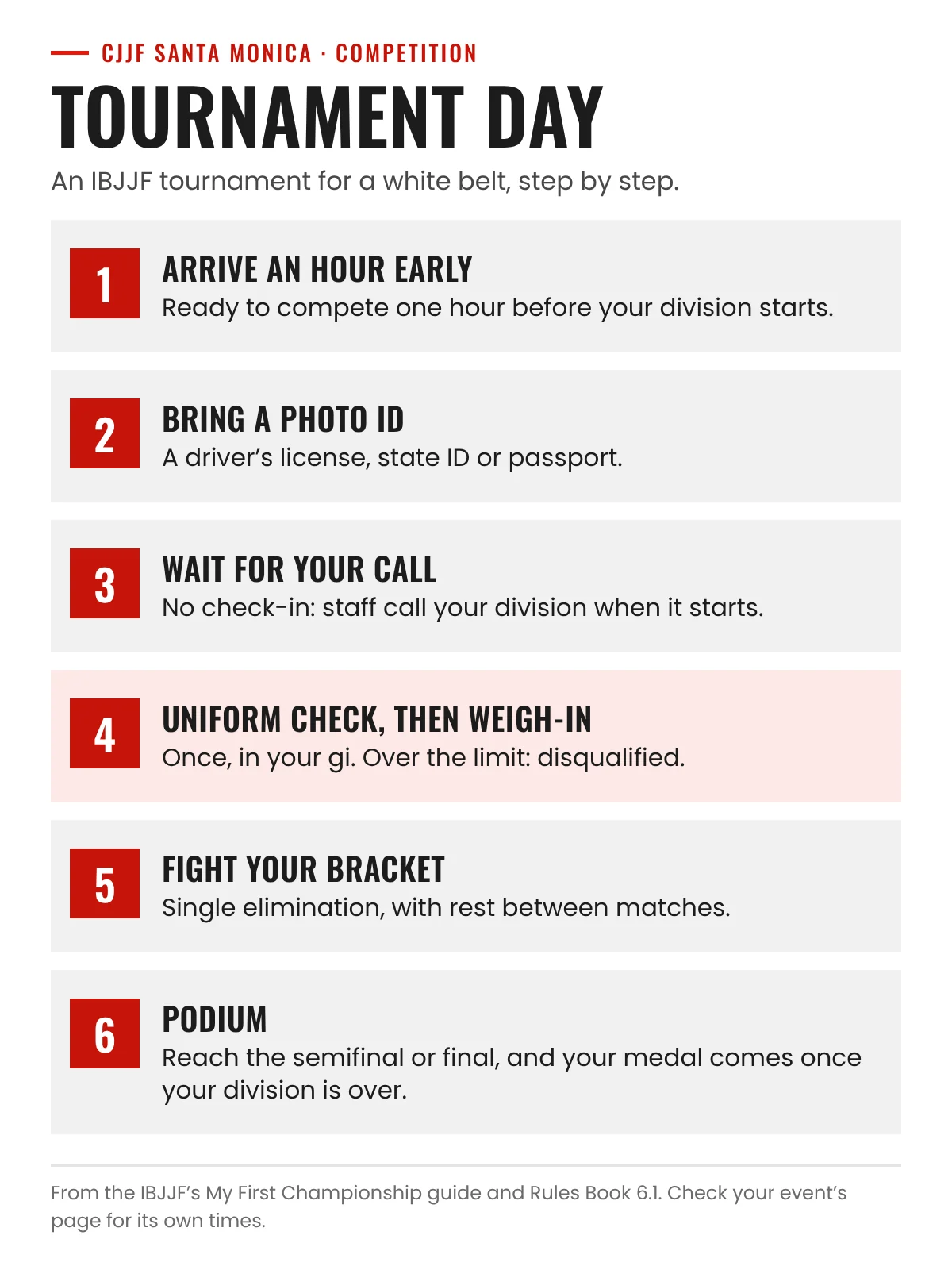
Here’s what an IBJJF tournament day looks like, from the IBJJF’s own guide for first-timers:
- Arrive an hour early. Be ready to compete one hour before your division’s start time, since events can run early.
- Bring a photo ID. A driver’s license, state ID or passport. You don’t need your membership card.
- Wait for your call. There’s no check-in: staff call your division when it starts.
- Pass the uniform check and weigh in. You step on the scale once, in the uniform you’ll compete in. If you’re over your division’s limit, you’re disqualified.
- Fight your bracket. Matches are single elimination, with rest between them.
- Go to the podium. If you reach the semifinal or the final, you get your medal on the podium once your division is over.
How to prepare for your first tournament
Start with your coach: they know your game and which events suit a first-timer. Then, in the weeks before:
- Get your membership early. IBJJF events need an active membership under your current belt and academy, signed by an instructor listed at your academy. Approval can take up to five business days after your documents arrive.
- Pick your division carefully. Weigh yourself in your gi a few times before you register, and choose the division you’ll make on the day without starving yourself.
- Train the start of a match. Every match begins standing. Decide what you’ll do first, a takedown or pulling guard with a grip, and practice it until it’s automatic.
- Roll full rounds. Practice five-minute rounds with a clock, so you know how your energy lasts.
- Learn the rules for your belt. Know how points are scored and which moves are illegal at white belt.
- Pack the night before. A gi that fits the rules (two, if you have them), your belt, a photo ID, flip-flops for walking off the mat, water, snacks, and finger tape if you use it. Here’s how to tape your fingers for BJJ.
What to eat before a competition
Eat what you already eat before training, and nothing new on the day. For exercise in general, the Mayo Clinic suggests a large meal at least three to four hours before and a small meal or snack one to three hours before; the Mayo Clinic’s timing for meals before exercise is a good starting point. Since you weigh in right before your first match, check that what you eat and drink still leaves you under your limit. Bring water and something light for the hours between matches.
Handling nerves
Nerves before a first tournament are normal. A few things help:
- Have one plan for the start of the match, and let the rest happen.
- Warm up before your division is called, the way you warm up for class.
- Breathe slowly through your nose while you wait.
- Watch a few matches in your division before yours, to see the referee and the mat.
- Remember why you’re there: to learn. A first tournament teaches you a lot, win or lose.
Submission-only tournaments
In a submission-only match, points don’t decide anything: you win by making your opponent tap. What happens when time runs out depends on the organizer. Some go to overtime rounds, and some award points for positions after all. Rules vary between events, so read the ruleset before you register.
For a first tournament, a points-based event is a natural place to start: the rules reward control and position, the things you practice every class.
Finding a tournament near Los Angeles
Search “BJJ tournament” or “jiu jitsu competition” and you’ll mostly find event listings. The simplest path:
- IBJJF events: listed on the IBJJF’s Championships page, with each event’s divisions, weight chart and deadlines. Its first championship guide explains registration step by step.
- Local events: other organizers run tournaments in Southern California too, each with its own rules. Ask your coach which ones run well-refereed white belt divisions.
- Timing: give yourself time. An event a couple of months out leaves room to register, choose your division and train for it.
Competing with CJJF
Competing is always optional at CJJF Santa Monica, and nobody is pushed to compete. If you want to, the competition team trains together in Competition Training on Saturdays, 10 to 11:30 am, and during the week Advanced classes (with coach approval) cover guard systems, pressure passing and competition strategy. Kids can join the kids’ competition team once they’re ready.
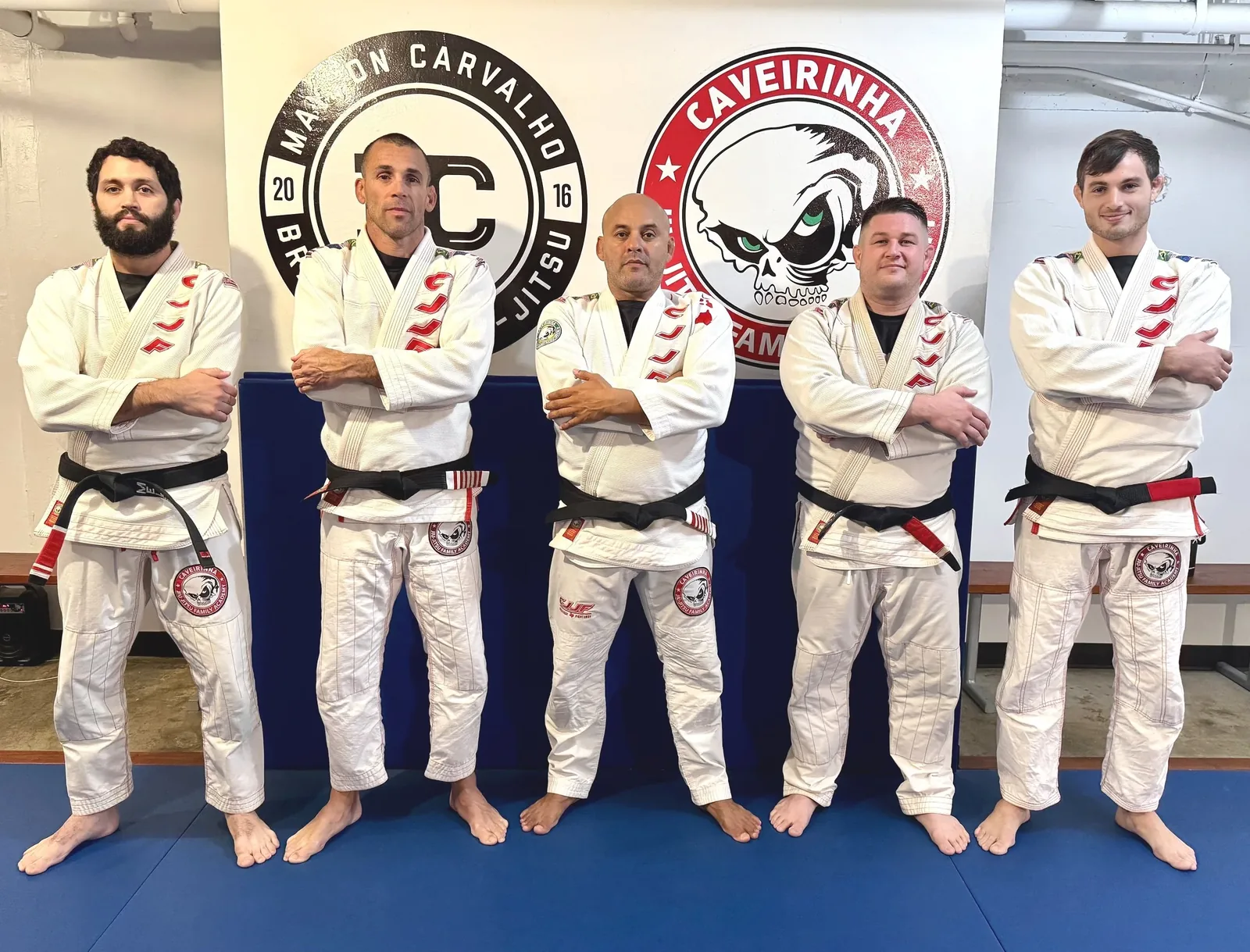
Our coaches compete and coach from experience. Professor Maycon Carvalho is an IBJJF Master 1 No-Gi World Champion (2009, black belt, medium heavy). Professor Kevin Melendrez won bronze at the IBJJF American Nationals No-Gi in 2021, and Professor Jacob Goode has IBJJF medals at blue, purple and brown belt.
They have a good mix of top competitors who go out and win all the tournaments, and those just there on a more recreational level.
J M, Google review
Competition trainingBook a free class
Your first tournament: questions
Is IBJJF single elimination?
Yes. IBJJF brackets are single elimination: the loser of each match is out and the winner moves on. The one exception is a bracket of three athletes, where the loser of the first match faces the third athlete. Both losing semifinalists take bronze.
How long should I train before my first tournament?
Ask your coach. IBJJF tournaments have divisions for every belt, white belt included, grouped by age and weight, so you don’t need years of training to enter. You should be able to roll a full round safely and know when to tap.
Should I do a gi or a no-gi division first?
Pick the one you train most. The rules are close, but the grips and the pace differ, and the no-gi weight limits are lower, since you weigh in wearing your no-gi uniform instead of a gi. Our article on gi vs no-gi jiu jitsu explains the differences.
What happens at weigh-in?
Staff call your division when it starts. Your uniform is checked, then you step on the scale once, in the uniform you’ll compete in. Weight limits are maximums with the uniform on, and if you’re over, you’re disqualified, so weigh yourself in your gi before the day.
Do I need an IBJJF membership to compete?
For IBJJF events, yes: an active membership under your current belt and academy, signed by an instructor listed at your academy. Approval can take up to five business days after your documents arrive, so apply early. Other organizers have their own requirements.
What should I bring to a BJJ tournament?
A government-issued photo ID, a gi that meets the rules (or your no-gi uniform), your belt, flip-flops for walking off the mat, water and light snacks. Some events charge spectators, so check the event page if family is coming.
What if I lose my first match?
That’s the end of your division, since brackets are single elimination, but it’s still a full match against someone your size and level, and a real lesson. Watch the video with your coach and pick one thing to work on.
Sources: International Brazilian Jiu-Jitsu Federation, Rules Book 6.1 (June 2024): General Competition Guidelines, Article 1 (age divisions and match lengths), Article 2 (brackets), Article 4 (medals) and Article 5 (registration, rule 5.5); Rules Book 2.5 (points), 3.1 (3 seconds), 6.2.2 W (jumping guard at white belt) and 8.1.11 (uniform check); Technical Fouls and Illegal Moves chart (valid from January 1, 2024). IBJJF, My First Championship: membership, registration, the photo ID, arriving an hour early, weigh-in. IBJJF Help Desk, Championship questions: weights are maximums with the uniform on; disqualification over the limit; one division per championship. Mayo Clinic Staff, Eating and exercise: 5 tips to maximize your workouts (December 21, 2023): when to eat before exercise. Wikipedia, Submission grappling: submission-only events and their rulesets.