
- Forty isn’t too old: IBJJF masters divisions start at 30 and have no upper age limit.
- Your age alone isn’t a reason to see a doctor first. Heart, metabolic or kidney disease, or symptoms of it, is.
- Start with two classes a week. In a survey of 1,287 adults, those who trained more days a week reported more injuries.
- Tap early, pick calm partners and keep live rounds optional until you’re ready.
- At CJJF, beginners start in Fundamentals, and your first class is free.
Why jiu jitsu after 40 suits beginners
Jiu jitsu was built so a smaller, weaker person could control a bigger one with leverage and timing. That same idea makes it a good fit later in life: technique matters more than speed, and patience beats strength.
- You set the pace. You can drill a technique slowly, ask for a lighter round or sit one out. Nobody expects you to train like a 20-year-old competitor.
- No punches or kicks. Classes are grappling only, so there are no strikes to the head.
- A full-body workout that doesn’t feel like one. Grip, core, hips, cardio and flexibility all get work while your mind is busy solving a puzzle.
- Your experience helps. Patience, listening and staying calm are real advantages on the mat.
New to the sport itself? Start with what Brazilian jiu jitsu is and how it works.
Do you need a doctor’s OK first?
Not because of your age alone. The American College of Sports Medicine updated its exercise screening advice in 2015. It now looks at three things: whether you exercise now, whether you have heart, metabolic or kidney disease or signs or symptoms of it, and how hard you plan to train. Age isn’t one of them (Riebe and colleagues, 2015).
That matters after 40. Under the older checklist, nearly 95% of men and women over 40 would have been told to see a doctor before exercising. The new approach cut referrals by about 41%, according to ACSM’s summary of the update.
Talk with your doctor before you start if you have heart, metabolic or kidney disease or symptoms of it, a recent injury or surgery, or a condition you’re not sure about. Tell them what a class involves: drilling with a partner and, later, live rounds. This article is general information, not medical advice.
Your first month
Most adults start in a beginner class. At CJJF Santa Monica that’s Fundamentals, where a coach teaches the core positions, escapes and control step by step. A typical class looks like this:
- A warm-up that builds the movements you’ll use, like bridging and the hip escape.
- One or two techniques, shown slowly and drilled with a partner.
- Positional practice: you start in one position with a simple goal, at a pace you choose.
- Optional live rounds once you’re ready. At CJJF, sparring is always by consent and supervised.
Expect to feel sore in new places for the first few weeks, especially your neck, forearms and hips. That fades as your body adapts.
For the first day itself, here’s what to wear and bring to your first class.
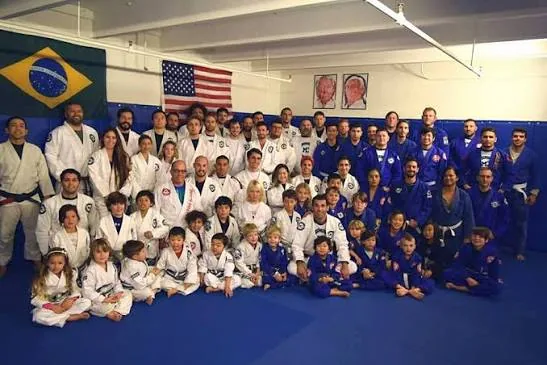
“I am 50 and started BJJ 6 years ago, this is a good place whether you are a young competitor or an old guy like me. This is a place where everyone is welcome and safe above all.” Joe A., Google review
How often should you train?
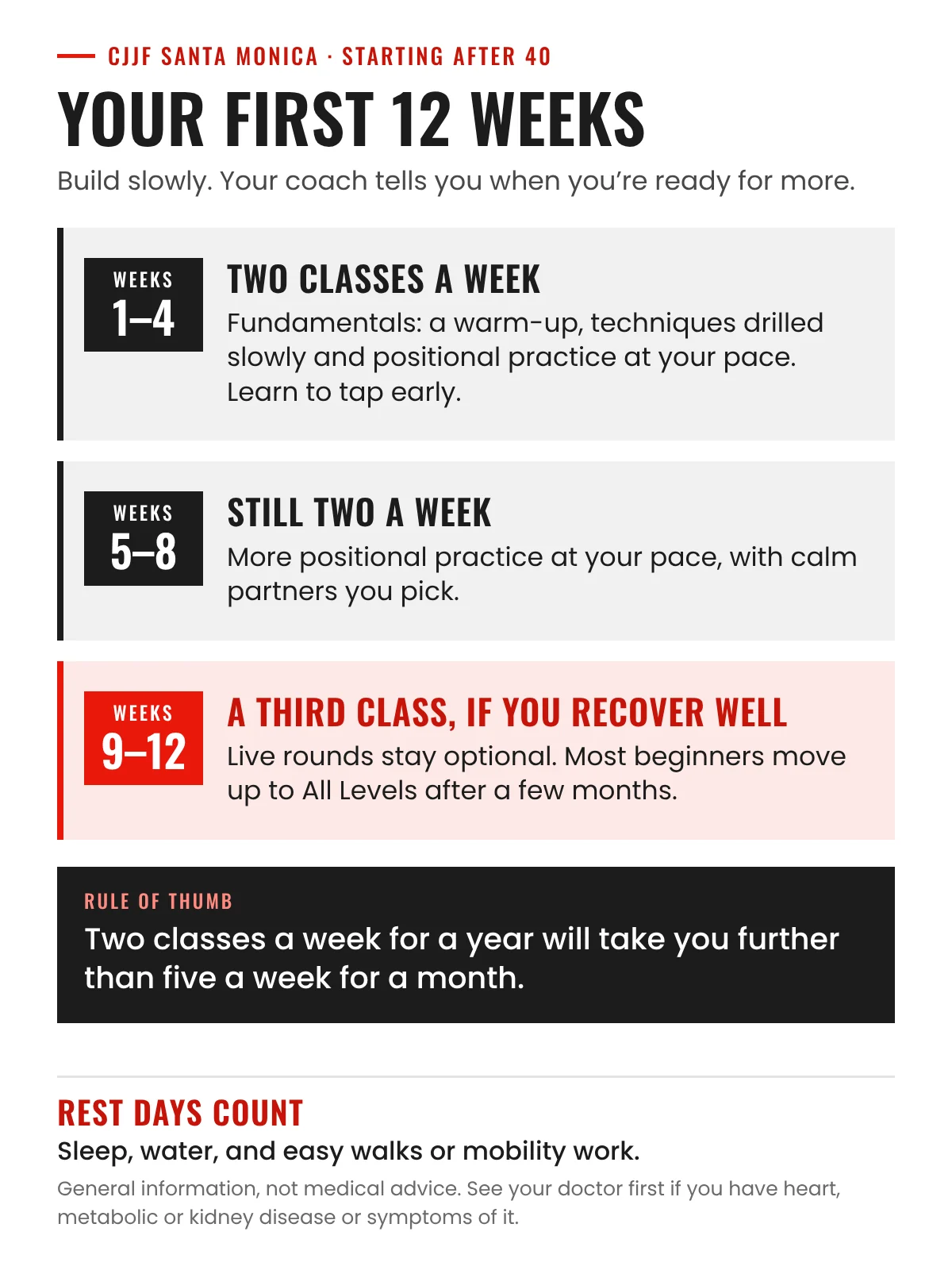
Twice a week is a good start for most beginners over 40. It’s enough to remember what you learned, with time to recover between sessions. After two or three months, many people add a third class. Consistency beats intensity: two classes a week for a year will take you further than five a week for a month.
There’s evidence for building up slowly. In an online survey of 1,287 adult practitioners, 59% reported at least one injury in six months. Those who trained more days a week reported more injuries, and those with more years of training reported fewer (Moriarty and colleagues, 2019).
A good first 12 weeks: two Fundamentals classes a week for the first two months, with drilling and positional practice at a pace you choose. Then a third class if you’re recovering well. Live rounds stay optional, and most beginners move up to All Levels classes after a few months.
On rest days, the CDC’s guidelines for adults are a useful frame: 150 minutes of moderate activity or 75 minutes of vigorous activity a week, plus muscle-strengthening on at least 2 days (CDC guidelines for adults). Walks or bike rides add to that total.
How to train safely after 40
Injuries happen in every contact sport. A 2024 review of seven studies found the highest rate of injuries among men over 30, mostly during training sessions (Santos and colleagues, 2024). That’s a reason to train smart, not to stay away. A few habits keep you on the mat:
- Tap early. Tap as soon as you feel pressure on a joint or a choke. There’s no prize for waiting.
- Pick your partners. Ask for calm, technical partners while you learn. Partner choice is part of every class at CJJF.
- Tell your coach about old injuries. Bad knees, shoulders or backs can usually be worked around.
- Warm up fully. Arrive early and loosen up, especially for early-morning classes.
- Skip live rounds when you’re worn out. Drilling still counts.
- Recover on purpose. Sleep, water and easy walks or mobility work on rest days help more than an extra class.
More on how safe jiu jitsu is and how to lower the risk.
Starting at 45, 50 or 60
The approach doesn’t change with the number: beginner classes, two a week, tap early and build up slowly. Joe A., quoted above, started at 44 and was still training at 50 when he wrote his review.
Jiu jitsu for seniors works the same way, with two additions. Talk with your doctor first if you have any of the conditions above, and spend your first weeks on drilling and positional practice before any live rounds. A private lesson is a gentle way to learn the basics before you join a group class.
For adults 65 and older, the CDC adds activities that improve balance to the same weekly minutes and two days of muscle-strengthening. If that’s more than you can do now, its advice is to be as active as your abilities and conditions allow (CDC guidelines for older adults).
Starting after 40 as a woman
Women start in their 40s too, in the same beginner classes. At CJJF, women train with other women when they’re on the mat, and otherwise with an instructor or a man close to their height and weight. There’s no women-only class: women train in the regular adult classes.
More on jiu jitsu for women at CJJF. If self-defense is your main reason, start with self-defense for women.
Competing after 40: masters divisions
You never have to compete, and at CJJF nobody is pushed to. If you want to, IBJJF tournaments group adults 30 and older into masters divisions by age, with no maximum age. Your division is set by the age you are, or will be, in the year of the tournament (IBJJF Rules Book 6.1, Article 1).
| Division | Age in the tournament year | Match length |
|---|---|---|
| Master 1 | 30 and older | 5 minutes (white and blue belts), 6 minutes (purple, brown and black) |
| Master 2 | 36 and older | 5 minutes |
| Master 3 | 41 and older | 5 minutes |
| Master 4 | 46 and older | 5 minutes |
| Master 5 | 51 and older | 5 minutes |
| Master 6 | 56 and older | 5 minutes |
| Master 7 | 61 and older | 5 minutes |
Each division sets a minimum age, so a 45-year-old can enter Master 3 or a younger division such as Master 2 or Master 1. Professor Maycon won his IBJJF No-Gi World title in 2009 in the Master 1 black belt division. Members who want to compete train with the competition team on Saturday mornings. Every division by age and weight is in our article on IBJJF masters divisions and weight classes.
Common worries, answered
“I’m out of shape.”
That’s normal on day one. Classes build the fitness you need, and you can rest whenever you need to.
“Everyone will be younger and stronger.”
Adult classes mix ages and sizes, and partners adjust to each other. If you ever compete, you’d face people your own age in the masters divisions.
“I’ll get hurt.”
Any contact sport carries some risk. Controlled drilling, tapping early and choosing your partners lower it, and a coach watches every round.
“I’ll be the only beginner.”
Fundamentals classes are built for people starting from zero, so you’ll learn alongside other new students.
Gi or no-gi?
Both work after 40. The gi, the traditional jacket and pants, gives you grips that slow the game down, which many beginners like. No-gi, in a rashguard and shorts, is faster and more athletic. Start with whichever class fits your schedule; most of the fundamentals carry over. Read more about no-gi jiu jitsu.
Starting at CJJF Santa Monica
Adult beginners start in Fundamentals: Monday and Wednesday at 6 pm, Tuesday and Thursday at 7 pm, and Friday at 6 pm. All Levels classes at 6 am (Monday and Wednesday) and 11 am (Tuesday and Thursday) fit around work. Classes run 60 minutes; arrive 10 minutes early. Your first class is free.
“Best gym ever. The three professors (Maycon, Kevin, and Jacob) are very knowledgeable teachers with many years of experience under their belts. All classes from the kids to adults are professionally handled. It’s so great seeing people of all ages come here and train hard.” Ana A., Google review
Adult BJJ classesBook a free class
Questions about starting after 40
Is 50 too old to start jiu jitsu?
No. The same approach works at 50 and beyond: start in beginner classes, train twice a week, tap early and build up slowly.
Is 60 too old to start jiu jitsu?
Not necessarily. See your doctor first if you have heart, metabolic or kidney disease or symptoms of it, spend your first weeks drilling before any live rounds, and consider a private lesson to learn the basics. More on starting at 60.
Is 30 too old to start BJJ?
No. Everything on this page applies at 30, and if you ever compete, 30 is when IBJJF masters divisions begin.
What’s the best martial art to start at 40?
One that lets you control the intensity, without strikes to the head. Jiu jitsu does both: you drill, choose your partners and decide when you’re ready for live rounds. Compare the options by which martial art fits your situation.
Do I need to get in shape before I start?
No. Jiu jitsu gets you in shape. Come as you are and rest when you need to.
Can I start jiu jitsu with a bad knee or back?
Often, yes, with your doctor’s OK. Tell your coach before class so they can adjust drills and partners.
How long until I join live rounds?
It depends on you. Most beginners spend their first weeks on drilling and positional practice. At CJJF, most move up to All Levels classes, where live rounds happen, after a few months.
How long does it take to learn jiu jitsu after 40?
It depends more on how often you train than on your age. Here’s how long it takes to learn jiu jitsu, from your first month to your first belt.
Why do people quit jiu jitsu?
Training at a pace you can keep is the best protection: two classes a week, real rest days and partners who match your pace. Here’s why people quit, and how to keep going.
Sources: Riebe D, Franklin BA, Thompson PD, et al., Updating ACSM’s Recommendations for Exercise Preparticipation Health Screening, Medicine & Science in Sports & Exercise, 2015. American College of Sports Medicine, ACSM’s New Exercise Preparticipation Screening, February 2018. Moriarty C, Charnoff J, Felix ER, Injury rate and pattern among Brazilian jiu-jitsu practitioners: A survey study, Physical Therapy in Sport, 2019. Santos SP, Soares HHP, Perez Neto S, et al., Epidemiology of Injuries and Their Implications in Jiu-Jitsu Practitioners, Revista Brasileira de Ortopedia, 2024. CDC, Adult Activity: An Overview and Older Adult Activity: An Overview. IBJJF, Rules Book 6.1 (June 2024), Article 1: age divisions and match lengths.