

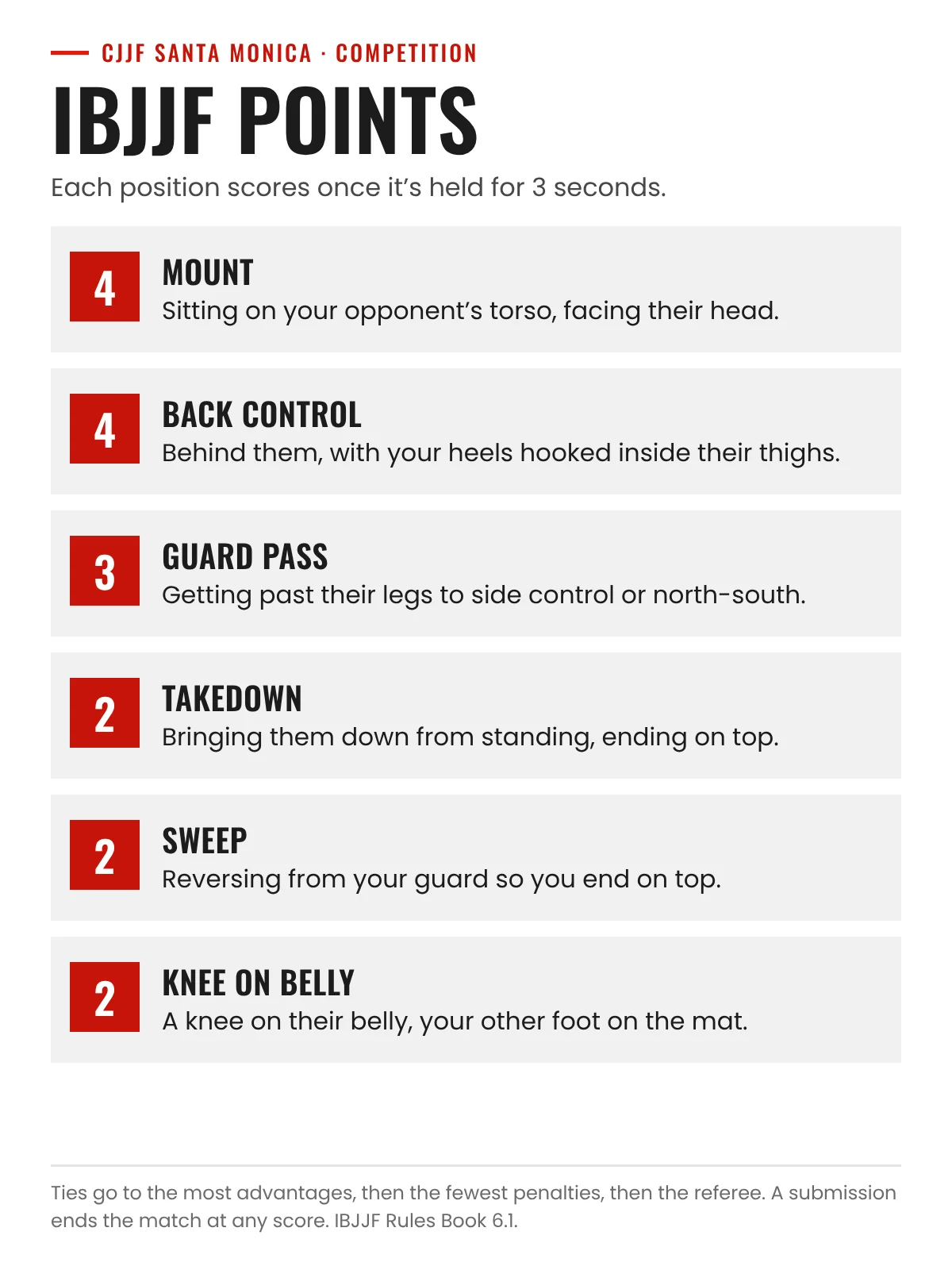
- Mount and back control: 4 points. Guard pass: 3. Takedown, sweep and knee on belly: 2.
- Every position has to be held for 3 seconds to score.
- Points add up: passing the guard and then mounting scores 7.
- Advantages break ties; penalties can give your opponent advantages and points, and a fourth penalty disqualifies you.
- A submission wins the match no matter the score.
The IBJJF point system at a glance
These are the points in the IBJJF rule book:
| Position | Points | How it scores |
|---|---|---|
| Mount | 4 | Sitting on your opponent’s torso, facing their head |
| Back control | 4 | Behind them, with your heels hooked inside their thighs |
| Guard pass | 3 | Getting past their legs to side control or north-south |
| Takedown | 2 | Bringing them down from standing, ending on top |
| Sweep | 2 | Reversing from your guard so you end on top |
| Knee on belly | 2 | A knee on their belly, your other leg out with its foot on the mat |
Each one counts only once it’s held for three seconds.
How BJJ scoring works
Points reward control: getting to a better position and holding it. A few rules shape how they add up:
- The 3-second rule. The referee awards points only once a position is held for three seconds.
- Points add up. If you pass the guard and go straight to mount, you score both: 3 plus 4 makes 7.
- No double counting. Give up a position on purpose to score it again, and you don’t get the points a second time.
- Caught in a submission? If you reach a scoring position while your opponent has you in a submission, you only score once you’ve escaped and held the position for three seconds.
- Both pull guard? The athlete who gets to the top first earns an advantage.
Matches start standing, so the first points usually come from a takedown, or from a sweep after one athlete pulls guard.
How to score points in jiu jitsu
Takedown: 2 points
Start with both feet on the ground and bring your opponent down onto their back, side or seat, then hold the top position for three seconds. If they land on all fours or belly-down, you score once you control their back, with at least one of their knees on the mat, for three seconds.
Sweep: 2 points
From your guard or half guard, reverse the position so your opponent ends up underneath you, and hold it for three seconds. Getting up and taking them down from your guard also counts as a sweep.
Knee on belly: 2 points
Put a knee on your opponent’s belly with your other leg out and its foot on the mat, and hold it for three seconds. With both knees down, you get an advantage instead.
Guard pass: 3 points
Get past your opponent’s legs, from their guard or half guard, and hold side control or north-south for three seconds. A takedown that lands you in side control scores as a takedown: the 3 points for a guard pass come from getting past your opponent’s legs.
Mount: 4 points
Sit on your opponent’s torso, free of their legs, with both knees on the mat (or one foot and one knee), facing their head, and hold it for three seconds. You can trap one of their arms under your leg, as long as your leg doesn’t extend past their shoulder. The back mount, on top of your opponent’s back, also scores 4.
Back control: 4 points
Take your opponent’s back with your heels hooked inside their thighs, without crossing your feet, and hold it for three seconds. You can trap one of their arms, but not above the shoulder line. Crossed feet or a figure-four around the waist earn an advantage, not 4 points.
Advantages and penalties
An advantage is a near-score. The referee gives one when you almost reach a scoring position but can’t hold it for three seconds, or when you attempt a submission that puts your opponent in real danger of tapping. Advantages only matter if the points are tied.
Penalties are for fouls such as stalling or fleeing the mat. They escalate:
- First penalty: marked on the scoreboard.
- Second penalty: your opponent gets an advantage.
- Third penalty: your opponent gets 2 points.
- Fourth penalty: you’re disqualified.
For stalling, the referee counts 20 seconds without engagement before penalizing. The most serious fouls, like striking, biting, pulling hair, or pressing on the eyes or genitals, mean disqualification straight away.
How a match is decided
A submission wins outright: when someone taps twice or says they give up, the match is over, whatever the score. A match can also end with a disqualification or when the referee stops it for safety. If time runs out, the IBJJF breaks the result in this order:
- Most points.
- Most advantages, if points are tied.
- Fewest penalties, if advantages are tied too.
- The referee’s decision, based on who attacked more and came closest to scoring or submitting.
A white belt match lasts five minutes at IBJJF events, and matches get longer as belts go up. Our first BJJ tournament guide has the full table and what happens on the day.
Points under other rule sets
Not every tournament scores the same way. Other organizers write their own rules, and submission-only events don’t use points to decide a match at all; our guide covers how submission-only tournaments work. Judo scores a match differently again: our comparison shows how judo and BJJ matches are won. Before any event, read its ruleset.
Competition trainingBook a free class
BJJ points questions
How many points is a sweep?
Two. Reverse the position from your guard or half guard so you end on top, and hold it for three seconds.
How many points is side control?
Side control itself doesn’t score. Getting there by passing your opponent’s guard scores 3, once you hold it for three seconds. Reaching it straight from a takedown scores the takedown’s 2.
How many points is knee on belly?
Two, once it’s held for three seconds with your other foot on the mat.
How many points is a takedown?
Two, once your opponent lands on their back, side or seat and you hold the top for three seconds.
What is an advantage in BJJ?
A near-score: the referee gives it when you almost reach a scoring position or put your opponent in real danger with a submission. Advantages decide the match only when the points are tied.
Are pressure points legal in BJJ?
Pressure points don’t score in IBJJF rules, and some pressure is a foul: pressing on the eyes or genitals, striking, biting and pulling hair all get you disqualified. In class, your coach sets the rules.
Do submissions give points?
No. A submission ends the match, so it doesn’t need points. A submission attempt that nearly works earns an advantage.
Sources: IBJJF, Rules Book 6.1 (June 2024): Article 2 (how matches are decided: 2.1 submission, 2.5 points, advantages and penalties, 2.6 referee decision), Article 3 (the 3-second rule, cumulative points, no double counting, points while caught in a submission, both pulling guard), Article 4 (each scoring position), Article 5 (advantages), 6.1.3 (severe fouls) and Article 7 (the penalty sequence and the 20-second count for stalling); General Competition Guidelines, Article 1 (match lengths).