
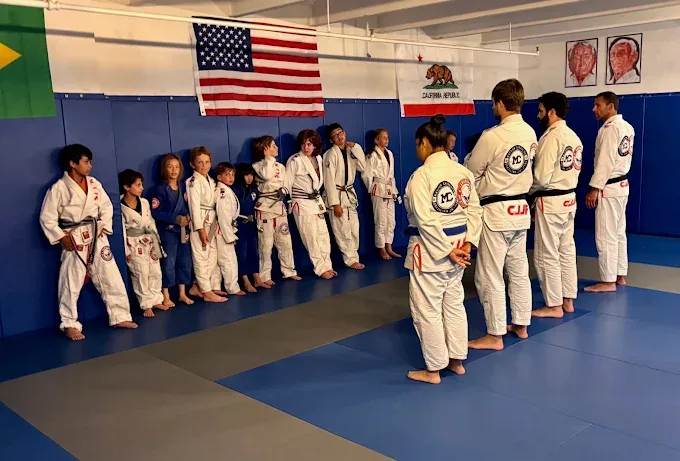
- Jiu jitsu is grappling: kids learn to hold, escape and control, with no punches or kicks.
- Parents usually notice confidence, focus and how their child handles losing first.
- Most kids can start between 3 and 5, in a class built for their age. Readiness matters more than the number.
- Pediatricians want blows to the head kept out of youth martial arts, and competition delayed until a child is ready.
- Twice a week for two or three months is a fair trial.
What jiu jitsu is, in one minute
Brazilian jiu jitsu is a grappling martial art. Instead of punching or kicking, kids learn to hold a partner, escape when they’re held and get back to a safe position. When a hold gets uncomfortable, they tap their partner or the mat, and everyone stops. Tap and stop is the first rule every child learns.
For young kids, most of a class is organized play: somersaults, crawling, balance games and partner challenges. Older kids add real technique and controlled sparring, which coaches call rolling, with a coach watching every round.
Benefits of martial arts for kids: what to watch for
- Confidence. Standing taller, speaking up and trying new things.
- Focus. Listening to a coach and following steps in order.
- Handling difficulty. Losing a round, tapping, and trying again without a meltdown.
- Respect. Waiting their turn and taking care of their partner.
- Coordination and fitness. Rolling, balancing and moving with more control. The CDC recommends at least 60 minutes of activity a day for kids 6 to 17, and a class covers a good share of it.
- Friendships. Kids who train together look forward to seeing each other.
The benefits of jiu jitsu for kids don’t show up in the first week. They build over a couple of months of steady classes.
What parents say
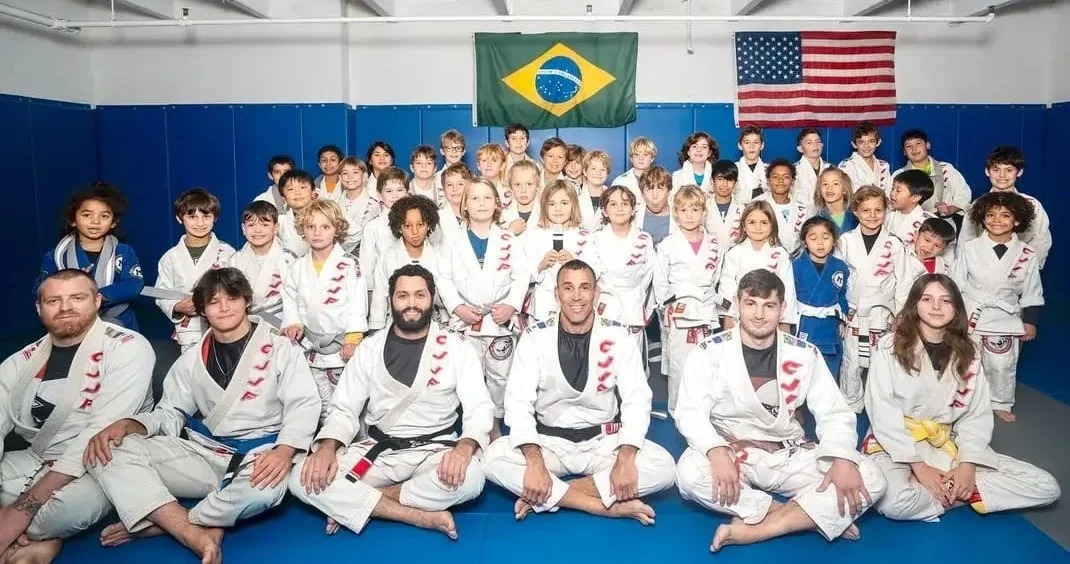
“My kids love training here! The environment is fun, safe, and perfect for everyone in the family to get involved. Also a great way to build community.” Tionna G., Google review
“I cannot say enough wonderful things about Maycon Carvalho Brazilian Jiu Jitsu Club! Professor Maycon, Kevin, and Jacob are not only incredible teachers but also amazing mentors and friends.” Mike O., parent · Google review
How safe is it? What pediatricians say
Every sport carries some risk, and the type of martial art matters. In its 2016 clinical report on youth martial arts, the American Academy of Pediatrics said martial arts can boost fitness, motor skills and emotional development. It named blows to the head and choking or submission moves among the higher-risk techniques, supported rules that remove blows to the head, and recommended delaying competition and contact-based training until a child has the physical and emotional maturity for it.
Jiu jitsu has no punches or kicks, so there are no blows to the head. It does include submissions, the holds that make a partner tap, so how a school teaches them matters. Look for:
- A coach watching every round, and rounds that stop the moment a child taps.
- Kids learning to fall, roll and tap before anything else.
- Partners matched by age and size.
- Sparring that starts gradually, once kids show they can keep control.
At CJJF, kids classes focus on control, tapping and age-appropriate drills, and a coach supervises every round. Little Champions I (ages 3.5 to 6) is built on games; sparring starts in Little Champions II (ages 7 to 12), in short supervised rounds matched by age and size.
The right age to start
Most kids can start between 3 and 5, in a class built for their age, if they can follow a simple instruction, take turns and stay with a group for most of a class. At CJJF, Little Champions I starts at 3.5. More on readiness in what age kids can start martial arts.
| Age | Class at CJJF | What to expect |
|---|---|---|
| 3.5–6 | Little Champions I, Monday to Thursday, 4:15–5 pm | 45 minutes of games, movement and first positions |
| 7–12 | Little Champions II, Monday to Thursday, 5–6 pm | Real technique, escapes and controlled sparring |
| 13–17 | Teen jiu jitsu, in the Fundamentals, All Levels and Advanced classes | Full technique and conditioning, alongside adults |
What a kids class looks like
Every Little Champions class follows the same rhythm, which helps young kids settle in.
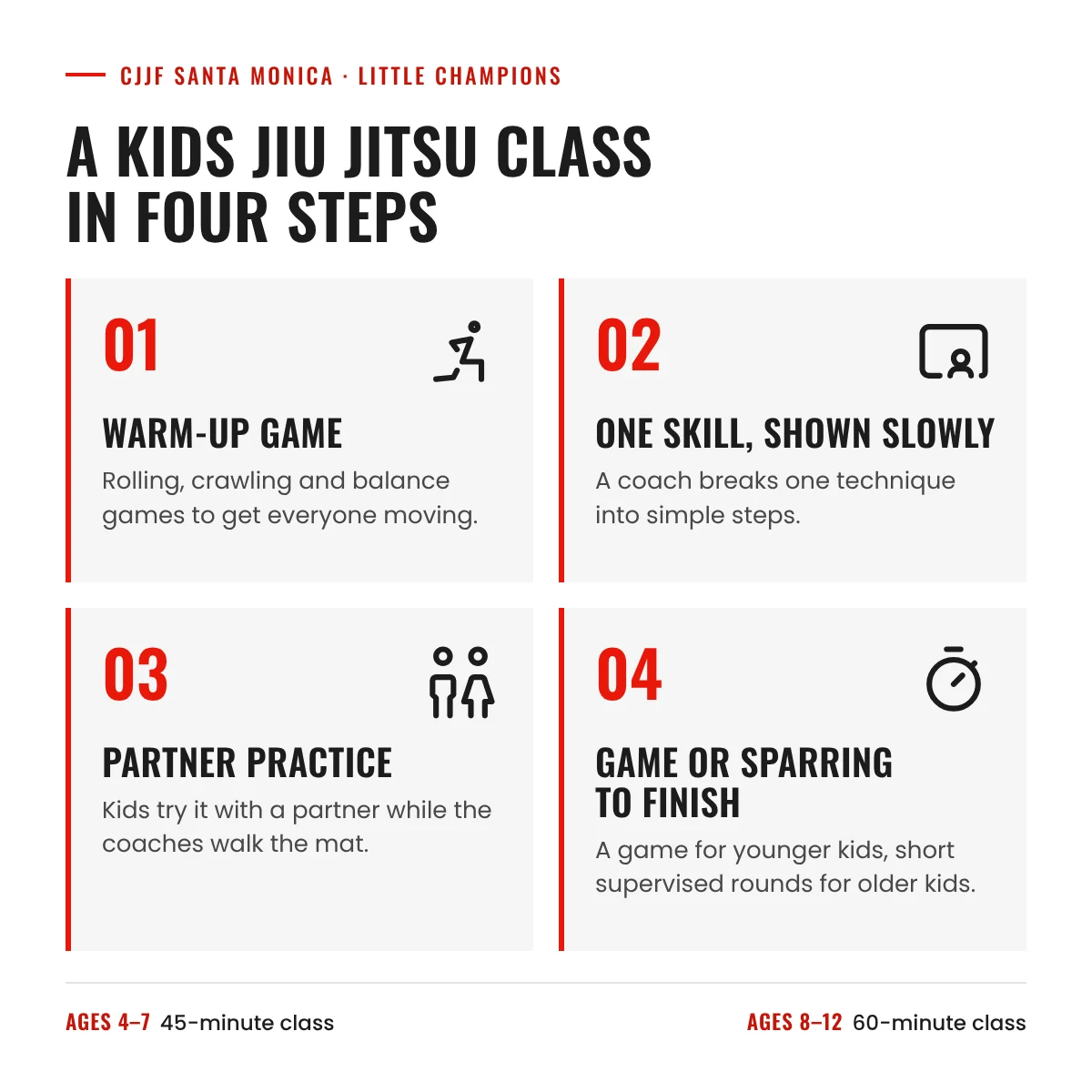
- Warm-up game. Movement that gets kids rolling, crawling and laughing.
- One skill, shown slowly. A coach teaches one technique and breaks it into simple steps.
- Partner practice. Kids try the skill with a partner while the coaches walk the mat.
- A game or sparring to finish. Younger kids end with a game; older kids finish with short sparring rounds, with a coach watching.
Parents are welcome to stay, watch and film class. Kids classes are taught by Professor Maycon Carvalho, a 5th-degree black belt, with Professor Kevin Melendrez and Professor Jacob Goode.
What it asks of your family
- Time. A kids membership covers up to four classes a week, and two is a good start. Monday to Thursday: Little Champions I (ages 3.5–6) at 4:15 pm and Little Champions II (ages 7–12) at 5 pm.
- Money. A monthly membership; see membership and prices.
- Gear. Comfortable athletic clothes with no zippers or buttons for the free class, or ask to borrow a gi. After that, your child will need a gi of their own, and the coaches will help you choose one.
- Patience. Belts take time. Stripes mark progress along the way.
How to tell if it’s working
Is it worth it for your child? Give it two or three months of steady classes. Then ask yourself:
- Does my child want to go, most weeks?
- Do they show me what they learned?
- Are they calmer when something is hard, at home or at school?
- Do they talk about their training partners?
A couple of yeses is a good sign. The coaches can also tell you how your child is doing in class; just ask after class.
Is jiu jitsu good for kids? Common worries
- Is it violent? No. There are no strikes, and every round is supervised and stops the moment someone taps.
- Will it make my child aggressive? Good classes teach the opposite: control, respect and when not to fight. Kids learn they can stay safe without hitting anyone.
- What about injuries? See what pediatricians say above. For more, read is jiu jitsu safe?
- My child is shy. Many shy kids start here. Partner work builds confidence a little at a time.
- My child has ADHD or autism. Many families find the structure, physical play and clear rules of a class helpful, but every child is different. Talk to the coaches about your child before the first class, and check with your child’s doctor or therapist if you’re unsure.
- Why do some kids quit? Often because classes feel too hard too soon, or they haven’t made friends yet. Age-grouped classes, small wins and a steady routine help kids stick with it.
Jiu jitsu or another activity?
Jiu jitsu suits kids who love to move, wrestle and climb, and kids who need confidence. If your child prefers routines and practicing alone, karate may suit them; if they love team play, a team sport might. Many kids do one martial art and one team sport. Compare the two in jiu jitsu vs karate for kids, and plan the week with after-school activities in Santa Monica.
How to start
Bring your child to a free class. Dress them in comfortable athletic clothes, bring a water bottle, and arrive 10 minutes early to tell the coach it’s their first class. You’re welcome to stay and watch. We’re at 320 Wilshire Blvd #101, with $1 parking for 90 minutes in the public structure right behind the building.
Questions parents ask before their child starts jiu jitsu
Is jiu jitsu safe for kids?
Yes, when it’s taught well. There are no strikes, kids learn to tap and stop first, and a coach watches every round. See what pediatricians say above.
What age is best to start?
Most kids can start between 3 and 5, in a class built for their age. Little Champions I starts at 3.5, and the age guide linked above lists the signs your child is ready.
How often should kids train?
Twice a week is a good start. A kids membership covers up to four classes a week, but steady weeks matter more than extra classes.
Does jiu jitsu help with bullying?
It teaches kids to stay calm and control a situation without hitting anyone, and gives them the confidence to speak up and get help.
What do kids learn first?
How to fall and roll safely, how to tap, and simple positions and escapes, all taught through games.
Can my child do jiu jitsu and another sport?
Yes. Many kids pair it with a team sport. Keep an eye on the week so there’s still time for homework and rest.
When can kids start competing?
When they want to and they’re ready. The American Academy of Pediatrics recommends delaying competition until a child has the physical and emotional maturity for it. Plenty of kids train for years without competing.
How much does it cost?
Kids train on a monthly membership, with prices on the membership page. The first class is free.
Sources: American Academy of Pediatrics, “Youth Participation and Injury Risk in Martial Arts”, Pediatrics, December 2016. CDC, Child Activity: An Overview.