
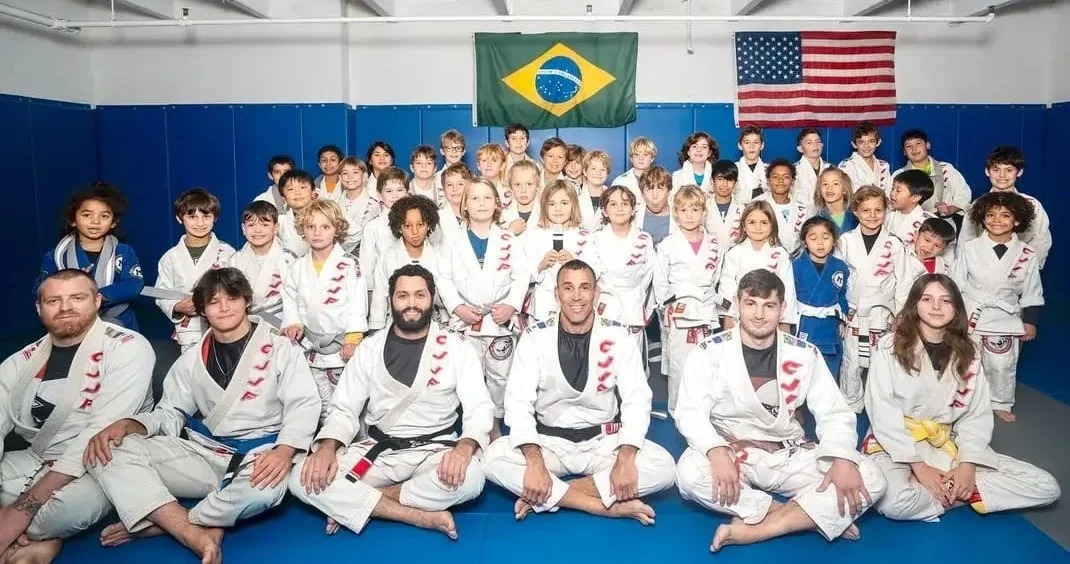
- Most kids can start between 3 and 5. Readiness matters more than age.
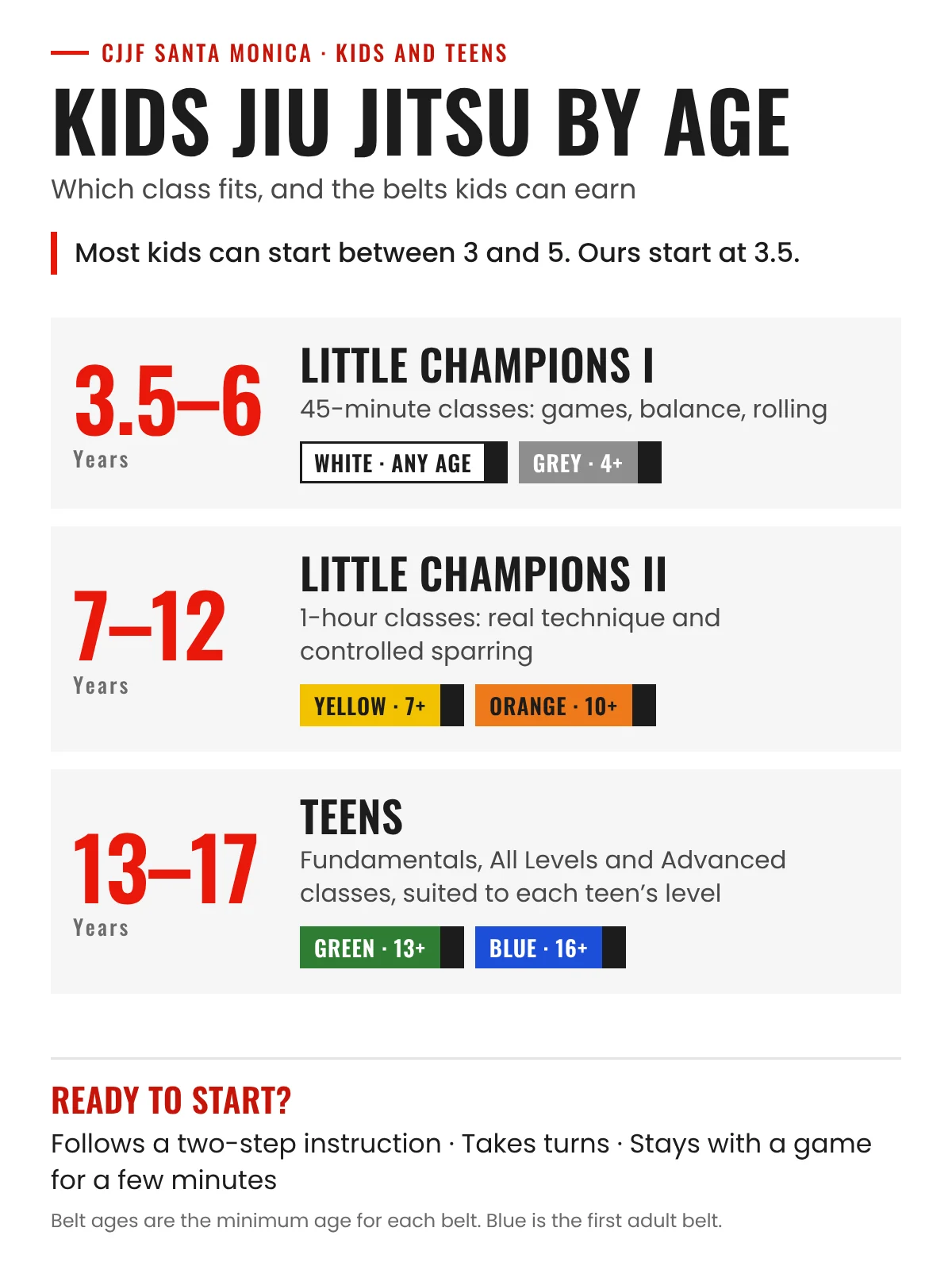
- Look for classes grouped by age: games at 3.5 to 6, real technique at 7 to 12, full training for teens.
- In jiu jitsu, kids belts have minimum ages, from grey at 4 to the first adult belt at 16.
- Pediatricians advise waiting on competition until a child is physically and emotionally ready.
What classes look like at each age
| Age | What they learn | What to expect |
|---|---|---|
| 3 | Moving, balance and listening, through play | Some schools run short toddler classes; at CJJF, kids start at 3.5 |
| 3.5–6 | Movement, balance, rolling safely and first positions, taught through games | Short, playful classes with lots of variety. At CJJF: Little Champions I, 45 minutes, Monday to Thursday at 4:15 pm |
| 7–12 | Real techniques, escapes and control, plus positional sparring | More structure, with belts and stripes to mark progress. At CJJF: Little Champions II, one hour, Monday to Thursday at 5 pm |
| 13–17 | Full technique and conditioning | Harder training; at CJJF, teens join the Fundamentals, All Levels and Advanced classes |
Whatever the age, a good kids class groups children by age and stage, keeps instructions short and makes practice feel like play.
Signs your child is ready
- Follows a simple two-step instruction, like “walk to the wall and sit down.”
- Can stay with a game or activity for a few minutes at a time.
- Takes turns and plays alongside other kids.
- Enjoys moving: rolling, climbing, wrestling with siblings.
- Is curious about trying. Some shyness on day one is normal.
These signs line up with the CDC’s milestones for age 5, things at least three in four children can do by then: following rules or taking turns in games with other children, and paying attention for 5 to 10 minutes during an activity. That’s why a good class for young kids is built from short games, each a few minutes long.
If your child isn’t there yet, wait a few months and try again. A good first experience matters more than starting early.
What age can kids start jiu jitsu?
The same answer holds: most kids can start between 3 and 5, and at CJJF they start at 3.5. What changes with age in jiu jitsu is the belt a child can earn. Everyone starts at white belt, and each kids belt after it has a minimum age:
- Grey belt: from 4
- Yellow belt: from 7
- Orange belt: from 10
- Green belt: from 13
- Blue belt, the first adult belt: from 16
At CJJF Santa Monica, kids move up through these belts and their stripes based on attendance, effort and skill, so a child who starts at 9 or 10 isn’t behind. For the colors, stripes and how promotions work, see how the kids belts work.
Why jiu jitsu suits young kids
Jiu jitsu is a grappling art: kids learn to hold, escape and control instead of punching or kicking. That makes it a natural fit for young children.
- Control, not hitting. Kids learn to stay safe without striking anyone, which helps with bullying.
- Coordination and balance. Rolling, bridging and crawling build body awareness.
- Confidence. Small wins every class: a new move, a stripe, an escape from a bigger kid.
- Focus and respect. Listening to the coach, taking turns, and stopping the moment a partner taps.
- A safe place for energy. Lots of movement in a structured, supervised setting.
For the full picture, from benefits to safety and cost, read what parents notice when kids start jiu jitsu.
Your child’s first class
A first class usually looks like this: a warm-up game, one simple skill shown slowly, practice with a partner, and a game to finish. Coaches keep instructions short and make sure every child gets a turn.
At CJJF, parents are welcome to watch and film class. Dress your child in comfortable athletic clothes with no zippers or buttons, and bring a water bottle.
When can kids start competing?
There’s no rush. In its 2016 clinical report on youth martial arts, the American Academy of Pediatrics recommended delaying competition and contact-based training until a child has the physical and emotional maturity for it. At CJJF, nobody is pushed to compete: some kids enter local tournaments for fun once they’re ready, and the kids competition team is there for those who want to go further.
Jiu jitsu, karate or taekwondo?
All three can build confidence, discipline and fitness. The difference is what kids practice:
- Karate and taekwondo focus on strikes, kicks and forms, practiced at a distance.
- Jiu jitsu focuses on grappling: holding, escaping and controlling, practiced up close with a partner.
The best martial art for your child is the one they enjoy enough to keep doing. For a closer look, read how jiu jitsu and karate compare for kids.
How to choose a kids class
- Classes grouped by age, so a 4-year-old isn’t learning next to a 12-year-old.
- Coaches who enjoy teaching kids and supervise every round.
- Clean mats and clear safety rules, like stopping the moment a partner taps.
- A free trial class, so your child can try it with no pressure.
- A schedule you can keep. Once or twice a week is plenty to start.
Kids classes at CJJF Santa Monica
Little Champions I is for ages 3.5 to 6 and runs Monday to Thursday at 4:15 pm, for 45 minutes. Little Champions II, for ages 7 to 12, follows at 5 pm for an hour. From 13, teens train in the Fundamentals, All Levels and Advanced classes. Your child’s first class is free.
Little Champions I (3.5–6)Little Champions II (7–12)Teen jiu jitsu
Starting-age questions parents ask
Can a 3-year-old do jiu jitsu?
Some can, in a class designed for toddlers: short, playful and mostly about moving and listening. At 3, the class matters more than the style. Many 3-year-olds aren’t ready to follow a coach for a whole class yet, and that’s normal. Our youngest class starts at 3.5; if your child is a little younger, call or email us and we’ll talk through whether they’re ready.
Is jiu jitsu good for 4-year-olds?
Yes, when the class is built for them. At 4, jiu jitsu is mostly games that teach balance, rolling, taking turns and stopping when a partner taps. That’s how our jiu jitsu classes for kids 3.5 to 6 work.
What’s the best age to start martial arts?
There’s no single best age. Most kids can start between 3 and 5, and kids who start at 8, 10 or 13 do well too. The best time is when your child is ready and there’s a class built for their age.
Is it too late to start at 10 or 13?
No. Kids who start at 10 often catch up quickly, and teens learn fast. At CJJF, kids 7 to 12 train in Little Champions II, and teens who are new to jiu jitsu start in Fundamentals, where a coach teaches the basics step by step. More on jiu jitsu for teens.
Is jiu jitsu safe for kids?
Yes, when it’s taught well. Kids classes have no strikes, are grouped by age and size and are supervised by coaches the whole time, and kids learn to tap from day one. More in how safe jiu jitsu is for kids.
How often should young kids train?
Once or twice a week is plenty to start. The CDC says children 3 to 5 need to be active throughout the day, and kids 6 to 17 need at least 60 minutes every day, so a class covers part of it. Consistency matters more than volume.
Will martial arts make my child more aggressive?
Good classes teach the opposite: control, respect and when not to fight. Jiu jitsu gives kids a way to stay safe without hitting anyone.
What should my child wear?
Comfortable athletic clothes with no zippers or buttons for the first class. If your child keeps going, the coaches will help you choose a gi. Kids’ gis come in their own sizes; see how BJJ gi sizes work.
Sources: American Academy of Pediatrics, “Youth Participation and Injury Risk in Martial Arts”, Pediatrics, December 2016. CDC, 5 Year Milestone Checklist. CDC, Child Activity: An Overview.