
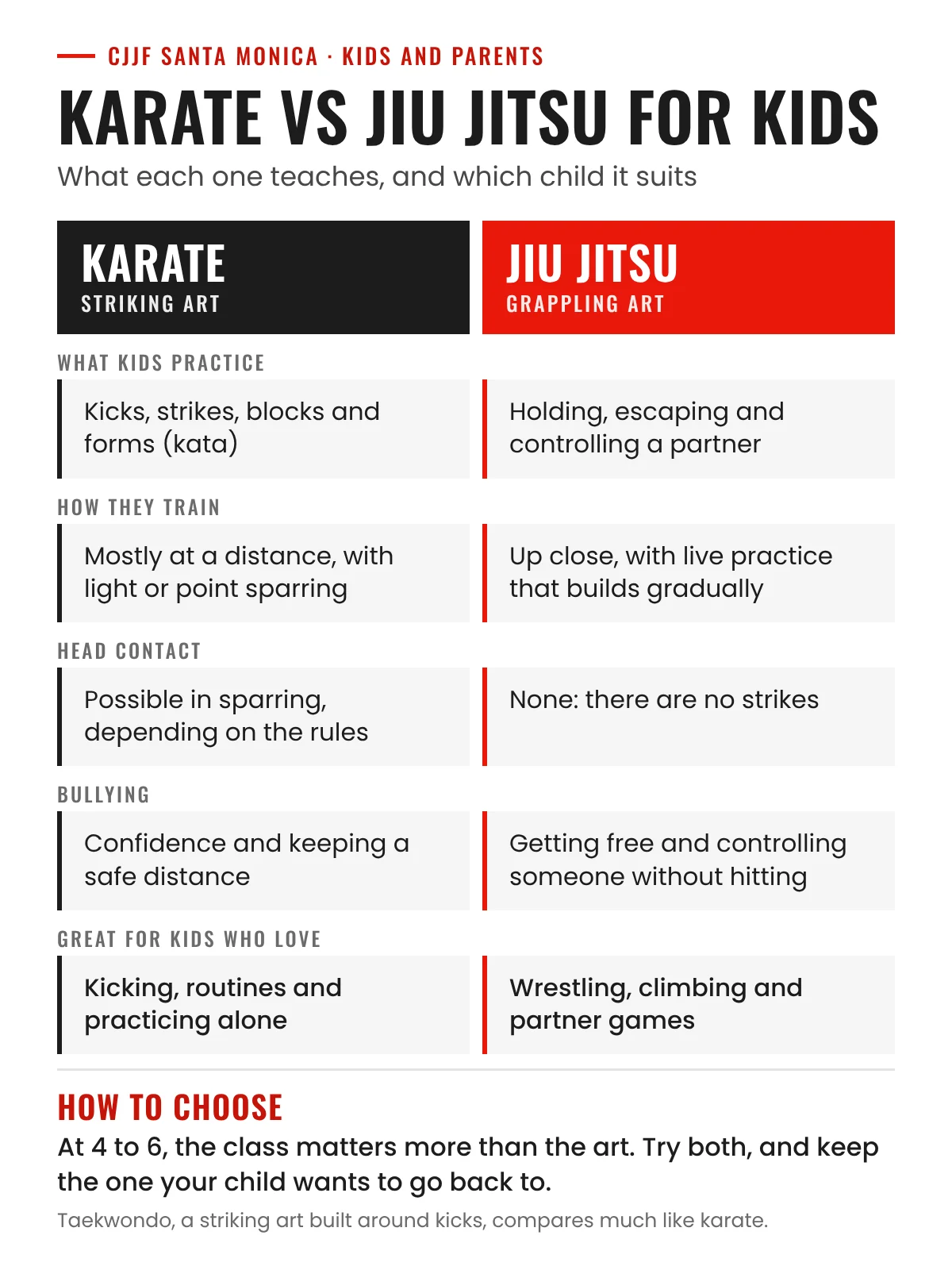
- Karate is striking: kicks, strikes and forms. Jiu jitsu is grappling: holding, escaping and controlling.
- Jiu jitsu has no strikes, so there are no blows to the head. Karate sparring can include them, depending on the rules.
- For bullying, jiu jitsu teaches kids to get free and control someone without hitting.
- At 4 to 6, the class matters more than the art.
- The best martial art is the one your child enjoys enough to keep doing.
Karate, taekwondo and jiu jitsu side by side
| Compare | Karate | Taekwondo | Jiu jitsu |
|---|---|---|---|
| Type of art | Striking | Striking, mostly kicks | Grappling |
| What kids practice | Strikes, kicks, blocks and forms (kata) | Fast, high kicks and forms | Holding, escaping and controlling a partner |
| How they practice | Mostly at a distance; sparring is often light or point-based | At a distance, with sparring in protective gear | Up close with a partner, with live practice that builds gradually |
| Head contact | Possible in sparring, depending on the rules | Kicks to the head can score in sparring | None: there are no strikes |
| Bullying | Confidence and keeping a safe distance | Confidence and keeping a safe distance | Getting free and controlling someone without hitting |
| Progress | Colored belts, usually with tests | Colored belts, usually with tests | Colored belts and stripes |
Every school runs things a little differently, so visit and watch a class before you decide.
Taekwondo is the third art many parents weigh. It’s a striking art like karate, with more emphasis on kicks, and it’s an Olympic sport, so there’s a clear path for kids who love to compete. Most of what follows about karate applies to taekwondo too.
What karate does well
Karate builds discipline, focus and coordination. Classes follow clear routines, and forms (kata) give kids something to practice on their own, even at home. Kicking builds balance and flexibility, and belt tests give kids goals to work toward. For a child who doesn’t like close contact, karate also keeps more personal space than grappling does.
What jiu jitsu does well
Jiu jitsu teaches kids to stay safe without hitting anyone. They learn to hold, escape and control a partner, and they practice with a partner who resists, building up gradually, so the skills work under pressure. Leverage and technique matter more than size, which gives smaller kids real confidence. It’s physical, close-contact play that many energetic kids love, and small wins every class (a new move, a stripe, an escape from a bigger kid) keep them coming back.
Which is safer for kids?
Both are safe when they’re taught well. The difference is head contact. In its 2016 clinical report on youth martial arts, the American Academy of Pediatrics found that noncontact forms and techniques may carry a lower risk of injury than contact sparring, and named blows to the head and choking or submission moves among the higher-risk activities. It supported rules that remove blows to the head, and recommended delaying competition and contact-based training until a child has the physical and emotional maturity for it.
Jiu jitsu has no punches or kicks, so there are no blows to the head. It does include submissions, the holds that make a partner tap, which is why a good kids class teaches tapping from day one, matches partners by age and size and keeps a coach watching every round. Karate sparring can include strikes to the head, depending on the school’s rules. Whichever you choose, ask how the school runs sparring for your child’s age. More in how safe jiu jitsu is for kids.
Which helps more with bullying?
Both build confidence, and that matters most. Jiu jitsu adds one practical edge: if a child is grabbed or pushed to the ground, they know how to get out of the hold and control the situation without hitting anyone, which keeps everyone safer and fits school rules. Karate teaches kids to stand tall and keep a safe distance; its physical tools are strikes, which good schools teach as a last resort. Whatever you choose, teach your child to walk away and tell an adult first.
Karate or jiu jitsu for a 5-year-old?
At 4, 5 or 6, the class matters more than the art. Look for short, playful classes grouped by age, coaches who enjoy little kids, and a child who comes out smiling. If your child loves to wrestle and climb, start with jiu jitsu; if they love to kick and copy moves, try karate.
At CJJF, kids 3.5 to 6 train in Little Champions I: games, one simple skill at a time and practice with a partner their size, 45 minutes, Monday to Thursday at 4:15 pm. Controlled sparring starts in Little Champions II, at 7, in short supervised rounds matched by age and size. At 3, many kids aren’t ready for a full class of either art; see what age kids can start martial arts.
Choosing the best martial art for kids
Start with your child, then your main goal:
- Loves rolling, wrestling and climbing: jiu jitsu is a natural fit.
- Likes routines, kicking and practicing moves alone: karate or taekwondo may suit them.
- Main goal is handling bullying: jiu jitsu, for getting free and controlling someone without hitting.
- Main goal is discipline and focus: either. Karate’s forms reward practice alone; jiu jitsu’s partner work rewards patience.
- Needs to burn energy: either. Jiu jitsu’s partner games are especially physical.
- Is shy: either can help. Look for patient coaches and small, age-grouped classes.
- Doesn’t like close contact: karate keeps more personal space. Jiu jitsu is close by nature, so let your child watch a class first.
The best martial art is the one your child enjoys enough to keep doing, and plenty of kids try both. For everything else parents ask, from benefits to cost, read whether jiu jitsu is worth it for your child. Comparing jiu jitsu with judo, wrestling or Muay Thai? See jiu jitsu vs other martial arts.
Try a jiu jitsu class in Santa Monica
At CJJF Santa Monica, Little Champions I is for ages 3.5 to 6 (Monday to Thursday, 4:15 pm) and Little Champions II for ages 7 to 12 (Monday to Thursday, 5 pm). From 13, teens join the Fundamentals, All Levels and Advanced classes. Your child’s first class is free, and parents are welcome to watch. Planning the whole week? See after-school activities in Santa Monica, by age.
Little Champions I (3.5–6)Little Champions II (7–12)Teen jiu jitsu
Karate vs jiu jitsu questions parents ask
Is jiu jitsu or karate better for kids?
Neither is better for every child. Karate focuses on striking and forms; jiu jitsu on holding, escaping and controlling, with no strikes. Pick the one your child enjoys enough to keep doing, and try a class of each if you can.
Is jiu jitsu safe for kids?
Yes, when it’s taught well. Kids classes have no strikes, are grouped by age and size and are supervised by coaches the whole time, and kids learn to tap from day one.
Is taekwondo good for kids?
Yes, for kids who love kicking and moving fast. Taekwondo builds balance, flexibility and focus, and it’s an Olympic sport, so there’s a clear path for kids who like to compete. It’s a striking art like karate, so the same comparison holds: taekwondo for kicking and speed, jiu jitsu for grappling and control without strikes.
Can my child do karate and jiu jitsu?
Yes. The skills complement each other: striking at a distance and grappling up close. Start with one, add the other once the first is a habit, and keep time in the week to rest and play.
What age can kids start karate or jiu jitsu?
Most kids can start either between 3 and 5, in a class built for their age. At CJJF, kids start jiu jitsu at 3.5, in Little Champions I.
Which is better for a shy child?
Either can help. Many shy kids find it easier to work with one partner than to perform in front of a group, which suits jiu jitsu, but patient coaches matter most. Let your child watch a class first.
Why do kids quit martial arts?
Usually because class stops being fun: it’s too long or too hard for their age, they’re grouped with much older kids, or the schedule clashes with everything else. A class built for their age, a schedule you can keep and small wins, like a new stripe, help kids keep going.
Source: American Academy of Pediatrics, Council on Sports Medicine and Fitness, “Youth Participation and Injury Risk in Martial Arts”, Pediatrics, December 2016.