
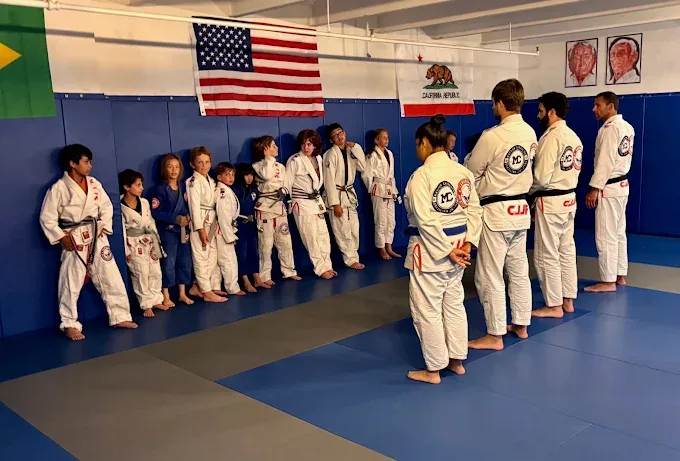
- No punches or kicks, and a tap stops any technique, so most injuries are sprains and strains, not blows to the head.
- In a 2025 survey of 881 practitioners, injuries came to about 5.5 per 1,000 hours of training, most often to the knees and shoulders.
- Most injuries happen in training, where people spend their time; per match, competing carries more risk.
- Cauliflower ear and skin infections are preventable: an ear guard, a shower after class, a clean, dry gi and no training with a rash.
- Tap early, train at a controlled pace and choose an academy where coaches watch the room.
Common jiu jitsu injuries
Jiu jitsu is a contact sport, and these are the injuries people most often deal with:
- Fingers and hands, from gripping the gi.
- Knees and ankles, from twisting under pressure.
- Ribs, from a partner’s weight and pressure in top positions.
- Shoulders, elbows and neck, usually when a joint lock or an awkward position isn’t stopped in time.
- Ears, from rubbing and pressure, which can lead to cauliflower ear.
- Skin, from mat burn and infections such as ringworm and staph that spread on shared mats.
Most are minor, and most are avoidable. There are no punches or kicks, so there are no blows to the head.
What the research says about BJJ injuries
Several studies have counted injuries among jiu jitsu practitioners. Most are surveys in which people report their own injuries, and methods differ, so treat the numbers as a guide. Here’s what they found:
- How often: about 5.5 injuries per 1,000 hours of training, in a 2025 survey of 881 practitioners around the world (Stegerhoek and others).
- Where: the knees most of all, then the shoulders, in that survey. A 2024 review of seven studies and 2,847 practitioners also found the chest and ribs high on the list (Santos and others).
- What kind: mostly sprains and strains, to the fingers, arms and neck, in a study of 70 athletes (Petrisor and others, 2019).
- When: most injuries happen in training, simply because that’s where people spend their time. In the same study, 91% had been hurt in training, and 60% of those who competed had been hurt in competition. Per match, competing is riskier: the 2025 survey counted 55.9 injuries per 1,000 matches.
- Who: people who train more days a week, in a 2019 survey of 1,287 adults, 59% of whom reported at least one injury over six months (Moriarty and others), and men over 30, in the 2024 review. On experience, the studies disagree: the 2019 survey found newer students got hurt more, the 2025 survey higher belts.
- Compared with other combat sports: a study of BJJ tournaments found a substantially lower injury risk than published figures for judo, taekwondo, wrestling and MMA (Scoggin and others, 2014).
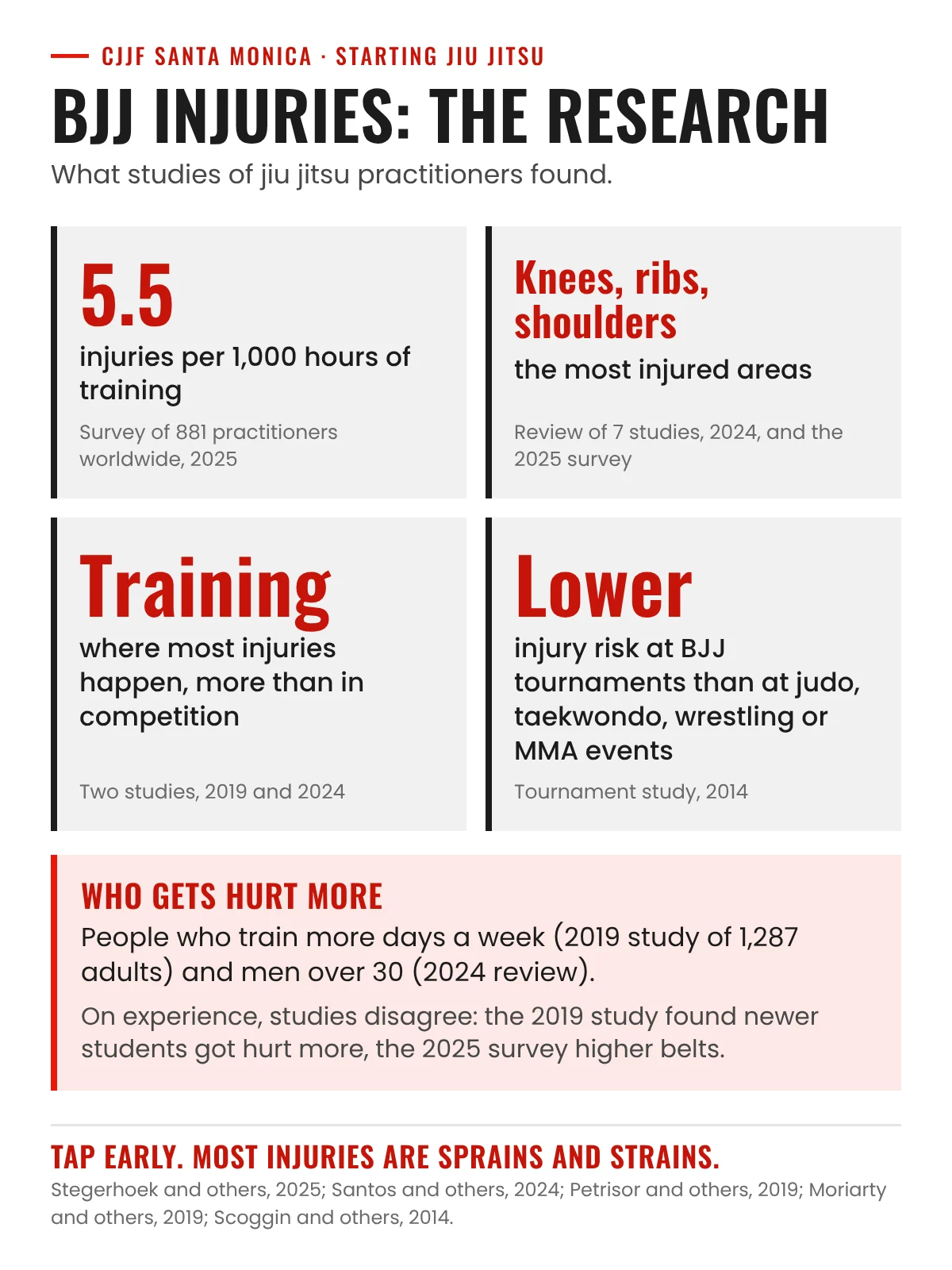
What it means for you: most injuries are sprains and strains, more mat time means more chances to get hurt, and the habits below lower the odds.
Tapping: your built-in off switch
When a hold or lock gets uncomfortable, you tap: pat your partner or the mat, or say “tap”. Your partner lets go straight away. Tap early, before it hurts, and always let go the moment your partner taps. That one rule prevents most serious injuries.
It’s the first thing you learn in your first jiu jitsu class, and the reason partners can practice chokes and joint locks against real resistance. In a match, a tap ends it: here’s how jiu jitsu works.
How a good academy keeps you safe
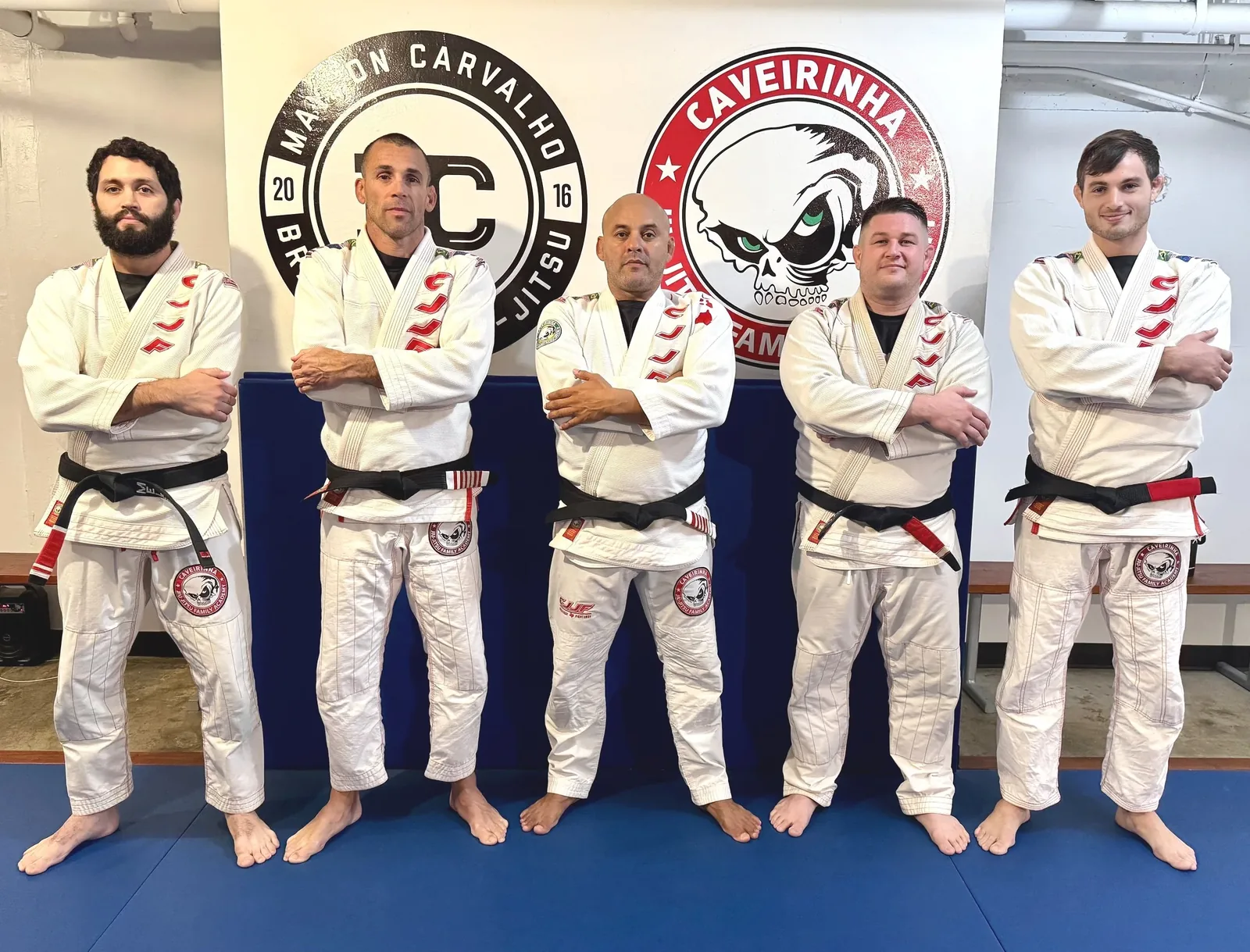
- Coaches watch the room and stop a round that gets out of hand.
- Beginners drill first. Live rounds are optional until you’re ready.
- You choose your partners, and can always ask for someone your size.
- Riskier leg locks wait for higher belts, the same way competition rules limit them.
- Clean mats. We clean the mats daily, and shoes stay off them.
What you can do
- Tap early, and tell your partner and coach about any injury before class.
- Train at a controlled pace while you learn. Speed comes later.
- Trim your nails, take off jewelry and cover any cuts.
- Look after your fingers: here’s taping your fingers for training, and when a sore finger needs a doctor instead.
- Wash your gi after every class, let it dry completely, and shower after training. Here’s how to wash a BJJ gi.
- Don’t train with a skin infection or an open wound.
- Start with two classes a week and rest when you’re sore.
Cauliflower ear
Cauliflower ear is a lumpy, swollen ear. It follows blunt trauma, like the rubbing, pressure and knocks an ear takes in grappling, and the Cleveland Clinic lists it as common in wrestlers, boxers and martial artists (Cleveland Clinic).
It’s treatable when it’s caught early. If an ear swells after training, see a provider: they drain it, ideally within six hours, and left alone the swelling can become permanent in about 7 to 10 days. Don’t drain it yourself. Until you’re seen, the Cleveland Clinic suggests ice, 15 minutes on and 15 minutes off.
To prevent it, the Cleveland Clinic recommends properly fitted headgear: in jiu jitsu, an ear guard. It’s worth wearing if your ears get sore or red after training.
Skin infections: ringworm and staph
Ringworm is a fungal skin infection, not a worm. It spreads through skin-to-skin contact and through shared towels and surfaces such as locker room floors, and the CDC notes that athletes in high-contact sports such as wrestling may be at higher risk (CDC on ringworm). Staph infections, including MRSA, a type that resists some antibiotics, are a concern in contact sports too. The CDC’s advice for athletes (CDC on MRSA):
- Shower right after training.
- Don’t share towels or bar soap.
- Cover cuts and scrapes with a clean, dry bandage until they heal.
- Wash your gi after every use and dry it completely. The CDC prefers a dryer to air drying; if you hang your gi to keep it from shrinking, make sure it’s fully dry before you wear it again.
If you notice a rash, or a red, swollen or painful spot on your skin, see a provider and tell your coach, and stay off the mats until a doctor says you’re clear. That protects your partners too.
Is jiu jitsu safe for kids?
Kids classes have no strikes, are grouped by age and size, and are supervised by coaches the whole time. Kids learn to tap and to let go from day one. Monday to Thursday: Little Champions I (ages 3.5–6) at 4:15 pm and Little Champions II (ages 7–12) at 5 pm.
Here’s what pediatricians say about martial arts and injury risk, in our kids guide.
When to see a doctor
This article is general information, not medical advice. Check with your doctor before you start if you have a heart condition, a past joint injury or another health concern. See a doctor for pain that doesn’t ease with rest, numbness or tingling, any head or neck injury, or a rash that spreads.
Two problems are worth a same-day visit: an ear that swells after training (cauliflower ear) and a red, swollen or spreading spot on your skin (skin infections). Both are easier to treat early.
Jiu jitsu safety questions
Is jiu jitsu dangerous?
Not for most people. Injuries happen, about 5.5 per 1,000 hours of training in one large survey, but they’re mostly sprains and strains, and a tap stops any technique before it hurts. The risk rises when you train harder and more often.
What are the most common jiu jitsu injuries?
Sprains and strains, most often to the knees, shoulders, ribs and fingers, plus skin problems like mat burn and ringworm. Most are minor and avoidable.
Is jiu jitsu safer than striking martial arts?
It removes punches and kicks, so there are no blows to the head, and one study found a lower injury risk at BJJ tournaments than at judo, taekwondo, wrestling and MMA events. Like any contact sport it has risks, mostly to joints and skin. Here’s how jiu jitsu compares with other martial arts.
Can I train with an old injury?
Often, with care. Tell your coach, skip techniques that aggravate it, and check with your doctor first.
How do beginners avoid getting hurt?
Tap early, train at a controlled pace, choose your partners and skip live rounds until you feel ready.
Is jiu jitsu safe after 40?
Yes, with a gentler start. A 2024 review found the highest injury rates in men over 30, so ease in: two classes a week, a controlled pace, and your doctor’s OK if you have a health concern. Here’s how to train safely after 40.
How do you prevent cauliflower ear?
Wear a properly fitted ear guard, especially if your ears get sore after training. If an ear swells, see a provider the same day: draining it early, ideally within six hours, keeps it from hardening. Don’t drain it yourself.
Can you train with ringworm?
No. Ringworm spreads through skin contact and shared mats and towels. Stay off the mats until it’s treated and a doctor says you’re clear, and tell your coach so your partners can check their skin.
Is jiu jitsu bad for your body?
For most people it’s good for the body, building strength, cardio and mobility. The wear comes from injuries, mostly to joints, and from training hard too often without rest. Tap early and train at a pace you can keep for years. Here’s what jiu jitsu does for your fitness.
Sources: Stegerhoek and others, Injury prevalence among Brazilian Jiu-Jitsu practitioners globally: a cross-sectional study in 881 participants, BMJ Open Sport & Exercise Medicine, 2025: 881 practitioners; 5.5 injuries per 1,000 training hours and 55.9 per 1,000 matches; knees and shoulders most affected; higher rates at higher belts. Santos and others, Epidemiology of Injuries and Their Implications in Jiu-Jitsu Practitioners: An Integrative Systematic Review, Revista Brasileira de Ortopedia, 2024: seven studies, 2,847 practitioners; knee, chest and ribs most affected; highest rate in men over 30. Petrisor and others, Injury in Brazilian Jiu-Jitsu Training, Sports Health, 2019: 70 athletes; 91% injured in training, 60% of competitors in competition; mostly sprains and strains. Moriarty and others, Injury rate and pattern among Brazilian jiu-jitsu practitioners: a survey study, Physical Therapy in Sport, 2019: 1,287 adults; 59.2% injured over six months; more injuries with more training days a week, fewer with more years of training. Scoggin and others, Assessment of Injuries During Brazilian Jiu-Jitsu Competition, Orthopaedic Journal of Sports Medicine, 2014: 9.2 injuries per 1,000 match exposures; lower than judo, taekwondo, wrestling and MMA. Cleveland Clinic, Cauliflower Ear, reviewed August 2024: causes, early drainage, ice until seen, headgear. CDC, What Causes Ringworm, reviewed February 2026: how it spreads; athletes’ higher risk. CDC, Athletes: MRSA Prevention and Control, reviewed June 2025: prevention steps for athletes, including washing and fully drying uniforms after each use.