
- BJJ is a grappling art: leverage and position let a smaller person control a bigger one, mostly on the ground.
- You win with a submission, a choke or joint lock that makes your partner tap. In tournaments, positions also score points.
- The main positions are guard, side control, knee on belly, mount and back control.
- It’s trained in a gi (a jacket and pants you can grip) or no-gi (a rashguard and shorts).
- Beginners start with tapping, escapes and the basic positions. Two to three classes a week is plenty.
What BJJ means
BJJ stands for Brazilian jiu jitsu. “Jiu jitsu” is an older spelling of the Japanese word jujutsu: jū means gentle or yielding, and jutsu means art or technique, so jiu jitsu is “the gentle art.” The idea is to use a stronger person’s force and momentum instead of meeting strength with strength.
You’ll see it written jiu jitsu, jiu-jitsu, ju-jitsu, jujitsu or jujutsu. In the US, a gym that says “jiu jitsu” usually teaches Brazilian jiu jitsu. It’s a martial art, a self-defense system and a combat sport at the same time.
How Brazilian jiu jitsu works
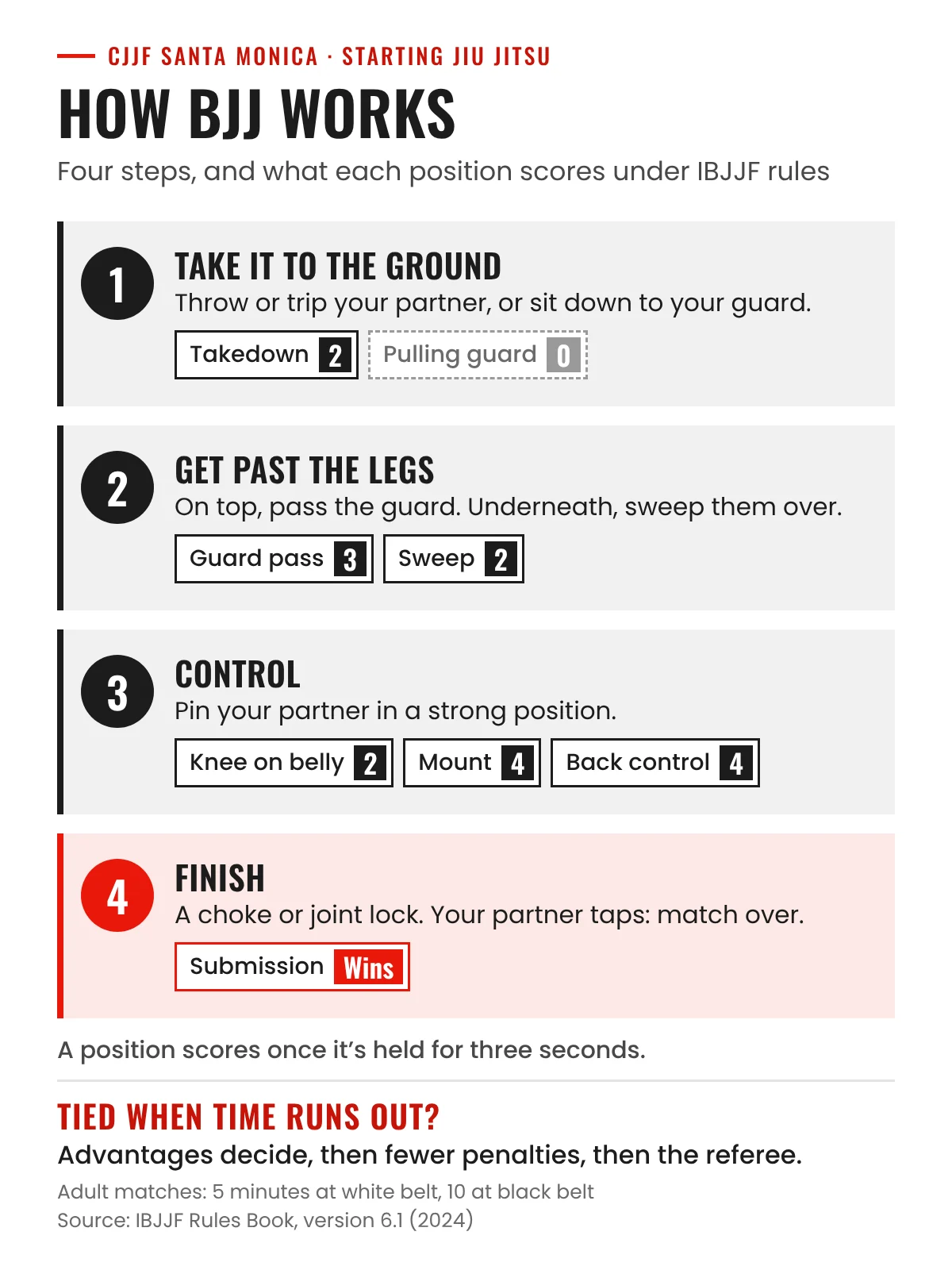
BJJ is built on one idea: with the right leverage and position, a smaller person can control a bigger one. Most of the action happens on the ground, where knowing where to put your hips, hands and weight matters more than size. A round follows four steps:
- Take it to the ground, with a takedown or by sitting to your guard, with your legs between you and your partner.
- Get past the legs. The person on top works to pass the guard; the person underneath tries to sweep them over.
- Control from a strong position like side control, mount or back control.
- Finish with a choke or joint lock, and your partner taps.
Because you can practice at full resistance and stop with a tap, you learn what actually works, safely.
Tapping is how you say “stop”: tap your partner or the mat twice with your hand, tap the mat with your foot if your arms are trapped, or just say “tap.” Your partner lets go right away. It’s the first thing beginners learn. More on how safe jiu jitsu is.
The main BJJ positions
Every match moves through a handful of positions. Knowing who’s ahead in each is the first map beginners learn:
| Position | What it looks like | Who’s ahead |
|---|---|---|
| Closed guard | You’re on your back with your legs locked around your partner’s waist | Even: the bottom player attacks and sweeps from here |
| Half guard | Your legs trap one of your partner’s legs | Close to even: the top player works to pass, the bottom player to sweep |
| Side control | You’re on top, chest to chest, across your partner’s body | The top player |
| Knee on belly | You pin your partner with one knee across their stomach | The top player |
| Mount | You sit on your partner’s chest or stomach | The top player, by a lot |
| Back control | You’re behind your partner with your legs hooked around them | The player behind, as strong as mount |
| Turtle | Your partner is on hands and knees, protecting their neck | The player on top |
More words you’ll hear on the mat, from “shrimp” to “oss,” are in our jiu jitsu terms glossary.
BJJ rules: how a match is won
BJJ is also a competitive sport. Under the International Brazilian Jiu-Jitsu Federation (IBJJF) rules, a match ends as soon as someone taps. If time runs out first, points decide it, and a position scores once it’s held for three seconds:
| Move | Points |
|---|---|
| Takedown | 2 |
| Sweep | 2 |
| Knee on belly | 2 |
| Guard pass | 3 |
| Mount | 4 |
| Back control | 4 |
If the points are tied, advantages (near-scores) decide, then fewer penalties, then the referee; our guide to the BJJ points system explains each. Adult matches last five minutes at white belt and ten at black belt.
What’s not allowed: strikes, biting, hair pulling, slams, bending fingers back, spinal locks without a choke and scissor takedowns. White belts also can’t use wrist locks, knee bars, toe holds or heel hooks, and heel hooks are legal only for adult brown and black belts in no-gi. In class, your coach sets the rules, and beginners start with the safest techniques.
Competing is optional. Most people train for fitness, self-defense and the fun of solving problems with a partner.
The history of Brazilian jiu jitsu
Brazilian jiu jitsu grew out of judo, which Kanō Jigorō built in Japan in the late 1800s from older jujutsu schools. Outside Japan judo was still called jiu-jitsu, so when the judoka Mitsuyo Maeda reached Brazil in 1914, newspapers announced his art as jiu-jitsu, and the name stuck.
In 1917, Carlos Gracie began training, taught by Maeda or one of his students; historians still debate which. Carlos taught his brothers, and Hélio Gracie, whose small frame made judo’s big throws hard, reshaped the techniques around leverage and ground fighting. A second line, from Luiz França to Oswaldo Fadda, grew alongside the Gracies’ and became known for its footlocks.
The Gracie family spread the art through Brazil. Rorion Gracie moved to the United States in 1978 and co-founded the Ultimate Fighting Championship, and at the first UFC, in 1993, Royce Gracie beat bigger opponents with technique and leverage. After that, BJJ spread around the world.
Jiu jitsu vs Brazilian jiu jitsu
Japanese jujutsu is the older art, developed in feudal Japan to defeat an armed and armored opponent, with the emphasis on throws, pins and joint locks; many schools also teach strikes. Brazilian jiu jitsu kept the grappling, moved most of it to the ground and made live sparring against a resisting partner the center of training. That’s the biggest change: in BJJ you test every technique on someone trying to stop it.
Judo, the other art that came from jujutsu, focuses on throws, and Gracie jiu jitsu is the family’s self-defense-first version of BJJ. Compare them in jiu jitsu vs judo and Gracie jiu jitsu vs Brazilian jiu jitsu, or see how jiu jitsu stacks up against other martial arts.
Gi and no-gi
What is a gi? It’s BJJ’s uniform: a thick cotton jacket, pants and a belt that shows your rank. In the gi you can grip the collar, sleeves and pants, which makes it slower and more technical. No-gi is trained in a rashguard and shorts; with fewer grips it’s faster and closer to wrestling. Most of the fundamentals carry over, and many people train both: here’s how gi and no-gi compare. See no-gi classes at CJJF and how to find your gi size.
What a BJJ class looks like
A typical class has a warm-up, a technique the coach shows step by step, drilling it with a partner, positional sparring from a set position and, for those ready, live rounds called rolling. At CJJF, new students start in Fundamentals, where the pace is controlled and light rounds are optional, and most move up to All Levels classes, where live rounds happen, after a few months of steady training. Here’s what to expect at your first jiu jitsu class.
BJJ for beginners: how to start
You don’t need to be fit, flexible or strong to start. Here’s what beginners learn first, and how to make it stick:
- Tap early and learn to fall safely, before anything else.
- Two movements power most escapes: the bridge and the hip escape, or “shrimp.”
- The basic positions: closed guard, side control, mount and back control, and how to get out of the bad ones.
- Then passing, sweeping and your first submissions, one at a time.
- Train two to three times a week. That’s the sweet spot for new students; three to four moves you faster.
- For your first class, wear a T-shirt and athletic pants with no zippers. We keep spare gis and help you choose your own later.
Stripes on your belt mark your progress, and the belt system takes you from white to black over many years. If you’re comparing academies, here’s how to choose a BJJ gym.
Keeping going through the first months
The first months are humbling: everyone taps you, the words are new and progress is hard to see. That’s normal, and it passes. What helps:
- Compare yourself with last month, not with the people tapping you.
- Tap early and roll light. You can’t learn while you’re hurt.
- Keep a steady schedule. Two classes every week beat five one week and none the next.
- Find your people. Good training partners are a big part of why people stay.
The slump some students feel later, after their first promotion, has a name of its own: here’s how to get through the blue belt blues.
Who it’s for
Almost anyone: kids from 3.5 in classes built for them, teens, adults starting in their 40s and 50s, women who want self-defense that works, and athletes who want to compete. You don’t need to be fit or flexible to start; that comes with training, along with the other benefits of jiu jitsu, from confidence to a full-body workout.
Our lineage
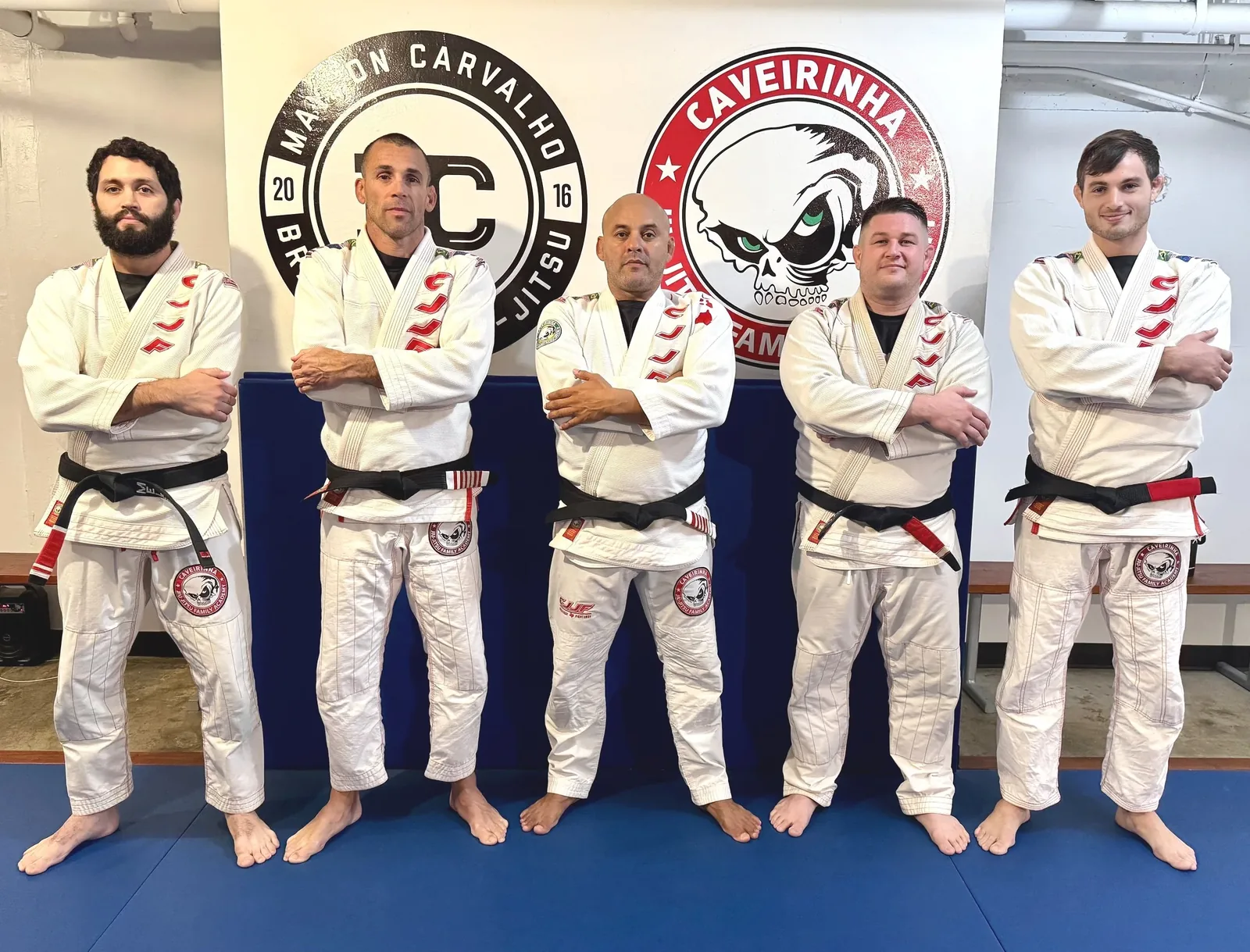
CJJF Santa Monica traces its jiu jitsu directly to the Gracie family: Carlos Gracie → Carlos Gracie Jr. → Master Aldo Caveirinha → Professor Maycon Carvalho, a 5th-degree black belt and the 2009 IBJJF Master 1 No-Gi World Champion. About the academy.
Questions about Brazilian jiu jitsu
What does jiu jitsu mean?
It comes from the Japanese jujutsu: jū means gentle or yielding and jutsu means art, so jiu jitsu is “the gentle art.” BJJ stands for Brazilian jiu jitsu.
Is Brazilian Jiu Jitsu the same as jiu jitsu?
In everyday use, mostly. In the US, “jiu jitsu” usually means BJJ. Traditional Japanese jujutsu is an older, related art with more standing techniques and strikes.
Is BJJ sparring?
Yes. Live sparring, called rolling, is a core part of BJJ: you try your techniques on a partner who resists, and either of you can tap at any time. At CJJF, sparring is always by consent and supervised, and light rounds are optional for beginners.
What is a person who does jiu jitsu called?
Usually a BJJ practitioner or a grappler. On the mat you’ll also hear jiujiteiro (jiujiteira for women), the Portuguese word from Brazil.
What is harder, MMA or BJJ?
They’re hard in different ways. MMA adds punches, kicks and takedowns to grappling, so there’s more to learn and more impact. BJJ goes deeper on the ground with no strikes, which makes it easier to start at any age.
What is forbidden in BJJ?
Strikes, biting, hair pulling, slams and bending fingers back, along with spinal locks without a choke and scissor takedowns. White belts also can’t use wrist locks, knee bars, toe holds or heel hooks in IBJJF tournaments.
Is BJJ good for self-defense?
Yes. It teaches you to escape holds, control someone without striking and get back to your feet. See the best martial art for self-defense.
Do you need to be strong to do jiu jitsu?
No. Technique and leverage matter more than strength, which is why BJJ suits smaller people.
How long does it take to learn BJJ?
The basics take about three months of regular training. See how long it takes to learn jiu jitsu.
Sources: International Brazilian Jiu-Jitsu Federation, Rules Book (version 6.1, June 2024) and Technical Fouls and Illegal Moves chart (valid from January 1, 2024): points, how matches are decided, match lengths, illegal moves by belt. Wikipedia, Brazilian jiu-jitsu (Maeda’s arrival in 1914, Carlos Gracie in 1917 and the debate over who taught him, Hélio Gracie, the França–Fadda line, the UFC) and Jujutsu (the meaning of the name, its spellings, judo’s roots). Encyclopaedia Britannica, Royce Gracie (won UFC 1 in 1993 using technique and leverage).