
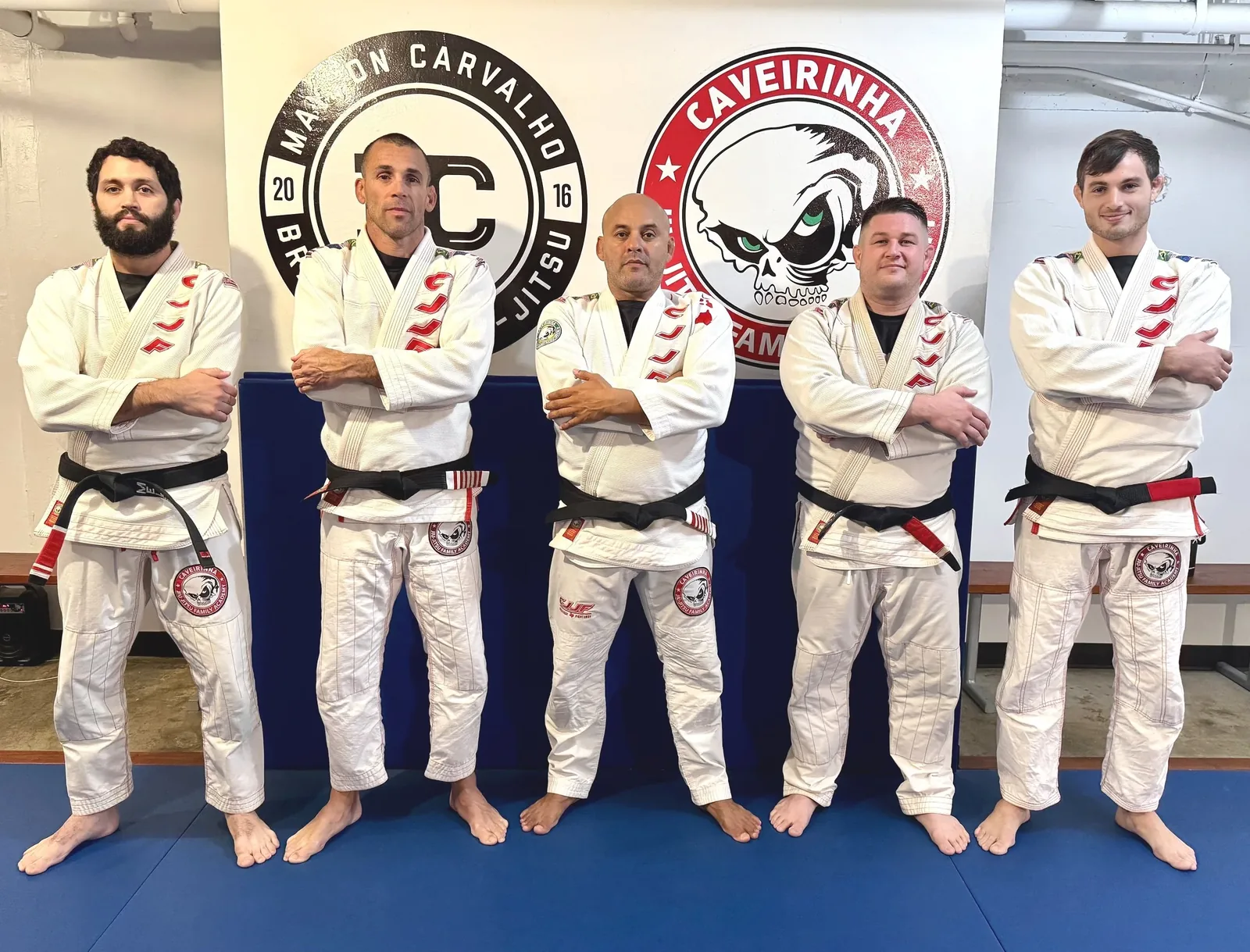
- Judo is the throwing art; jiu jitsu is the ground art. Jiu jitsu grew out of the judo that reached Brazil in 1914.
- A clean throw onto the back can end a judo match. In jiu jitsu it’s 2 points, and the match goes on.
- Judo allows joint locks only on the elbow; jiu jitsu also allows leg locks, some of them only at higher belts.
- Judo players adapt fast in jiu jitsu: their grips, throws and falls carry over.
- In the US, people search for jiu jitsu near them about six times as often as for judo.
Jiu jitsu and judo side by side
| Compare | Jiu jitsu | Judo |
|---|---|---|
| Main goal | Control on the ground and submit | Throw your opponent cleanly to the mat |
| Where it’s fought | Mostly on the ground | Mostly standing, with limited ground time |
| Submissions | Chokes, arm locks and leg locks, with some leg locks limited to higher belts | Chokes and arm locks; leg locks are banned |
| Winning | Submission, or points when time runs out | A full-point throw, a 20-second pin or a submission |
| Thrown onto your back | 2 points for the thrower; the match goes on | Can end the match (ippon) |
| Uniform | Gi in white, blue or black, or no-gi | Judogi in white or blue |
| Olympic sport | No | Yes, first held at the 1964 Games |
How a match is won
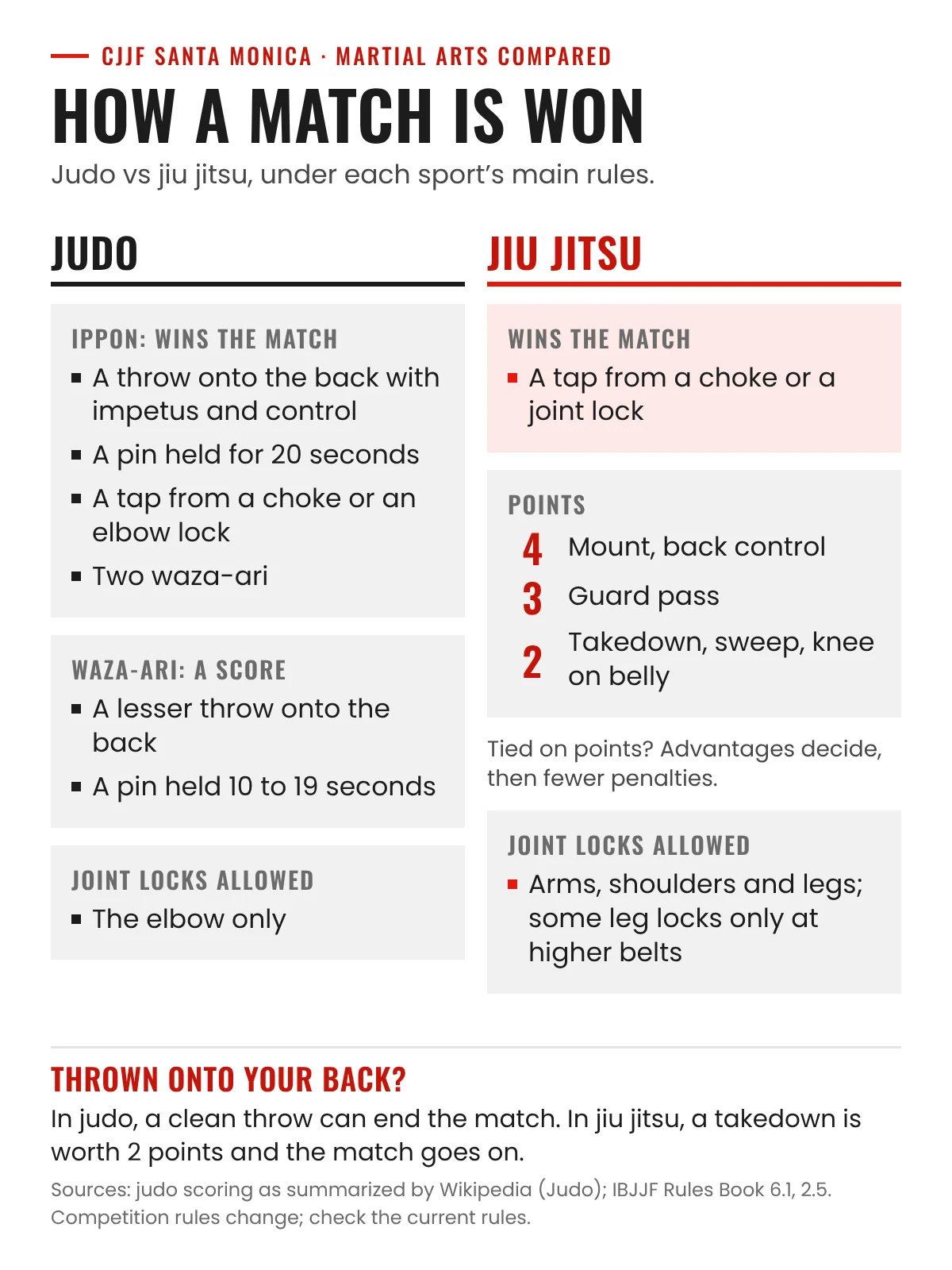
In judo, a throw that lands your opponent on their back with impetus and control scores ippon and wins the match, and so does a 20-second pin or a tap from a choke or an elbow lock. A lesser throw, or a pin of 10 to 19 seconds, scores waza-ari, and two waza-ari make an ippon (Wikipedia).
In jiu jitsu, only a submission ends the match early. Otherwise points decide it: 4 for mount or back control, 3 for passing the guard, and 2 for a takedown, a sweep or knee on belly, then advantages and penalties if the score is tied (IBJJF Rules Book, 2.5). Here’s how a BJJ match is won, in full.
Shared roots
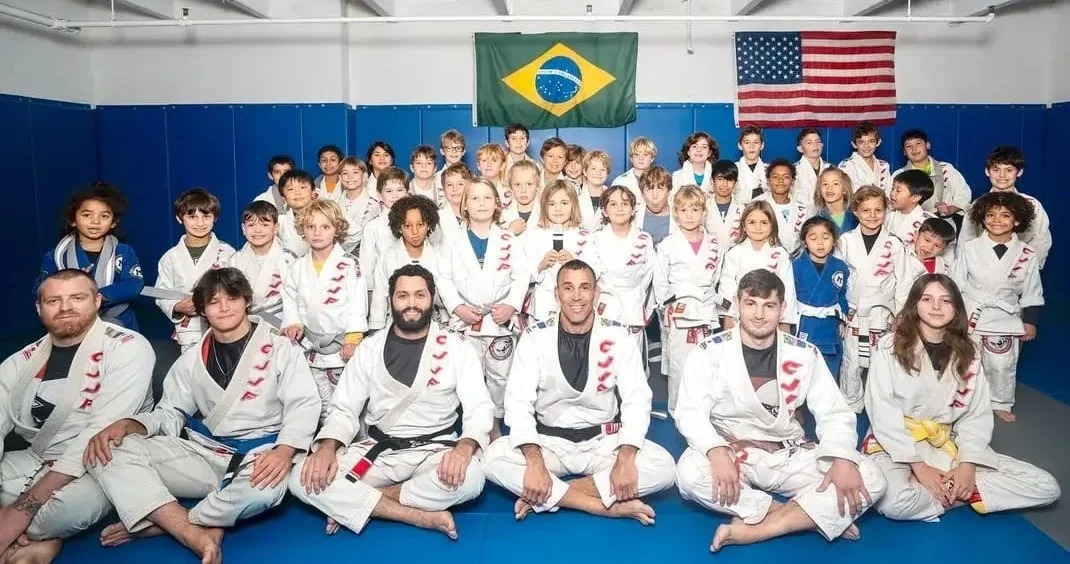
Judo was founded in Japan by Kanō Jigorō in 1882. The judoka Mitsuyo Maeda reached Brazil in 1914, and from 1917 Carlos Gracie trained under Maeda or one of his students; historians still debate which. The Gracie family adapted what they learned toward ground fighting and leverage, and that became Brazilian Jiu Jitsu. The two arts are cousins: same root, different emphasis. Here’s the history of Brazilian jiu jitsu.
What judo does best
Judo is the art of throwing. Judoka learn to off-balance an opponent, throw them with power and control, and fall safely themselves. Its rules reward standing exchanges, so judo players are excellent at grips and takedowns.
What jiu jitsu does best
Jiu jitsu is the art of the ground. Practitioners learn to escape bad positions, control from the top and finish with submissions, with time to work through long exchanges on the mat. Pulling guard, sitting down to fight from your back, is allowed, which judo rules don’t reward.
Judo for jiu jitsu: what carries over
Judo is one of the best ways to sharpen the standing half of jiu jitsu. Every jiu jitsu match starts on the feet, and under IBJJF rules a takedown scores 2 points once you hold top position for 3 seconds.
- Grips. Judo’s grip fighting works on the same collar and sleeves.
- Throws and trips. They count as takedowns in jiu jitsu.
- Breakfalls. Knowing how to fall safely protects you when you’re the one thrown.
- What changes: landing the throw isn’t the end. Follow it to a pin or a guard pass, and expect opponents to pull guard, which jiu jitsu allows.
Which is better for self-defense?
Both are practical because both are trained against resisting partners. Judo’s throws and breakfalls shine in a standing scuffle; jiu jitsu shines when a fight hits the ground and when you need to control someone without striking. See the best martial art for self-defense.
Is judo or jiu jitsu more popular?
Judo is the Olympic sport, with a world federation and a place in every Games since 1972. In the US, though, jiu jitsu draws far more interest: Google searches for “jiu jitsu near me” run about 135,000 a month, against about 22,200 for “judo near me”, roughly six to one (Google search data, October 2026).
Should you do both?
Many people do. Judo sharpens takedowns and grip fighting, and jiu jitsu fills in the ground game. If you’re starting from zero, pick the one whose classes you’ll actually attend.
Coming from judo? You’ll recognize the grips on day one. Here’s what your first jiu jitsu class is like, and how jiu jitsu compares with other martial arts.
Adult BJJ classesBook a free class
Jiu jitsu vs judo questions
Is jiu jitsu or judo better?
Neither is better overall. Judo is the stronger throwing art; jiu jitsu is the stronger ground art. Choose based on what you want to learn.
Is BJJ based on judo?
Yes, in large part. BJJ grew from the judo Mitsuyo Maeda brought to Brazil in 1914: Carlos Gracie trained under Maeda or one of his students, and the Gracie family developed BJJ from there.
Can judo players do well in BJJ?
Yes. Their throws, grips and balance carry over well, and they learn the ground game quickly.
Do judo throws work in BJJ?
Yes. Throws and trips score 2 points as takedowns under IBJJF rules once you hold top position for 3 seconds. The difference is that the match keeps going after the throw.
What is harder, BJJ or judo?
They’re hard in different ways. Judo asks for explosive throws and a lot of falling; jiu jitsu asks for patience on the ground and has more positions and submissions to learn.
What are the disadvantages of judo?
Compared with jiu jitsu: more time being thrown, which is hard on some bodies, and competition rules that limit ground work and allow joint locks only on the elbow.
Is judo in the Olympics?
Yes. Judo was first held at the 1964 Games in Tokyo and has been part of every Olympics since 1972. Brazilian Jiu Jitsu is not an Olympic sport.
Sources: Wikipedia, Judo: founded in 1882 by Kanō Jigorō; an Olympic sport since 1964 (women since 1992); ippon for a throw onto the back with impetus and control, a 20-second pin or a submission; waza-ari for a lesser throw or a 10 to 19-second pin; competition joint locks limited to the elbow. IBJJF, Rules Book 6.1 (June 2024), 2.5 and 4.1: points (4 mount and back control, 3 guard pass, 2 takedown, sweep and knee on belly), then advantages and penalties; a takedown scores once top position is held for 3 seconds. Wikipedia, Brazilian jiu-jitsu: Maeda in Brazil from 1914, Carlos Gracie from 1917 and the debate over who taught him. Google search data via DataForSEO, US, October 2026: “jiu jitsu near me” about 135,000 searches a month, “judo near me” about 22,200.