
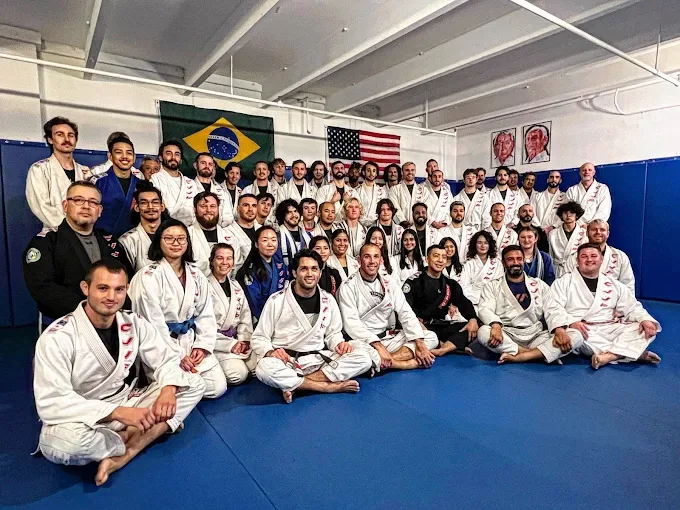
- Striking arts hit; grappling arts hold, throw and pin. Jiu jitsu is the grappling art built around the ground.
- Jiu jitsu, judo, wrestling and sport sambo have no strikes, so no head contact.
- A study of BJJ tournaments found a substantially lower injury risk than in judo, taekwondo, wrestling or MMA.
- MMA combines striking and grappling, and jiu jitsu is one of its core skills.
- The best martial art to learn is the one you’ll keep training, so try a class before you choose.
The main martial arts at a glance
| Martial art | Striking | Grappling | Contact | Best for |
|---|---|---|---|---|
| Brazilian Jiu Jitsu | No | Yes, mostly on the ground | Close contact, no strikes | Control, escapes, smaller vs bigger |
| Judo | No | Yes, mostly throws | Throws and falls | Takedowns and balance |
| Wrestling | No | Yes, takedowns and pins | Intense, close contact | Takedowns and top control |
| Muay Thai | Fists, elbows, knees and shins | Clinch only | Hard sparring is common | Striking and conditioning |
| Boxing | Fists only | No | Head contact in sparring | Punching and footwork |
| Karate | Strikes and kicks | Little | Often light or point sparring | Discipline and kicking range |
| Taekwondo | Mostly kicks | Little | Head kicks in Olympic sparring, no head punches | Kicking and flexibility |
| Sambo | Only in combat sambo | Yes, throws, pins and leg locks | Throws and falls | Throws and leg locks |
| MMA | Yes | Yes | Strikes and grappling combined | The most complete skill set |
Every school trains a little differently. These are general patterns, not rules about any particular gym.
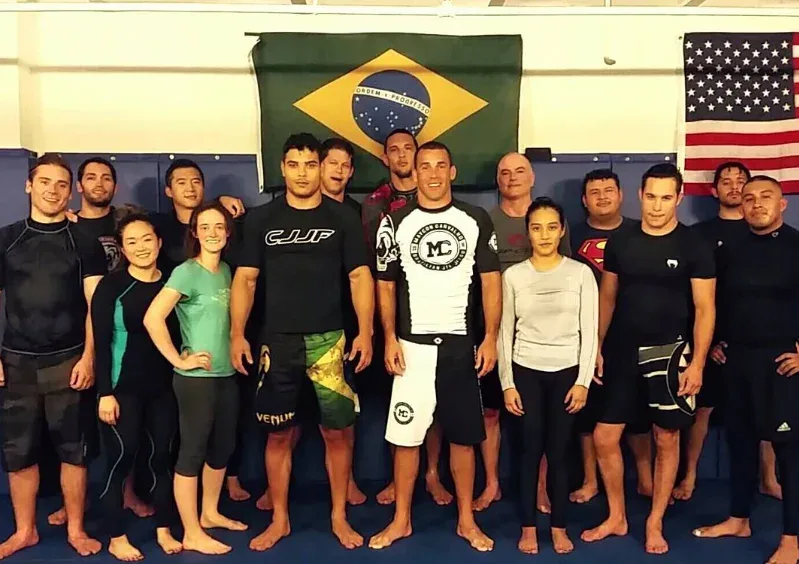
Grappling vs striking
Martial arts split into two families. Striking arts teach you to hit and avoid being hit: boxing uses only the fists, Muay Thai adds elbows, knees and shins, and karate and taekwondo lean on kicks. Grappling arts teach you to grip, throw, pin and submit: wrestling and judo specialize in takedowns and throws, and jiu jitsu in what happens once you’re on the ground.
The difference you’ll feel most in class is head contact. Grappling arts spar at full effort without strikes; striking arts spar with gloves, and the head is a target.
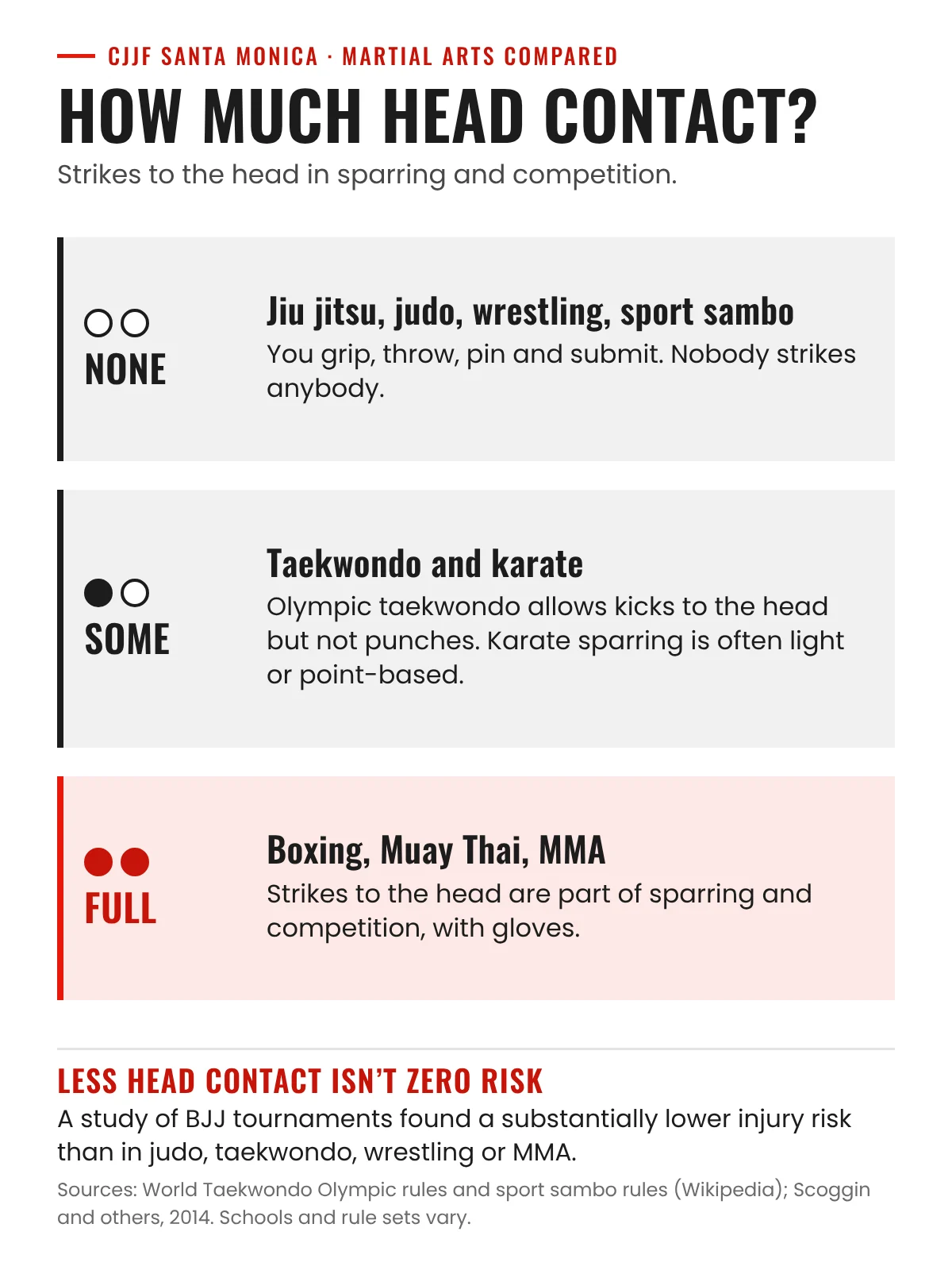
Less head contact isn’t zero risk. A study of injuries at BJJ tournaments found competitors at substantially lower risk than in judo, taekwondo, wrestling and MMA, and most of the injuries it did find were to joints, the elbow most of all (Scoggin and others, 2014). More in is jiu jitsu safe?
Jiu jitsu vs Muay Thai
Muay Thai, from Thailand, is called the art of eight limbs: fists, elbows, knees and shins. It builds powerful striking, a strong clinch and serious conditioning. Jiu jitsu has no strikes at all; it starts where Muay Thai mostly stops, on the ground. People who want both often train them side by side.
In training, the difference shows in sparring: Muay Thai rounds mean trading kicks and punches with gloves and shin guards on, while jiu jitsu rounds are grappling at full effort with no strikes. For self-defense, here’s how Muay Thai and jiu jitsu compare.
Jiu jitsu vs MMA
MMA combines striking and grappling into one sport, and jiu jitsu is one of its core skills; Royce Gracie’s win at the first UFC in 1993 is what made that clear (here’s how Gracie jiu jitsu and Brazilian jiu jitsu relate). Training MMA means taking strikes in sparring. Jiu jitsu on its own gives you the grappling half with no head contact.
Jiu jitsu matches are grappling only, won by a submission or on points for positions. Here’s how a BJJ match is won. At CJJF we teach that grappling half in the gi and in no-gi classes; no-gi, in a rashguard and shorts, is the closest to how grappling looks in MMA.
Jiu jitsu vs boxing
Boxing is the purest striking art: punches, footwork and head movement, with excellent conditioning. It has no grappling. Jiu jitsu has no punching. They cover opposite halves of a fight, which is why they pair well.
Jiu jitsu vs judo
Judo is jiu jitsu’s closest cousin, built around throws instead of ground work. Read the full comparison of jiu jitsu and judo.
Jiu jitsu vs wrestling
Wrestling is about takedowns and holding top position, with no submissions. Wrestlers often do very well when they start jiu jitsu, because balance and top control carry straight over.
Read the full comparison of jiu jitsu and wrestling.
Jiu jitsu vs karate
Karate focuses on strikes, kicks and forms; jiu jitsu on holding and controlling. For parents choosing for a child, see jiu jitsu or karate for kids.
Jiu jitsu vs taekwondo
Taekwondo, from Korea, is a kicking art and has been an Olympic sport since 2000. In Olympic sparring, kicks to the head score highest and punches to the head aren’t allowed (Wikipedia on taekwondo). Jiu jitsu has no kicks or punches at all: its sparring is all grappling. Weighing the two for a child? Most of jiu jitsu vs karate for kids applies to taekwondo too.
Jiu jitsu vs sambo
Sambo was developed in the Soviet Union in the 1920s and became an official sport there in 1938. Sport sambo is a wrestling style with throws and leg locks, and it doesn’t allow chokes; combat sambo adds strikes (Wikipedia on sambo). Jiu jitsu allows chokes as well as joint locks, and most of its training happens on the ground.
Which martial art should you learn?
Start with what you want from training:
- Want no head strikes? Jiu jitsu, judo or wrestling.
- Want to strike? Boxing or Muay Thai.
- Want it all? MMA, or a grappling art plus a striking art.
- Want self-defense? Anything trained against resistance. See the best martial art for self-defense.
- Above all: pick the classes you’ll keep going to.
Whatever you choose, watch or try a class before you sign up. Here’s what your first jiu jitsu class is like.
Questions about choosing a martial art
Is jiu jitsu better than Muay Thai?
They train different things. Muay Thai is striking; jiu jitsu is grappling with no strikes. Many people train both.
Is BJJ the same as MMA?
No. MMA combines striking and grappling; BJJ is grappling only. BJJ is one of the core skills in MMA.
Which martial art has the least head contact?
Grappling arts like jiu jitsu, judo, wrestling and sport sambo have no strikes to the head. Taekwondo and karate have some, and boxing, Muay Thai and MMA the most.
Is jiu jitsu safer than other martial arts?
In one study of tournaments, BJJ competitors had a substantially lower injury risk than judo, taekwondo, wrestling and MMA competitors. Injuries still happen, mostly to joints. Here’s how safe jiu jitsu is.
What should I learn first?
Whatever you’ll keep training. Many people start with a grappling art like jiu jitsu and add striking later.
Can you train jiu jitsu and Muay Thai at the same time?
Yes. Many people train one grappling art and one striking art, and MMA fighters train both. If you’re new, start with one for a few months, then add the other.
Which martial art is best for MMA?
Most MMA fighters train several: a grappling art like jiu jitsu or wrestling, and a striking art like Muay Thai or boxing. MMA rewards being able to fight in every range.
Is Japanese jiu jitsu the same as Brazilian jiu jitsu?
No. Japanese jujutsu is the older art, with throws, pins, joint locks and often strikes. Brazilian jiu jitsu grew out of judo in Brazil and centers on the ground and live sparring. Here’s jiu jitsu vs Brazilian jiu jitsu.
Sources: Scoggin and others, Assessment of Injuries During Brazilian Jiu-Jitsu Competition, Orthopaedic Journal of Sports Medicine, 2014: 9.2 injuries per 1,000 match exposures; substantially lower risk than judo, taekwondo, wrestling and MMA; mostly orthopedic, the elbow most often. Wikipedia, Taekwondo: Olympic since 2000; in World Taekwondo sparring, punches to the head aren’t allowed and kicks to the head score 3 to 5 points. Wikipedia, Sambo: developed in the Soviet Union in the 1920s, a Soviet sport discipline since 1938; sport sambo allows leg locks but not chokes; combat sambo adds strikes.