

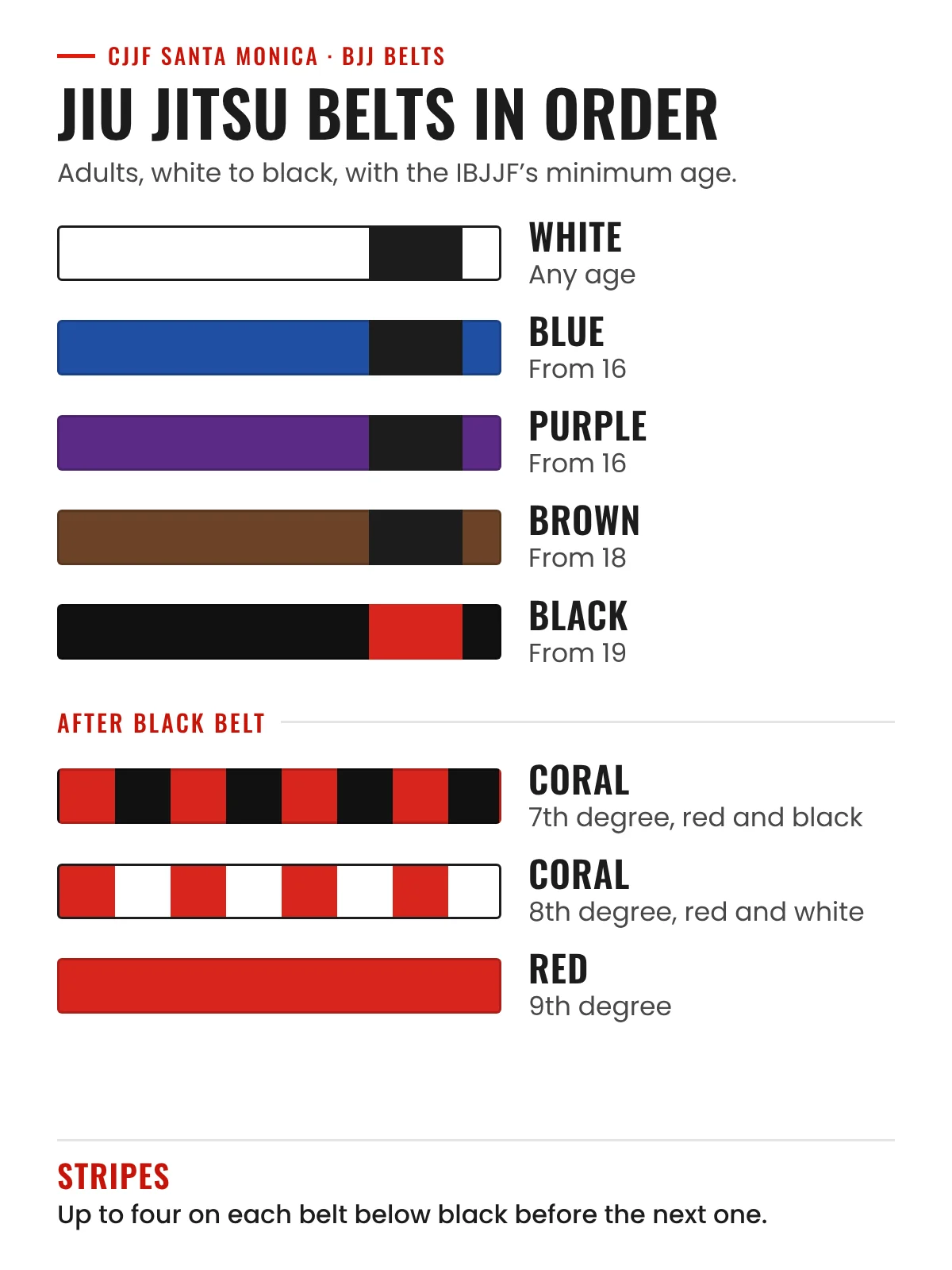
- Adult belts, in order: white, blue, purple, brown and black. Minimum ages: 16 for blue and purple, 18 for brown, 19 for black.
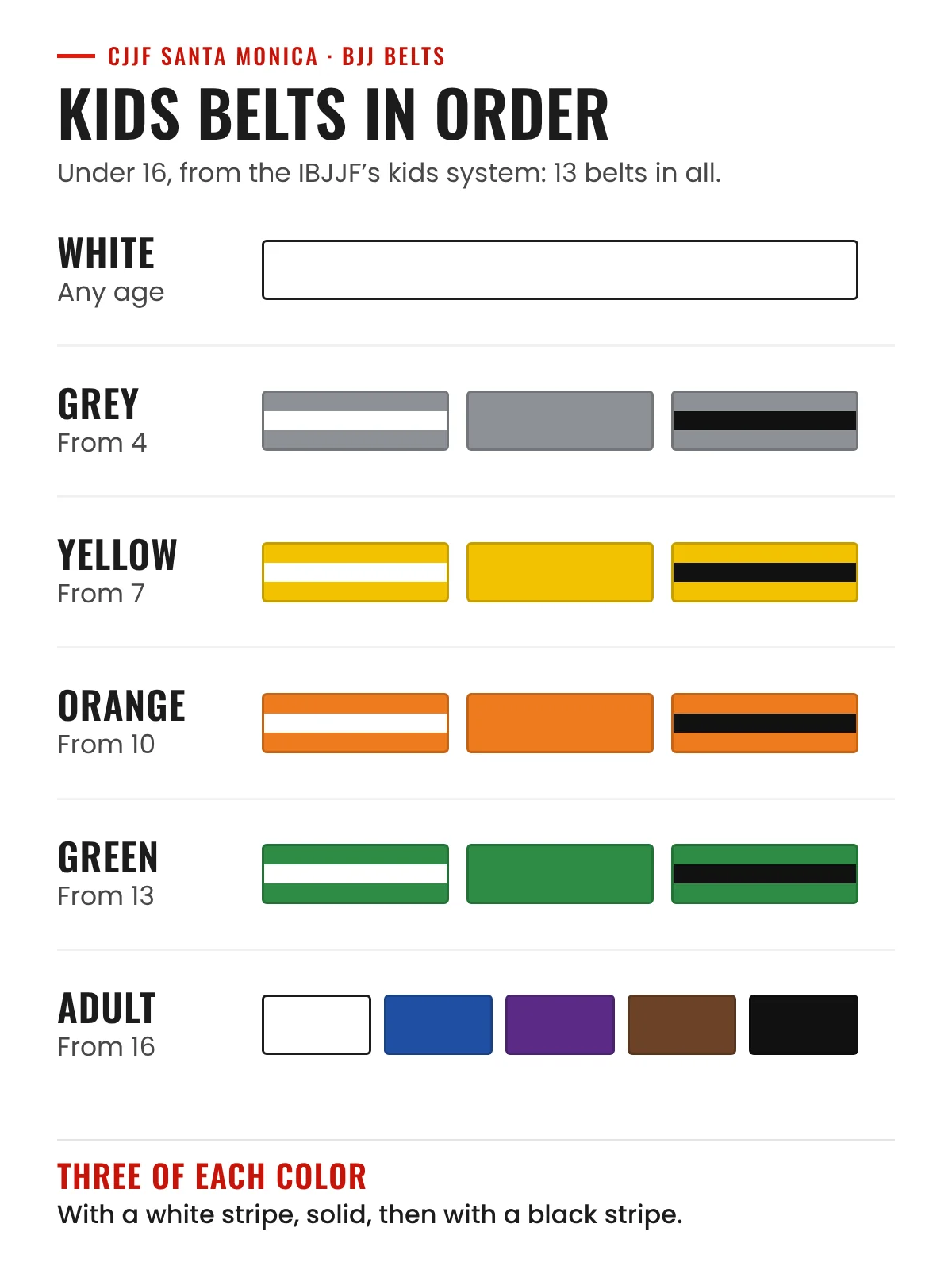
- Kids under 16 have 13 belts: white, then grey, yellow, orange and green in three versions each.
- Each belt below black carries up to four stripes before the next one.
- The IBJJF’s minimums add up to at least four and a half years from blue to black.
- Coral belts mark the 7th and 8th degrees; the red belt, the 9th.
Adult belts in order
| Belt | What it usually means | Minimum age |
|---|---|---|
| White | Learning the positions, escapes and how to stay safe. | — |
| Blue | Solid defense and fundamentals. | 16 |
| Purple | A real game of your own. | 16 |
| Brown | Refining and connecting techniques. | 18 |
| Black | Mastery of the fundamentals and the ability to teach. | 19 |
Minimum ages follow the IBJJF graduation system, which most academies use (IBJJF graduation system, via Wikipedia).
White belt
Everyone starts here, at any age, and white belts have no minimum time. You learn the positions, how to tap, escapes and how to stay safe. Your first job is to find your gi size and learn how to tie a BJJ belt so it stays on through class.
Blue belt
The first color, from age 16. Blue belts build broad technical knowledge through many hours on the mat, and the IBJJF asks for at least two years at blue before purple. Here’s how long a blue belt usually takes. Students even have a name for the slump some feel around this belt, the “blue belt blues”: here’s how to get through the slump.
Purple belt
The intermediate rank, also from 16: a real game of your own. Purple belts are generally considered ready to help teach lower belts. At least 18 months at purple before brown.
Brown belt
The highest color before black, from 18, often seen as the time for refining techniques and connecting them. At least a year at brown before black.
Black belt
From 19: an expert level of skill and the ability to teach. Black belt isn’t the end. Degrees follow, for decades.
What BJJ stripes mean
Stripes are small bands of tape on a belt’s black bar, or its red bar on a black belt. Most academies give up to four stripes on each belt below black, each marking real progress. After the fourth stripe, the next step is usually the next belt.
The IBJJF system works the same way: four stripes can be added before a student is considered for the next belt. Black belts don’t collect stripes; their marks are degrees. New words like these, and the rest of the mat vocabulary, are in our jiu jitsu terms glossary.
Kids BJJ belts
Kids under 16 follow their own system, with a white-striped and a black-striped version of most colors:
| Belt | From age |
|---|---|
| White | Any age |
| Grey (grey/white, grey, grey/black) | 4 |
| Yellow (yellow/white, yellow, yellow/black) | 7 |
| Orange (orange/white, orange, orange/black) | 10 |
| Green (green/white, green, green/black) | 13 |
That’s 13 belts for kids in all, counting white. Each color comes in three versions, so a child moves up step by step instead of waiting years for one new color.
At 16, kids move into the adult belts. At CJJF Santa Monica, kids advance through age-specific belts and stripes based on attendance, effort and skill.
Every child starts at white. Here’s what age kids can start martial arts, and whether jiu jitsu is worth it for your child.
Black belt degrees
Black belts earn degrees over decades. In the IBJJF system, the 1st to 6th degrees are worn on the black belt, the 7th is the red-and-black belt and the 8th the red-and-white belt. The 9th is the red belt. The 10th degree, also a red belt, was given only to the art’s pioneers, the Gracie brothers, and no one living holds it.
The IBJJF’s minimums: at least three years at each of the first three degrees, five years at each of the next three, seven years at the 7th degree and ten at the 8th before the next rank.
The coral belt and the red belt
“Coral belt” is the common name for the red-and-black belt of the 7th degree and the red-and-white belt of the 8th. The red belt marks the 9th degree, the highest a living practitioner can hold today. All of them come after decades of training and teaching as a black belt.
Our head coach, Professor Maycon Carvalho, is a 5th-degree black belt. He received his black belt from Master Aldo Caveirinha and his first degree from Master Carlos Gracie Jr.

How long to get each BJJ belt, up to black belt
| Step | Typical time | IBJJF minimum |
|---|---|---|
| White to blue | 1–3 years | None |
| Blue to purple | 2–3 years | 2 years at blue |
| Purple to brown | 1½–2 years | 1½ years at purple |
| Brown to black | 1–2 years | 1 year at brown |
| First class to black belt | Often around 10 years | None |
These are typical ranges, not promises. Time on the mat, effort and skill decide promotions, not the calendar.
The fastest path the IBJJF allows is two years at blue, 18 months at purple and a year at brown: at least four and a half years from blue to black, and no black belt before 19. Since 2022, coaches may skip those minimums for someone who has won an adult world championship at that belt.
Time on the mat is what counts, so extra sessions like an open mat add up. For your first year and your first belt, here’s how long it takes to learn jiu jitsu.
How promotions work
Most academies promote based on attendance, technical skill, how you do in live rounds, and attitude. At CJJF Santa Monica, adults progress through white, blue, purple, brown and black belts, and kids through age-specific belts and stripes.
Belts matter in competition too. Under the IBJJF’s rules, you compete at the belt you’re registered under, and someone promoted before the minimum time or age can’t compete at the new belt or the previous one (IBJJF Rules Book 6.1, rule 5.8). That’s why the minimums matter if you plan to compete.
At CJJF, the path runs all the way from white to black. Professor Jacob Goode was 19 when he first walked into Professor Maycon’s academy. He competed at every colored belt and was promoted to black belt here in December 2024, in the top photo. A belt is worth keeping in good shape, too: here’s how to wash a BJJ gi and belt. Gi grips are hard on your hands, too: here’s how to tape a sore finger.
BJJ belt questions
What is the order of belts in BJJ?
White, blue, purple, brown and black for adults. Kids under 16 go white, grey, yellow, orange and green.
How many belts are there in BJJ?
Five for adults, from white to black, and 13 for kids under 16, counting white. After black belt come the degrees, with the coral and red belts at the top.
How many stripes are on a BJJ belt?
Usually up to four on each belt below black.
How long does it take to get a black belt in BJJ?
Often around ten years of steady training, though it varies a lot from person to person.
What is the highest belt in BJJ?
The red belt, for the 9th degree. The 10th degree was given only to the art’s pioneers, and no one living holds it.
What is a coral belt in BJJ?
The red-and-black belt of a 7th-degree black belt, and the red-and-white belt of the 8th degree. Both come after decades as a black belt.
What belt do kids start at?
White, like adults. Their first color is grey, from age 4.
Sources: IBJJF graduation system (minimum ages, stripes, minimum times at each belt and degree, kids belts, the 2022 change), via Wikipedia, Brazilian jiu-jitsu ranking system. IBJJF, Rules Book 6.1 (June 2024), rules 5.8 and 5.9.