

- Use rigid (non-stretch) athletic tape, about half an inch (1.25 cm) wide.
- Tape between the knuckles, never over them, so every joint can still bend.
- Buddy taping supports a sore finger by taping it to the finger next to it, with padding between them.
- Snug, not tight: if the finger turns pale, blue or numb, tape it again, looser.
- A finger that’s bent out of place, won’t straighten or is badly swollen needs a doctor, not tape.
Why grapplers tape their fingers
In the gi you spend whole rounds gripping collars and sleeves, and a partner breaking your grip can bend a finger the wrong way. Grapplers tape their fingers for three reasons:
- Support for a finger that’s sore or recovering, so it can still bend without moving sideways.
- Prevention: a band of tape can make a grip feel more secure on a finger that’s been jammed before.
- Skin: tape protects knuckles and fingertips from friction on the gi.
Tape doesn’t replace good grip habits: grip with your whole hand rather than your fingertips, and let go when a grip is being torn away.
Which tape to use
Use rigid athletic tape, the non-stretch kind, often sold as zinc oxide tape. Half an inch (1.25 cm) is a good width for fingers; if you only have 1-inch tape, tear it lengthwise into thinner strips.
For buddy taping you’ll also want a little gauze or cotton to go between the fingers.
How to tape your fingers for BJJ: ring taping
This is the everyday method: a ring of tape on the part of the finger between two knuckles. It adds support while leaving every joint free to bend.
- Pick the spot. Choose the section of finger between two knuckles that you want to support.
- Wrap once or twice. Wrap the tape around that section, snug but not tight, and tear it off.
- Keep the knuckles clear. The tape should never cover a knuckle: you need to make a full fist and grip.
- Smooth it down. Press the end flat so it doesn’t catch on your partner’s gi.
- Check it. Make a fist, then open your hand. If the finger tingles, goes numb or changes color, tape it again, looser.
Sore near the middle knuckle? Put one ring below it and one above it, so the knuckle between them can still bend.
How to buddy tape a sore finger
Buddy taping supports an injured finger by taping it to the healthy finger next to it, so the two move together. Doctors use it for mild sprains. The usual pairs are the index finger with the middle finger, and the ring finger with the little finger.
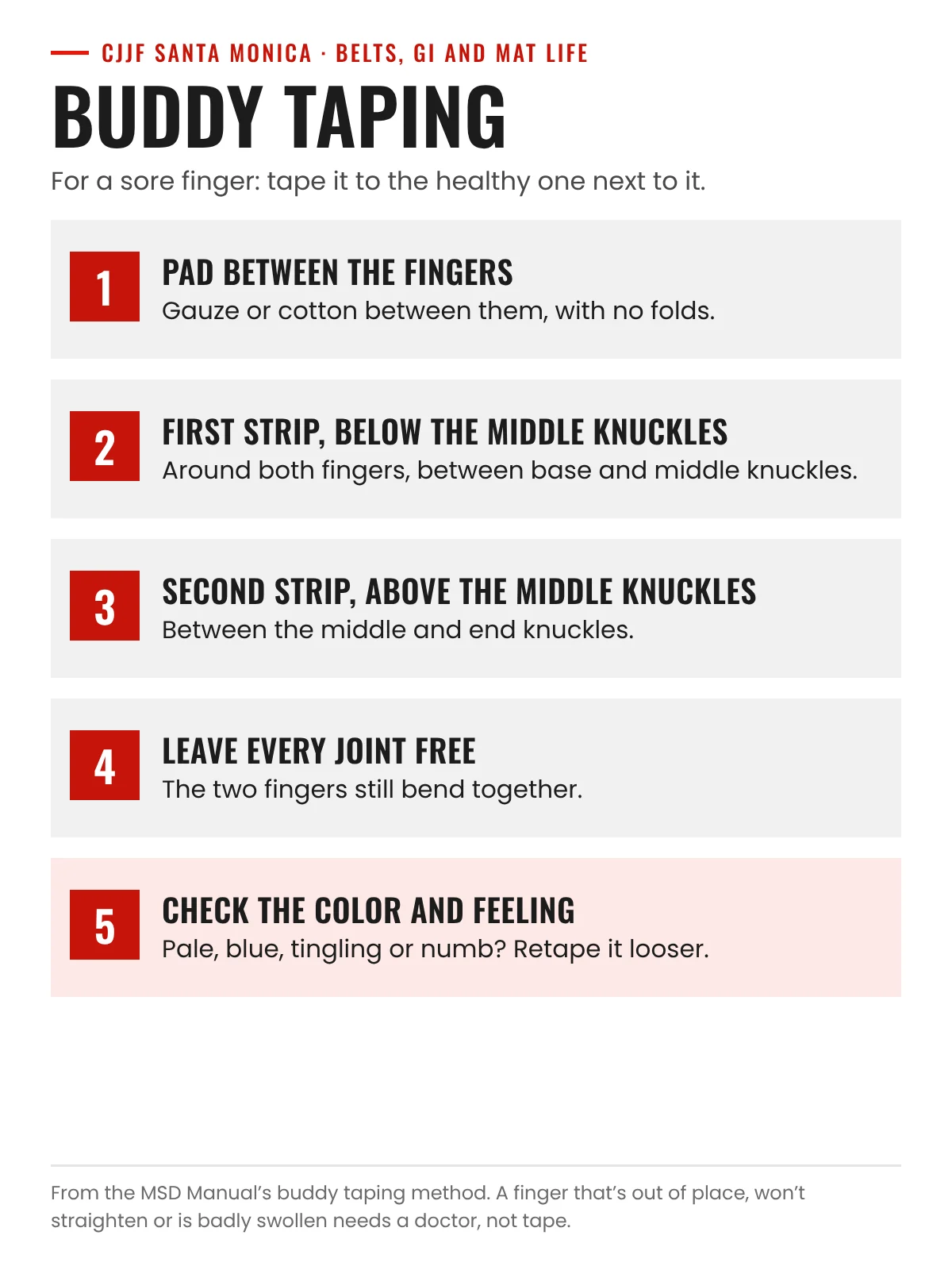
- Pad between the fingers. Put a strip of gauze or cotton between them, with no folds, to protect the skin.
- First strip, below the middle knuckles. Wrap tape around both fingers between the base knuckles and the middle knuckles.
- Second strip, above the middle knuckles. Wrap another strip between the middle knuckles and the end knuckles.
- Leave every joint free. The fingers should still bend together.
- Check the color and feeling. Pale, blue, tingling or numb means it’s too tight: tape it again, looser.
Keep buddy tape dry, and change the tape and padding if they get wet, so the skin doesn’t break down.
Mistakes to avoid
- Taping too tight. Tape that’s too tight can cut off circulation: snug is enough.
- Taping over a knuckle. It stops the joint from bending and makes you grip with the wrong part of your hand.
- Taping to train through a bad injury. If a finger needs tape to get through class, ask yourself whether it needs a rest or a doctor instead.
- Leaving it on for days. Take your training tape off after class, and check your skin.
When to see a doctor instead
Some finger injuries shouldn’t be buddy taped at all. Doctors don’t buddy tape unstable or displaced fractures, dislocations that stay loose after being put back, open fractures or tendon injuries such as mallet finger, a fingertip that won’t straighten on its own.
See a doctor before you tape and train if a finger looks bent or out of place, won’t straighten or bend, is badly swollen or bruised, or stays numb. Our article on whether jiu jitsu is safe has more on when to see a doctor after training. This page is general information, not medical advice.
Adult classesBook a free class
Finger taping questions
Should I tape my fingers for BJJ?
You don’t have to. Tape helps if a finger is sore or has been jammed before, or if gi grips are rubbing your skin raw.
Should I keep my finger taped overnight?
Training tape is for training: take it off after class and check your skin. If a doctor buddy taped an injured finger, follow their advice on how long to keep it on, keep it dry, and change it if it gets wet.
Should I tape a sprained finger?
Doctors buddy tape mild sprains, but not unstable fractures, dislocations that stay loose or tendon injuries like mallet finger. If you’re not sure how bad it is, get it checked before you tape it and train.
What’s the best finger tape for BJJ?
Rigid, non-stretch athletic tape about half an inch wide. Brand matters less than width and stickiness: it should stay on through a sweaty round and come off cleanly.
Do I need finger tape for my first class?
No. Come as you are. A coach can show you how to grip in a way that’s easier on your fingers.
Can I tape my fingers in a tournament?
The IBJJF rule book doesn’t mention finger tape. It bans hard protectors that could hurt you or your opponent, so check your event’s rules and ask the uniform inspector if you’re unsure.
Sources: MSD Manual Professional Version, How To Buddy-Tape Fingers (Dorothy Habrat, DO; updated February 2026): padding, the two strips between the joints, joints left free, the circulation check, keeping tape dry, and the injuries that shouldn’t be buddy taped. IBJJF, Rules Book 6.1 (June 2024), rule 8.3.7: no hard protectors. Sports Injury Clinic, How To Tape Fingers (Mike Walden; updated May 4, 2026): rigid zinc oxide tape of 2.5 cm or narrower, tearing wider tape into strips, the usual buddy pairs.