
- Guard means you’re on your back using your legs. Mount, side control and back control are the top positions you work toward.
- A sweep takes you from bottom to top; a pass gets you past the legs.
- Tap early: pat your partner or the mat, or say “tap”, and your partner lets go.
- Oss is a Japanese greeting that martial artists use for hello, thank you and “yes, coach”.
- In IBJJF tournaments, white belts can’t use wrist locks or leg locks other than the straight ankle lock.
Positions
- Guard. You’re on your back with your legs between you and your partner. In closed guard your legs are locked around their waist; in open guard they aren’t, and there are many styles, such as butterfly and spider guard
- Butterfly guard. An open guard with both feet hooked inside your partner’s thighs, set up for sweeps
- Spider guard. An open guard where you grip your partner’s sleeves and press your feet into their arms or hips
- De La Riva guard. An open guard where one leg hooks around the back of your partner’s leg from the outside, named for Ricardo De La Riva, who made it popular in competition
- Half guard. You trap one of your partner’s legs between yours
- Mount. You sit on your partner’s chest or stomach, knees on the mat
- Side control. You’re on top, chest to chest across your partner, past their legs
- Back control. You’re behind your partner with your feet hooked in front of their hips. Also called taking the back
- Knee on belly. One knee on your partner’s stomach, the other leg out for balance
- Turtle. On your hands and knees, curled up to protect yourself
More on how each one works in the main BJJ positions.
Moves
- Sweep. From the bottom, you reverse the position so you end up on top
- Pass. You get past your partner’s legs to side control or mount. Short for passing the guard
- Toreando and knee slice. Two common passes: in the toreando, or bullfighter pass, you step around your partner’s legs; in the knee slice, or knee-over pass, you drive your knee across their thigh
- Takedown. You bring a standing partner to the mat
- Guard pull. Sitting straight down to your guard from standing instead of going for a takedown
- Shrimp. You turn on your side and push your hips away to make space. Also called a hip escape, and the most important beginner drill
- Bridge. You push your hips up to lift and unbalance someone on top of you. Also called upa
- Base and posture. Staying balanced and upright so you’re hard to sweep
- Grips and hooks. Grips are holds on the gi or the body; hooks use your feet to control your partner’s legs or hips
Submissions
- Submission. A choke or joint lock that makes your partner tap
- Tap. Patting your partner or the mat, or saying “tap”, to stop. Your partner lets go right away. Tap early, before it hurts
- Rear naked choke. A choke from the back, with your arm around your partner’s neck
- Triangle. A choke using your legs around your partner’s head and one arm
- Guillotine. A choke from the front, with your arm around the neck of a partner who’s facing you
- Armbar. Straightening your partner’s arm against the elbow
- Kimura and Americana. Two shoulder locks on a bent arm that twist it in opposite directions: the americana, also called the keylock, with the hand up by your partner’s head, the kimura with the hand behind their back. The kimura is named after the Japanese judoka Masahiko Kimura, who beat Hélio Gracie with it
- Omoplata. A shoulder lock you apply with your leg instead of your arms, usually from guard
- Straight ankle lock. A leg lock on the ankle, and the one leg lock every adult belt can use in IBJJF tournaments
- Knee bar, toe hold and heel hook. Leg locks on the knee and foot. They’re riskier, so tournaments save them for higher belts, as the chart below shows
Which submissions can you use at your belt?
Tournaments open up the riskier submissions as you earn belts. Under the rules of the IBJJF, the International Brazilian Jiu-Jitsu Federation, white belts can use chokes, arm locks, shoulder locks and the straight ankle lock; wrist locks open up at blue belt; knee bars, toe holds and slicers at brown; and heel hooks only for brown and black belts in the adult no-gi division (IBJJF).
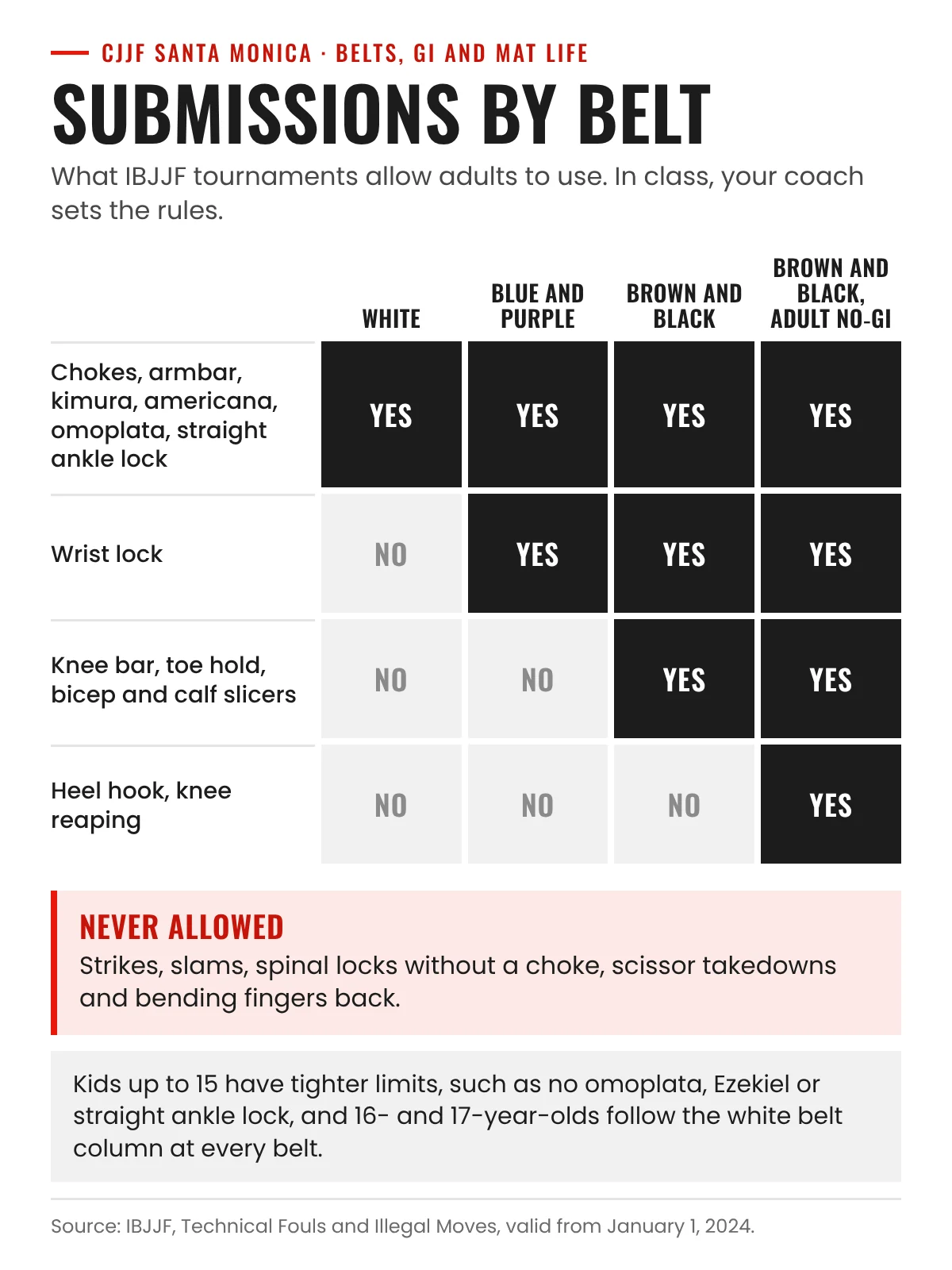
Some moves are never allowed: strikes, slams, spinal locks without a choke, scissor takedowns and bending fingers back. Kids up to 15 have tighter limits, and 16- and 17-year-olds follow the white belt rules at every belt. Here’s how a BJJ match is scored, from points to advantages.
Gear
- Gi. The jacket, pants and belt you train in. Some people call it a kimono
- No-gi. Training without the gi, in a rashguard and shorts
- Rashguard. A tight athletic shirt worn for no-gi
- Stripes. Strips of tape on your belt’s bar that mark progress between belts
- Ear guard. Soft headgear that protects your ears from rubbing and helps prevent cauliflower ear
In the gym
- Roll. A live round where both partners try their techniques against resistance. Rolling is sparring
- Drilling. Repeating a technique with a partner who cooperates
- Positional sparring. Live rounds that start from one position, such as guard or side control
- Fundamentals. The beginner class, where new students learn the core positions and escapes
- Open mat. Scheduled training time with no set lesson
- Professor. The title for a black belt instructor
- Oss. A greeting and sign of respect you’ll hear at many academies
- Points and advantages. In a match, positions score points: 4 for mount or the back, 3 for passing the guard, 2 for a takedown, sweep or knee on belly. Advantages, for nearly scoring, break ties
Belts have names too: adults go white, blue, purple, brown and black, and kids have grey, yellow, orange and green belts. Our guide to BJJ belts explains them, and what an open mat is explains how open training works.
BJJ slang you’ll hear
- Flow roll. A light, relaxed roll where both partners let techniques happen instead of fighting for them
- Slap and bump. The handshake and fist bump that start a roll
- Shark tank. One person stays in while a fresh partner comes in every minute or so
- Getting smashed. Being stuck under heavy pressure from a partner on top
- Mat time. Hours spent training, the thing that makes you better
- Comp. A competition, or a class that gets you ready for one
Hearing a word that isn’t here? Ask your partner or coach after class; everyone was new once. Here’s what to expect in your first jiu jitsu class.
What does oss mean?
Oss (or osu, おす) is a casual Japanese greeting tied to martial arts such as karate, kendo and judo, and outside Japan it’s used in karate and Brazilian jiu jitsu too. It’s a rough contraction of ohayō gozaimasu, “good morning”, and it can also mean “yes, sir!” to a teacher or senior student (Wikipedia).
You’ll often read that oss is written 押忍, “push” and “endure”. Those characters were added after the word was already in use, so they’re a popular story rather than its origin. Nobody is sure where it began: theories point to the Imperial Japanese Navy, a martial arts school in Kyoto and a university sumo club.
On the mat, people say it as hello, thank you, “got it, coach” or “nice roll”. Some academies say it a lot and some hardly at all, so follow the room.
Adult classesBook a free class
Questions about BJJ terms
What does “oss” mean in jiu jitsu?
It’s a Japanese greeting, used in martial arts as hello, thank you or “yes, coach”, and a rough contraction of ohayō gozaimasu, “good morning”. You’ll pick up when to say it from your training partners.
What does “roll” mean in BJJ?
A live round of sparring, where both partners try their techniques against resistance.
What’s the difference between gi and no-gi?
In the gi you wear a jacket and pants you can grip. No-gi is a rashguard and shorts, so there are no cloth grips.
What does it mean to tap?
You give up by tapping your partner or the mat, or by saying “tap”, before a hold hurts. Your partner lets go right away.
What is a sweep in jiu jitsu?
A move that takes you from the bottom to the top. In a match, a sweep from guard scores 2 points.
What’s the difference between a kimura and an americana?
Both are shoulder locks on a bent arm, twisted in opposite directions: the americana with your partner’s hand up by their head, the kimura with it behind their back.
Can white belts do heel hooks?
Not in IBJJF tournaments: heel hooks are allowed only for brown and black belts in the adult no-gi division. White belts can use the straight ankle lock. In class, your coach decides when you learn leg locks.
What is forbidden in BJJ?
Strikes, slams, spinal locks without a choke, scissor takedowns and bending fingers back are never allowed. Some submissions, like wrist locks and leg locks, depend on your belt; the chart above shows which.
What are the main positions in BJJ?
Guard, half guard, mount, side control, back control and knee on belly. Here’s how each position works.
Sources: IBJJF, Rules Book 6.1 and Technical Fouls and Illegal Moves, valid since January 1, 2024: points (2.5.2); the illegal moves table by age and belt. Wikipedia, Oss (greeting): a casual Japanese greeting from karate, kendo and judo, used in Brazilian jiu-jitsu; a contraction of ohayō gozaimasu; the kanji 押忍 added later; origin theories. Wikipedia, Guard (grappling): closed, half, butterfly, spider and De La Riva guards; pulling guard; the toreando and knee-over passes. Wikipedia, Armlock: the armbar, the americana (top shoulder lock, keylock), the kimura (named after Masahiko Kimura’s win over Hélio Gracie) and the omoplata.