
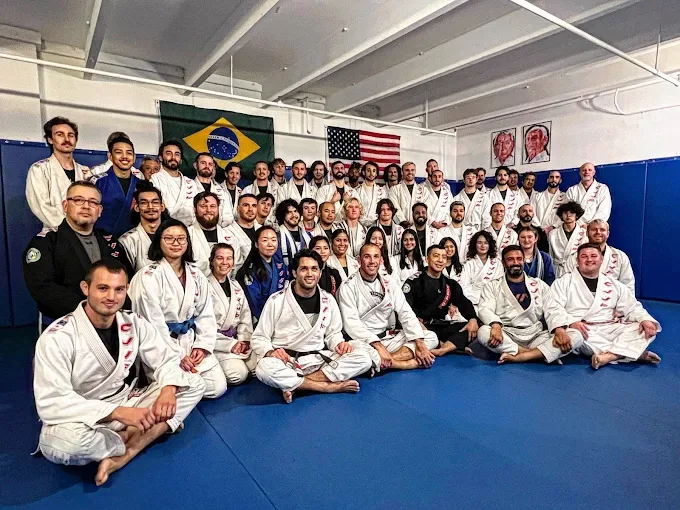
- No lesson: you choose to roll, drill or ask questions, often in 5- or 6-minute rounds.
- Ask before you roll, match your partner’s pace, tap early and let go fast.
- Visiting? Call first: are visitors welcome, gi or no-gi, and is there a waiver or mat fee?
- Beginners: go after a few weeks of classes, say you’re new, and drill or roll light.
- At CJJF, Live Training works like a short open mat, four times a week.
What happens at an open mat
There’s no lesson. The mats are open, and you choose what to do: roll with different partners, drill a technique you’re stuck on, or ask a higher belt to show you something. Rounds are often 5 or 6 minutes, and people rotate partners between them. A coach is usually there to keep things safe.
That’s close to tournament length. Under IBJJF rules, adult matches last 5 minutes at white belt, 6 at blue, 7 at purple, 8 at brown and 10 at black, and masters (30 and older) go 5 or 6 minutes (IBJJF). It’s one reason competitors like open mats: match-length rounds against partners they don’t see every day. The North American Grappling Association adds that rolling in other gyms gets you used to new mats and new rooms before a tournament (NAGA).
Open mat vs class
The difference is who decides what happens.
| Topic | Class | Open mat |
|---|---|---|
| Who leads | A coach teaches a technique | No lesson; a coach is usually there to keep it safe |
| Warm-up | Led by the coach | On your own |
| What you do | Learn it, drill it, then spar if you’re ready | Your choice: drill, positional rounds, rolls or questions |
| Partners | Often paired by the coach | You ask, and anyone can say no |
| Who comes | The students in that class | Members of every level, and often visitors from other gyms |
| Cost | Part of your membership | Usually included for members; visitors may pay a mat fee |
Class is where you learn a technique; open mat is where you try it. Here’s what a BJJ class looks like, step by step.
Kinds of rounds, from drilling to rolling
Rolling is jiu jitsu’s word for sparring, but an open mat has more than one speed. From easiest to hardest:
- Drilling. Your partner cooperates while you repeat a move on both sides until it’s smooth.
- Positional rounds. You start from one spot, like the bottom of side control, and restart when someone escapes, passes or taps. Good for fixing one problem.
- Flow rolls. Light, relaxed rolling where both partners let moves happen instead of fighting for them.
- Full rolls. Both partners resist and go for submissions, at a pace you’ve agreed on. It’s still practice, not a match.
Say what you’d like before you start: “Flow roll?” or “Can we start from side control?” works. New to the words? Here’s our jiu jitsu glossary.
Who it’s for
- Members who want extra rounds or missed a class.
- Competitors getting ready for a tournament.
- Visitors from other academies who are in town.
- Anyone who wants time to work on one thing.
Open mat etiquette
- Ask before you roll. A simple “Want to roll?” works.
- Match your partner’s pace. Go lighter with smaller or newer partners.
- Tap early and let go the moment your partner taps.
- Ask before leg locks. Rules on heel hooks and other leg locks differ from gym to gym, so check first and follow the room. Here’s which submissions each belt can use in tournaments.
- Don’t coach mid-roll. Save tips for after the round, and only if your partner asks.
- Rotate partners. Don’t keep one partner all session while others wait.
- Sitting out is fine. You can turn down a round or rest one, and so can your partner.
- Watch your space. Keep away from other pairs and the walls.
- Come clean. A washed gi or rashguard, trimmed nails, no shoes on the mat.
- Cover cuts, and stay off the mat with a rash. Skin infections spread on shared mats; here’s how to prevent skin infections.
- Say thanks after every round.
Free practice has had manners from the start. In a 1932 lecture at the University of Southern California, during the Los Angeles Olympics, judo’s founder Kanō Jigorō said partners in randori, judo’s free practice, “may use whatever methods they like provided they do not hurt each other,” and must keep the rules of etiquette (Kanō’s lecture). He taught students to use only as much force as a technique needs. Jiu jitsu grew out of judo, and a good roll still works that way.
Visiting another gym
Many academies welcome visitors at their open mat. Call or message ahead, since some ask you to sign a waiver or pay a small mat fee, and ask whether they have any rules about gis or patches. Bring your own gi or rashguard, introduce yourself to the coach, and follow the room’s rules.
Questions worth asking when you call:
- Are visitors welcome, and what time does it start?
- Gi, no-gi or both? If you’re not sure, pack both, as NAGA suggests.
- Is there a waiver or a mat fee? Open mats are usually free for members, but some gyms charge visitors (NAGA).
- Any house rules, such as on leg locks, or on gis and patches from other teams?
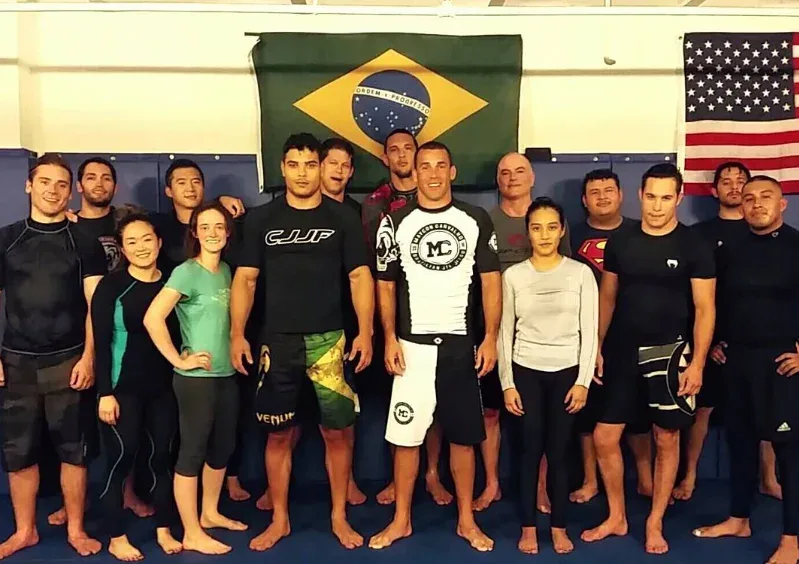
On the day, arrive a few minutes early with gear that’s washed and fully dry, tell the coach your name, belt and home academy, and roll at the host’s pace. You’ll meet grapplers outside your usual circle, and good training partners are a big part of why people stay with jiu jitsu.
Should beginners go?
Yes, once you’ve taken a few weeks of classes. Tell your partners you’re new, roll with people who control the pace, or simply drill. Open mats are a great place to ask questions.
A simple plan for your first one:
- Pick one thing from this week’s classes, such as an escape from side control.
- Drill it with a partner for a few minutes, on both sides.
- Do positional rounds from that spot, then a flow roll or two.
- If you feel ready, finish with a full roll with someone who controls the pace.
- Before you leave, ask a higher belt one question about a round you had.
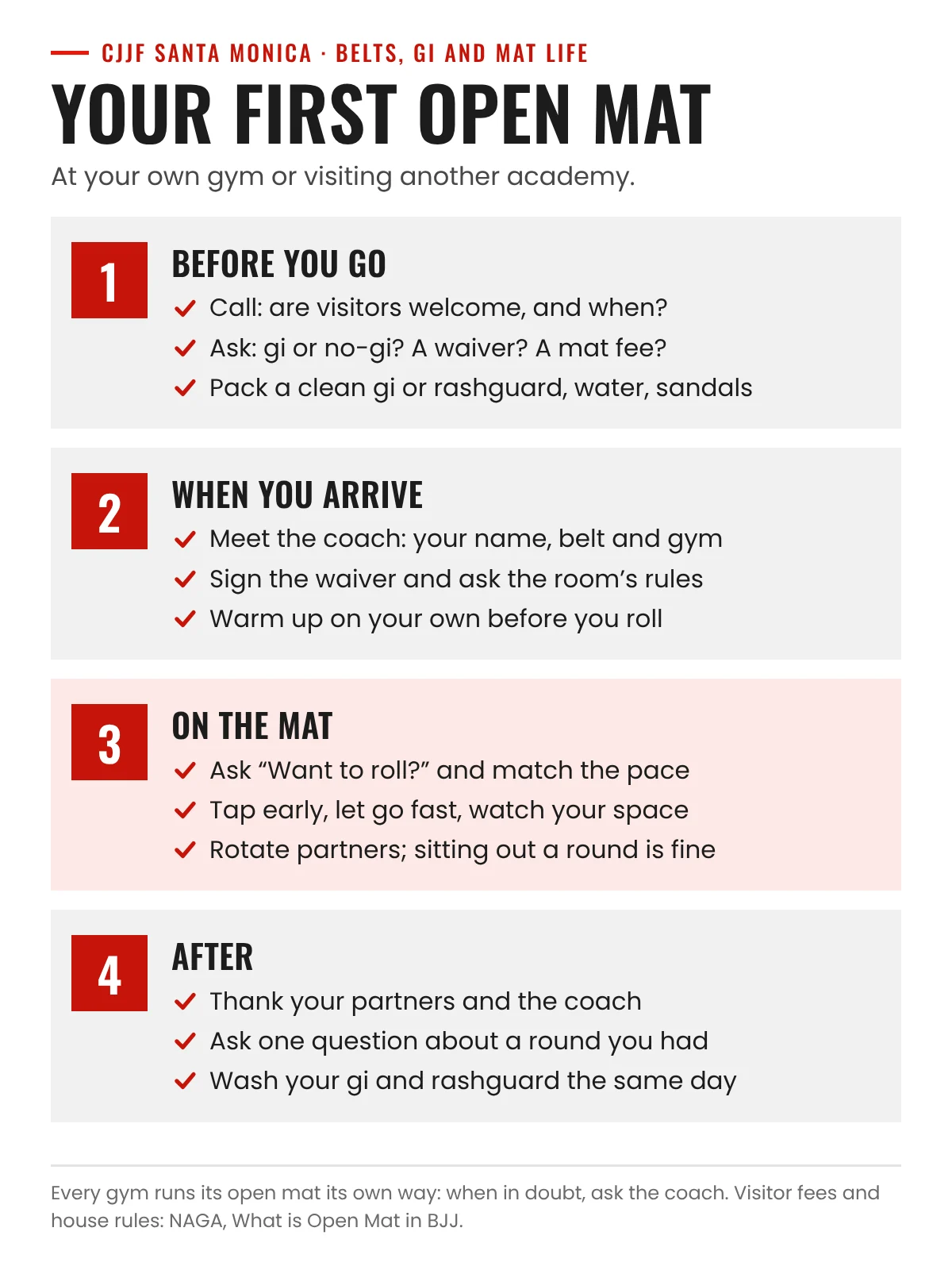
Classes still come first. Two a week is a good start, and what matters most is that your weeks don’t have gaps: here’s how often to train BJJ. Open mats add mat time, and mat time is what counts toward each new belt.
Open training at CJJF
Our Live Training sessions work like a short open mat: focused live rounds on Monday and Wednesday from 8 to 8:30 pm, and on Tuesday and Thursday from noon to 12:30 pm. Competitors train on Saturdays from 10 to 11:30 am. Visiting from another academy? Your first drop-in at CJJF is free: call (714) 872-1604 before you come.
Live Training comes right after the Advanced class on Monday and Wednesday evenings and the All Levels class on Tuesday and Thursday at lunchtime. New students start in Fundamentals, where light rounds are optional, and most move up to All Levels classes, where live rounds happen, after a few months of steady training.
The rolls with Academy members were top-notch — everyone was technical, tough, and welcoming to a visitor.
Roh H., Google review
Class scheduleBook a free class
Open mat questions
What is an open mat in BJJ?
Scheduled training time without a lesson, for rolling, drilling and asking questions.
Can I go to another gym’s open mat?
Often, yes. Call ahead first, since some gyms ask for a waiver or a small mat fee.
Do I need to be good to go?
No. Tell your partners you’re new, roll with people who control the pace, or drill instead.
What should I bring?
A clean gi or a rashguard and shorts, water, and sandals for off the mat.
Are open mats free?
Usually, for the gym’s own members. Some gyms charge visitors a mat fee, so ask when you call.
Do I have to roll at an open mat?
No. You can drill, do positional rounds or sit out a round. Nobody should push you into a roll you don’t want.
Should I wear a gi or no-gi to an open mat?
Whatever that open mat is: ask when you call. Many allow both, so pack both if you’re not sure.
Does CJJF Santa Monica have an open mat?
Our Live Training sessions work like a short open mat: Monday and Wednesday from 8 to 8:30 pm, and Tuesday and Thursday from noon to 12:30 pm. Visiting from another academy? Call (714) 872-1604 before you come.
Sources: NAGA (North American Grappling Association), What is Open Mat in BJJ, January 2025: no instructor-led lesson; meeting grapplers from other gyms; getting used to new gyms before a competition; usually free for members, a fee for some visitors; bring gi and no-gi gear; know the host gym’s rules. IBJJF, Rules Book 6.1, valid since January 1, 2024: match length by age division and belt. Kanō Jigorō, The Contribution of Judo to Education, a lecture at the University of Southern California during the 1932 Los Angeles Olympics (JudoInfo, pages 1 and 2): randori, “free exercise”, its etiquette, and using only as much force as needed.