
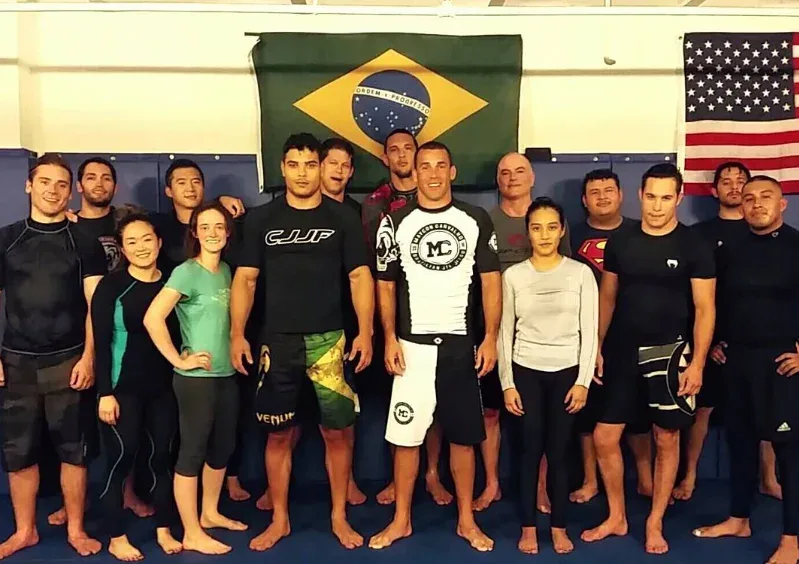
- For your first class, a fitted T-shirt or rashguard and athletic shorts or pants with no zippers are all you need.
- Gi classes use a jacket, pants and belt; no-gi uses a rashguard and shorts or spats. We can lend you a gi for your first class.
- Bring water, sandals and a hair tie. Shoes and jewelry stay off the mat.
- Trim your nails, wear clean clothes and skip class if you have a rash or an open wound.
- Class runs an hour: warm-up, technique, drilling and positional practice. Sparring is optional.
What to wear to jiu jitsu
You don’t need special gear for your first class. Wear:
- A T-shirt or rashguard that fits close to your body, so it doesn’t ride up or catch fingers.
- Athletic shorts or pants with no zippers, pockets or buttons. Zippers and buttons can scratch you or your partner.
- Nothing else. Take off rings, watches, earrings and necklaces before class, and tie back long hair with a soft hair tie, not a clip.
Want to try the gi, the traditional jacket and pants? At CJJF Santa Monica we can lend you one for your trial class. If you keep training, the coaches are happy to help you choose your own, and our gi size guide helps you find your size.
Gi or no-gi: what to wear to each class
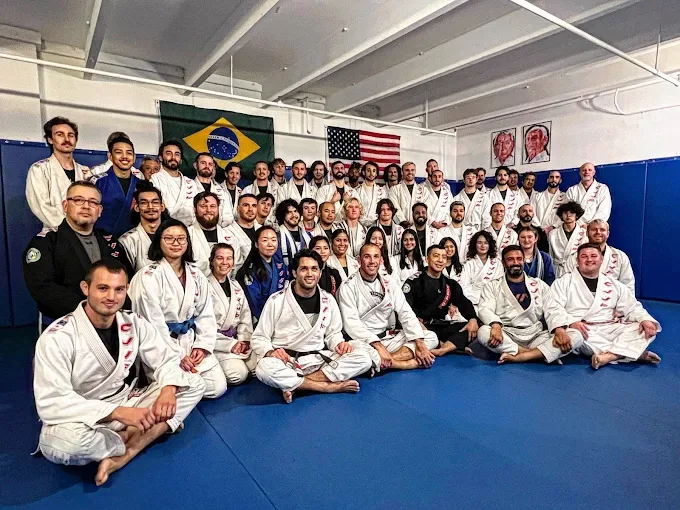
Jiu jitsu is trained two ways. In a gi class you wear the jacket, pants and belt, and you grip the cloth. In no-gi you wear a rashguard and shorts, and grip the body instead.
| What you wear | Gi class | No-gi class |
|---|---|---|
| Top | A gi jacket | A rashguard, a tight athletic shirt |
| Bottom | Gi pants | Grappling shorts with no pockets or zippers, spats (tight leggings), or both |
| Belt | Your rank belt; everyone starts at white | None |
| Your first class at CJJF | A T-shirt and athletic pants, or borrow one of our gis | A fitted T-shirt and athletic shorts |
What to wear under a gi
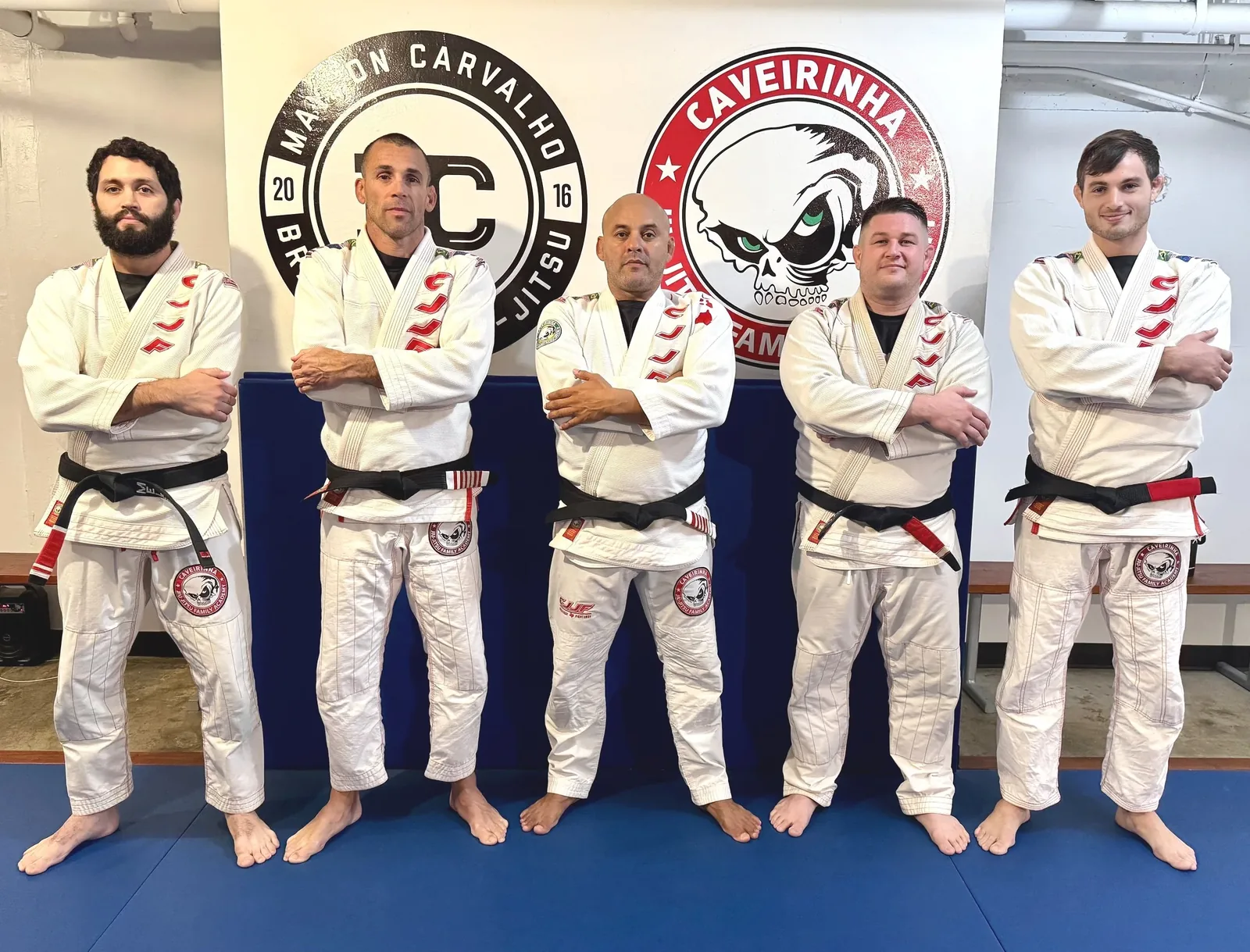
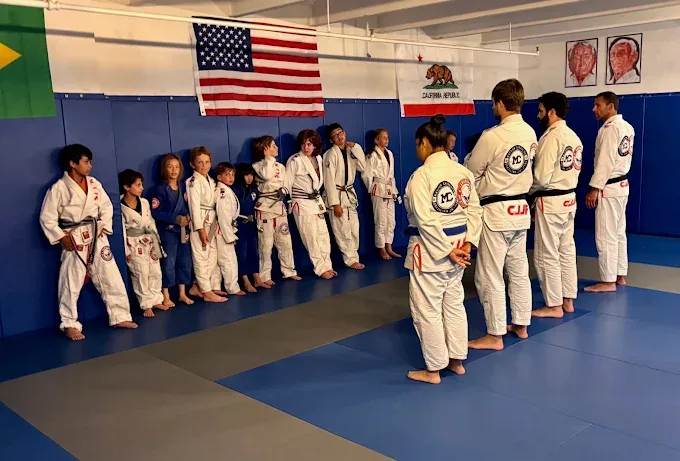
In class, wear what keeps you comfortable and covered. Under the jacket you can wear a rashguard or fitted T-shirt, as our coaches do in the photo below; women wear a sports bra under it. Under the pants, wear underwear or compression shorts.
Tournaments are stricter. Under IBJJF rules, men can’t wear a shirt under the gi jacket or any pants, like leggings, under the gi pants. Women must wear a close-fitting stretchy shirt, a one-piece swimsuit or a gymnastics top under the jacket, and may wear elastic leggings shorter than the gi pants.
Tying your belt
Borrowing a gi? A coach will help you tie the belt on day one. Here’s how:
- Find the middle. Fold the belt in half and put the middle just below your belly button.
- Wrap it twice. Take both ends around your back, cross them and bring them to the front, keeping both layers flat.
- Tuck it under. Pass the top end up behind both layers.
- Tie the knot. Lay it over the other end, then bring it up through the loop.
- Pull it tight. Pull both ends out to the sides until the knot is snug and the ends hang evenly.
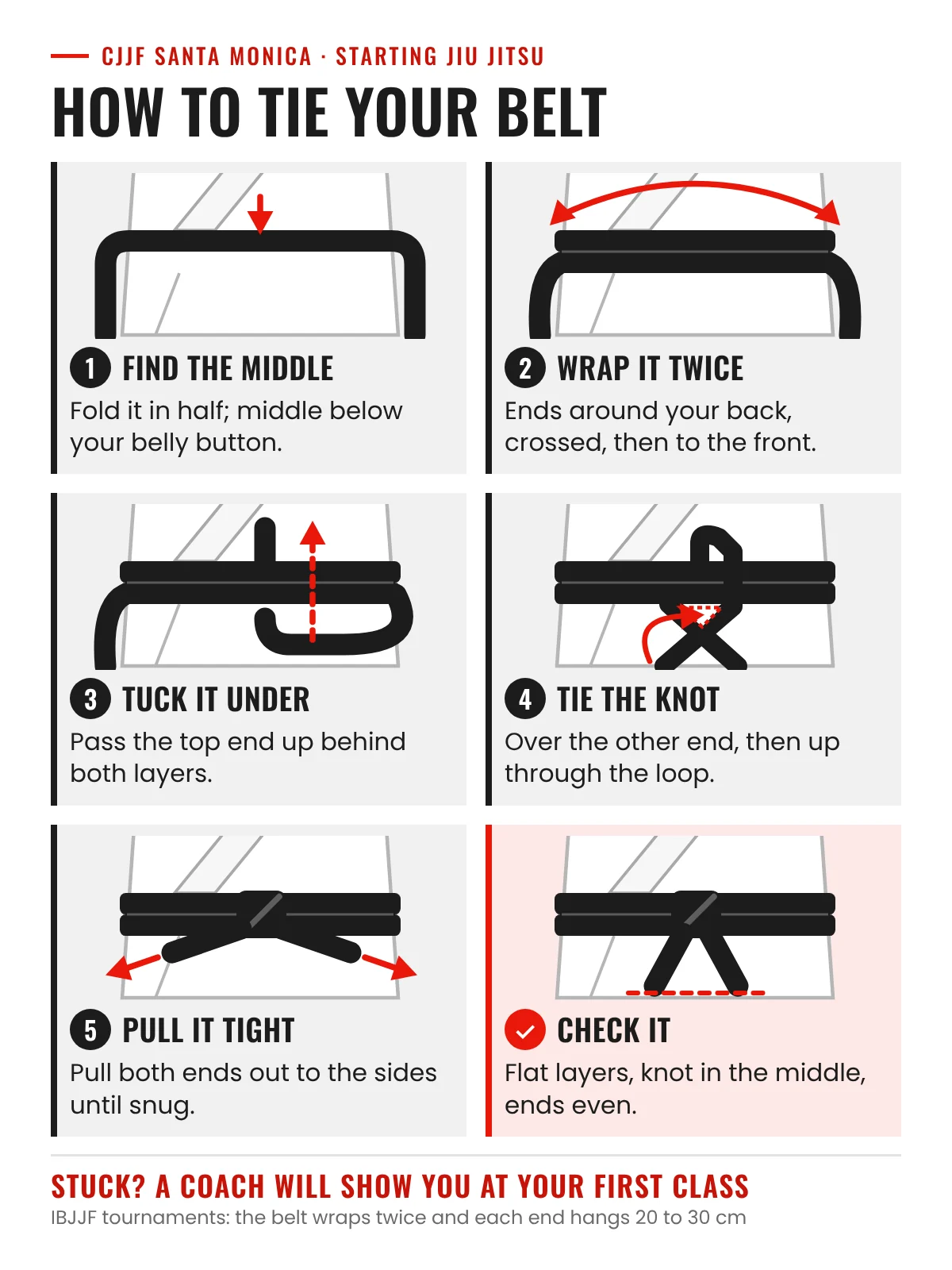
In IBJJF tournaments the belt must wrap around your waist twice, tied tight enough to hold the jacket closed, with each end hanging 20 to 30 cm. For the common mistakes and which side the stripe bar goes on, see how to tie a BJJ belt.
What to wear to no-gi jiu jitsu
For no-gi, wear a rashguard and grappling shorts or spats. For your free class, a fitted T-shirt and athletic shorts are fine. Skip open pockets, buttons, zippers and drawstrings that hang out. The IBJJF bans them from no-gi tournaments, and in class they can catch fingers or scratch a partner.
Our Friday no-gi class runs 7 to 8 pm and is open to all levels.
What women wear to jiu jitsu
The same as everyone else: a sports bra under a fitted T-shirt or rashguard, and leggings, shorts or shorts over leggings. Tie long hair back with a soft hair tie, and take out earrings.
At CJJF Santa Monica, women train in every adult class. When other women are on the mat, you train with them; otherwise you partner with an instructor or with a man close to your height and weight. More on women’s jiu jitsu at CJJF.
What to bring
- A water bottle.
- Sandals or flip-flops for walking off the mat.
- A hair tie if you have long hair.
- A mouthguard, if you have one.
- A towel and a change of clothes for the trip home.
Jiu jitsu hygiene: before and after class
Jiu jitsu is close contact, so clean habits protect everyone on the mat. The CDC says skin infections, including MRSA (a type of bacteria that can resist several antibiotics), are most reported in sports with a lot of physical contact, and that MRSA can spread through skin-to-skin contact and contaminated surfaces. Before and after every class:
- Trim your fingernails and toenails short. Long nails scratch, and IBJJF tournaments require short nails too.
- Come in clean clothes, and wash your gi or rashguard after every class and let it dry completely. Here’s how to wash a gi without shrinking it.
- Shower after training, and don’t share towels.
- Cover small cuts with a clean, dry bandage.
- Skip class if you have a rash, a sore or an open wound. Tell the coach, and see a doctor if you think it’s an infection.
- Go easy on perfume and cologne.
What happens in your first class
When you arrive
Arrive 10 minutes early to check in at 320 Wilshire Blvd #101, between the Third Street Promenade and 4th Street, and to change. Mention any injuries to the coach before class. Parking is $1 for 90 minutes in Public Parking Structure 1, right behind the building, and the Downtown Santa Monica E Line station is a 15-minute walk.
How the class runs
Beginners 13 and up start in Fundamentals. A one-hour class usually runs like this:
- Warm-up. Movements you’ll use in jiu jitsu, like bridging, the hip escape and rolling safely.
- Technique. The coach shows one or two techniques step by step.
- Drilling. You practice with a partner at a slow, cooperative pace.
- Positional practice. You start in one position with a simple goal, like escaping or holding.
- Live rounds, if you want them. Sparring is optional while you learn, and it’s always by consent and supervised.
Nobody expects you to know anything. Tell the coach it’s your first class and they’ll pair you with a patient partner.
Booked a Friday evening trial class. The whole experience was smooth and welcoming – you only need to bring a water bottle. The class was taught by 2 black belt professors, who were present to provide feedback on technique.
Kelly C., Google review
Never seen jiu jitsu? Our BJJ for beginners guide explains how the sport works, the main positions and how to start.
Bringing your child or teen?
Kids from 3.5 can try a free class. Little Champions I (ages 3.5–6) runs at 4:15 pm and Little Champions II (ages 7–12) at 5 pm, Monday to Thursday, and parents are welcome to watch and film. Kids wear comfortable clothes like a T-shirt and athletic pants; if they keep going, we’ll help you choose a gi. From 13, teens join the Fundamentals, All Levels and Advanced classes; see teen jiu jitsu.
Jiu jitsu etiquette: the mat rules
- No shoes on the mat, and no bare feet off it. Put your sandals on whenever you step off.
- Tap early, and stop the moment your partner taps. Tap your partner or the mat, or say “tap”.
- Keep it clean. Clean clothes every class, short nails, no strong perfume.
- Train at your partner’s pace. Match their intensity, and go lighter with newer or smaller partners.
- Listen when the coach talks. Stop, sit and watch when the coach demonstrates.
- Running late? Check in quietly and join after the warm-up with the coach’s OK.
- Tell your partner about any injury before you start, so they can work around it.
At CJJF Santa Monica, shoes and jewelry stay off the mat, and we clean the mats every day. More on how to train safely from day one.
You’ll hear new words on the mat, like roll and tap. Here are the words you’ll hear in a BJJ class, in plain English.
First class tips for beginners
A few habits make day one easier:
- Go slow. Drilling isn’t a contest. Let your partner finish the move, then take your turn.
- Breathe. It’s easy to hold your breath when you’re working hard, so keep breathing slowly and steadily.
- Relax your grip. Squeezing everything tires out your forearms fast.
- Ask questions. Ask the coach or your partner to show a step again. That’s what they’re there for.
- Rest when you need to. Step to the edge of the mat and catch your breath.
- Don’t compare yourself. Everyone on the mat had a first class, black belts included.
- Pick your next class before you leave. Fundamentals runs five evenings a week.
After your first class
Expect some soreness for a day or two, especially in your neck, forearms and hips. Drink water and come back when you feel ready: two classes a week is enough for steady progress, and three speeds it up. Ask the coach which classes fit your schedule, and see membership and prices when you’re ready to join.
Most beginners move up from Fundamentals to All Levels classes after a few months of steady training. To see what the first year looks like, read how long it takes to learn jiu jitsu. Still comparing academies? Use our checklist for choosing a BJJ gym.
Booking your free class
Your first class at CJJF Santa Monica is free. Fundamentals runs Monday and Wednesday at 6 pm, Tuesday and Thursday at 7 pm, and Friday at 6 pm. Kids classes run Monday to Thursday from 4:15 pm.
Call (714) 872-1604 or email mcbjjsantamonica@gmail.com and tell us who the class is for, the day and time you’d like to come, and any injuries or questions.
Book a free classSee the schedule
First class questions
Do I need a gi for my first class?
No. Wear a T-shirt and athletic shorts or pants with no zippers. If you’d like to try a gi, we can lend you one for your trial class.
Will I have to spar on my first day?
No. Sparring is optional while you learn. You’ll spend most of your first class on technique and drilling.
What if I’m out of shape?
That’s fine. Classes build your fitness, and you can rest whenever you need to. Here’s what jiu jitsu does for your fitness.
Should I eat before class?
Have a small meal or snack 1 to 3 hours before, and a large meal at least 3 to 4 hours before, as the Mayo Clinic advises for exercise in general. A banana, yogurt or a granola bar works. Bring water: you’ll sweat.
How early should I arrive?
Ten minutes early, so you can check in, change and meet the coach.
What is a BJJ outfit called?
A gi, sometimes called a kimono: a thick cotton jacket, pants and a belt that shows your rank. Without the gi you train no-gi, in a rashguard and shorts.
Do I need a rashguard for no-gi?
Not for your first class: a fitted T-shirt and athletic shorts are fine. If you keep training no-gi, get a rashguard. It fits close, so it doesn’t ride up or catch fingers, and IBJJF no-gi tournaments require a skin-tight shirt that covers your torso.
What’s not allowed in jiu jitsu?
Strikes, biting, hair pulling, slams and bending fingers back aren’t allowed, and white belts can’t use some leg locks, like heel hooks. In class, the coach sets the rules and beginners start with the safest techniques. See BJJ rules and points for the full list.
How many days a week should a beginner train?
Two or three. Two classes a week is enough for steady progress, and three speeds it up.
What’s the earliest age to start jiu jitsu?
At CJJF Santa Monica, kids can start at 3.5, in Little Champions I. Here’s what age kids can start martial arts and what to look for at each age.
Sources: International Brazilian Jiu-Jitsu Federation, Rules Book (version 6.1, June 2024), Article 8: gi and no-gi uniforms and hygiene. Centers for Disease Control and Prevention, Athletes: MRSA Prevention and Control (last reviewed June 27, 2025): how skin infections spread in sports, showering, laundry, covering cuts and reporting infections. Mayo Clinic Staff, Eating and exercise: 5 tips to maximize your workouts (December 21, 2023): when to eat before exercise.