
- Both are grappling with no strikes. Wrestling wins by pin or points; jiu jitsu by submission or points.
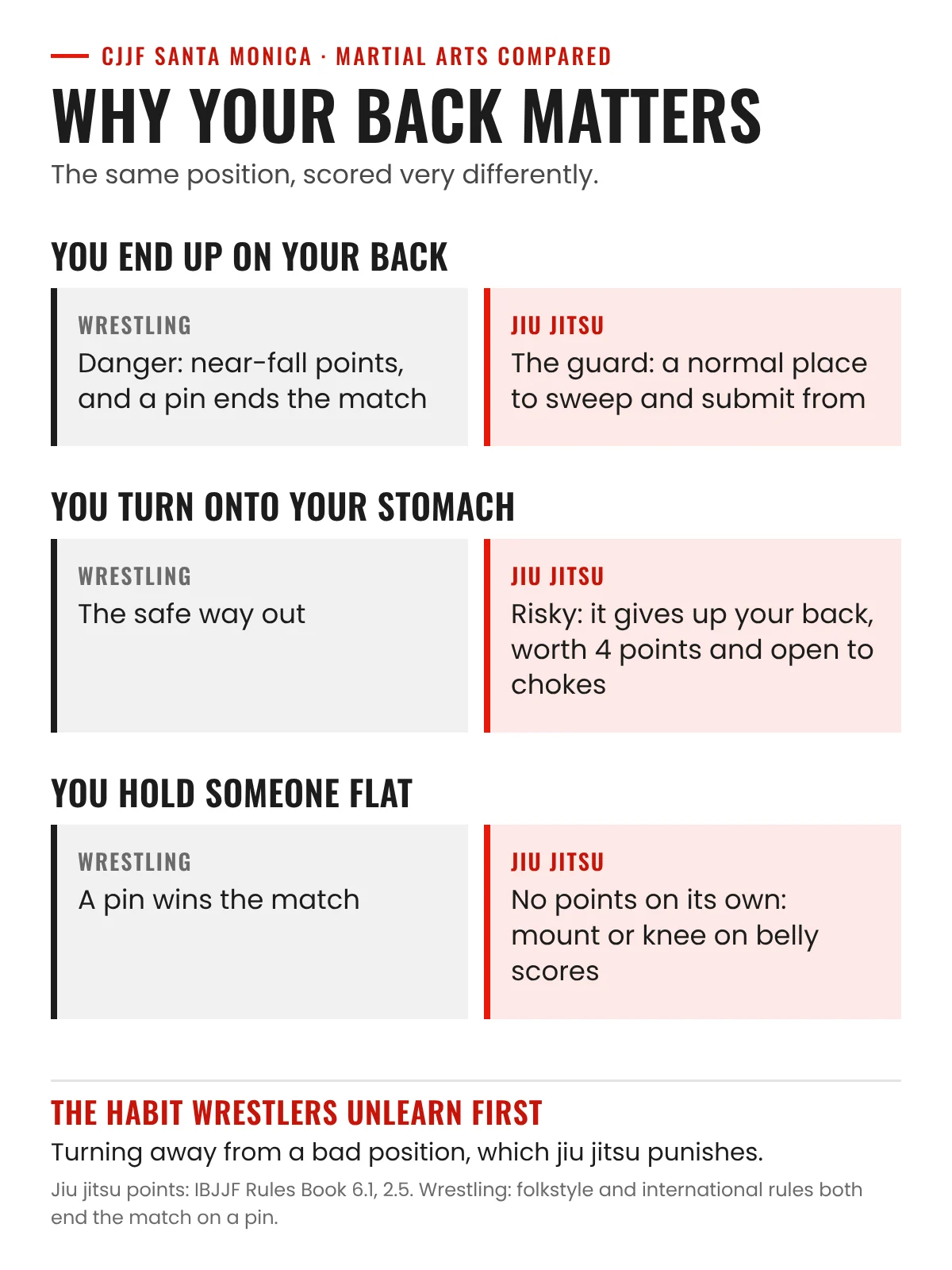
- On your back, a wrestler is in danger. A jiu jitsu player is in the guard, a normal place to attack from.
- Turning onto your stomach is a wrestler’s escape. In jiu jitsu it gives up your back: 4 points and open to chokes.
- Wrestling takedowns score 2 points in jiu jitsu, once you hold top position for 3 seconds.
- Wrestlers adapt fast. What takes time is the guard, the submissions and tapping early.
Jiu jitsu and wrestling side by side
| Topic | Wrestling | Jiu jitsu |
|---|---|---|
| How you win | A pin (both shoulders on the mat) or points | A submission (a joint lock or choke) or points |
| Submissions | Not allowed | The heart of the art |
| Fighting from your back | A losing position: you fight to get off it | The guard: a working position to sweep and submit |
| Turning onto your stomach | The safe way out | Gives up your back, worth 4 points |
| Takedowns | Central, and the main way to score | Scored, but most of the work happens on the ground |
| What you wear | A singlet | A gi, or a rashguard and shorts for no-gi |
| Where you find it | School and college teams; an Olympic sport | Academies and tournaments, for every age |
How each one wins
Wrestling is won by a fall, pinning both of your opponent’s shoulders to the mat, or on points for takedowns, escapes, reversals and near falls. American schools and colleges wrestle folkstyle; internationally and at the Olympics it’s freestyle and Greco-Roman, which bans attacks below the waist. Greco-Roman was part of the first modern Olympics in 1896, freestyle followed in 1904, and women’s freestyle joined in 2004.
Jiu jitsu is won by submission, when your opponent taps, or on points. Under IBJJF rules a takedown, a sweep or knee on belly scores 2, passing the guard scores 3, and mount or back control scores 4. There are no pins: holding someone down only matters if it leads somewhere.
The Olympic dates come from Wikipedia, and the jiu jitsu points from the IBJJF Rules Book, 2.5. Here’s how a BJJ match is won, in full.
The biggest difference: your back
A wrestler learns never to be on their back, because that’s how you get pinned. So when things go wrong, wrestlers turn to their stomach. In jiu jitsu that’s the riskier choice: turning away gives up your back, which scores 4 points and opens the door to chokes.
Jiu jitsu also has the guard, where you fight from your back with your legs between you and your opponent. Many wrestlers find this the strangest part of jiu jitsu, and the most useful new skill once it clicks.
Takedowns and the ground
Wrestling has the best takedowns in grappling, and wrestlers spend most of practice on their feet. A typical jiu jitsu class spends more time on the ground, so many jiu jitsu players cross-train wrestling to improve their takedowns. In the gi, grips on the collar and sleeves change how takedowns work, which makes them feel closer to judo.
Wrestling for jiu jitsu: takedowns that carry over
Every jiu jitsu match starts standing, and under IBJJF rules a takedown scores 2 points once you hold top position for 3 seconds. Double legs, single legs and the rest of a wrestler’s attacks all count.
- Your opponent can pull guard. Jiu jitsu lets them sit to their guard instead of defending, as long as they have a grip. If you start the takedown first, the 2 points are yours.
- Mind your head. A shot with your head low can be met with a guillotine choke, which wrestling never has to worry about.
- Some finishes are illegal. The IBJJF lists slams, scissor takedowns and suplexes that land on the head or neck among its illegal moves.
- In the gi, grips change. Collar and sleeve grips change the setups. No-gi feels closest to wrestling.
Try it on the mat: no-gi classes at CJJF are the closest to a wrestling room.
Wrestlers in jiu jitsu
Wrestlers usually do well in jiu jitsu from the start. Balance, pressure from the top, scrambles and conditioning all carry over. What takes time is the guard, the submissions, staying patient on your back, and tapping early when a submission is locked in. No-gi often feels most familiar, since there are no collar and sleeve grips.
Which should you try?
- Choose wrestling if you’re in school with a team, love hard conditioning and want to compete for your school.
- Choose jiu jitsu if you want something you can train at any age, with a pace you control and self-defense that works from the bottom as well as the top.
- Do both if you can. Wrestling and jiu jitsu fill each other’s gaps, and many grapplers train both.
Teens train with us too. See teen jiu jitsu, or try no-gi on Fridays from 7 to 8 pm, open to all levels.
No-gi classesBook a free class
Jiu jitsu vs wrestling questions
Is wrestling or jiu jitsu better for self-defense?
Both help. Wrestling keeps you on your feet and on top; jiu jitsu also teaches what to do if you end up on your back. Many people train both.
Do wrestlers do well in jiu jitsu?
Usually, yes. Balance, pressure and conditioning carry over. Wrestlers mainly need to learn the guard, submissions and not to turn their back.
Can I train jiu jitsu during wrestling season?
Many wrestlers do, often more in the offseason. Talk to your wrestling coach about your schedule first.
Is no-gi closer to wrestling?
Yes. Without the gi there are no collar and sleeve grips, so scrambles and takedowns feel more like wrestling.
Can a jiu jitsu fighter beat a wrestler?
It depends on the rules. Under wrestling rules, the wrestler usually wins, since takedowns and pins are what wrestlers train most. Under jiu jitsu rules, where submissions count and fighting from your back is normal, the jiu jitsu player has the edge. That’s why many grapplers train both.
Is BJJ harder than wrestling?
They’re hard in different ways. Wrestling practice is known for hard conditioning; jiu jitsu has more positions and submissions to learn, at a pace you can control.
Is jiu jitsu or wrestling better for kids?
Both teach balance, effort and grit. School wrestling gives kids a team and a season; jiu jitsu can start younger and runs year-round. At CJJF, kids start at 3.5. Here’s kids jiu jitsu at CJJF.
Is jiu jitsu safer than wrestling?
In one study of tournaments, BJJ competitors had a substantially lower injury risk than wrestling, judo, taekwondo and MMA competitors. Injuries still happen, mostly to joints. Here’s how safe jiu jitsu is.
Sources: IBJJF, Rules Book 6.1 (June 2024): 2.5 points; 4.1.1 a takedown scores once top position is held for 3 seconds; 4.1.10 a takedown started before the opponent pulls guard scores; 6.2.2 pulling guard without a grip is a serious foul; the illegal moves table (slams, scissor takedowns, suplexes landing on the head or neck). Wikipedia, Wrestling at the Summer Olympics: Greco-Roman since 1896, freestyle since 1904, women’s freestyle since 2004. Scoggin and others, Assessment of Injuries During Brazilian Jiu-Jitsu Competition, Orthopaedic Journal of Sports Medicine, 2014: substantially lower injury risk than judo, taekwondo, wrestling and MMA.