
- Same art: both names go back to the Gracie family and the judo Mitsuyo Maeda brought to Brazil in 1914.
- “Brazilian jiu jitsu” names the whole art and the sport; “Gracie jiu jitsu” usually signals a self-defense-first curriculum.
- The Gracie name’s American story began in Los Angeles: a Hermosa Beach garage in 1978, an academy in Torrance in 1989.
- Lineage is the chain of teachers behind a black belt: ask any coach who promoted them.
- Ours: Carlos Gracie → Carlos Gracie Jr. → Master Aldo Caveirinha → Professor Maycon Carvalho.
Shared roots
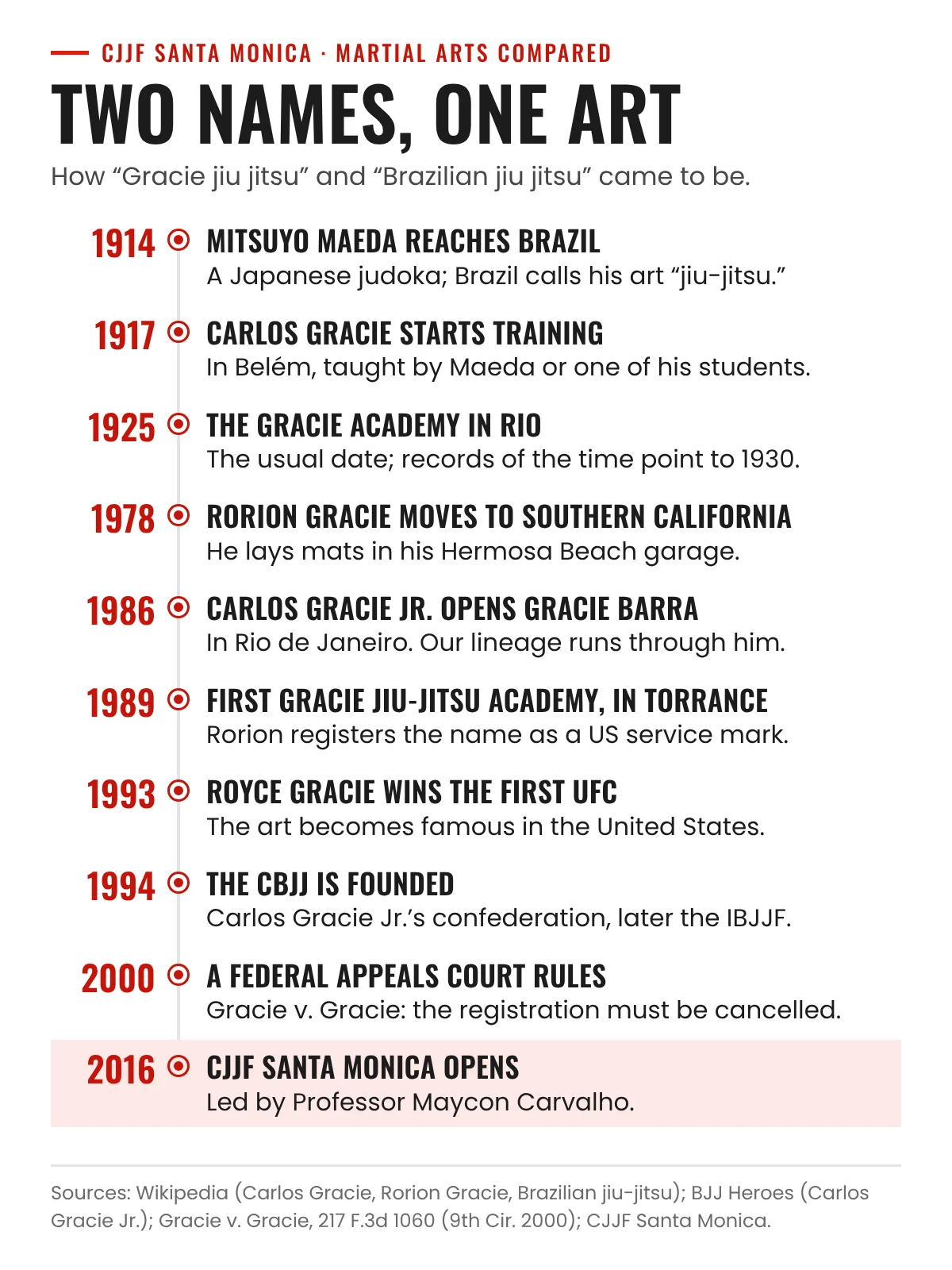
The judoka Mitsuyo Maeda reached Brazil in 1914, and in 1917 Carlos Gracie began training in Belém, taught by Maeda or one of his students; historians still debate which. After the family moved to Rio de Janeiro, Carlos trained under Donato Pires dos Reis, a Maeda student, and he and his brothers, especially Hélio, refined what they learned into a system built on leverage and timing, so a smaller person could control a bigger one. The family’s academy in Rio is usually dated to 1925, though records of the time point to 1930 (Wikipedia on Carlos Gracie).
The full story, from judo in Japan to the first UFC, is in our guide’s section on the history of Brazilian jiu jitsu.
How the two names came about
For decades the art was simply jiu jitsu, and the family’s version became known as Gracie jiu jitsu. As it spread through Brazil and then the world, it became known as Brazilian jiu jitsu, or BJJ. In 1993 Royce Gracie won the first UFC, which made the art famous in the United States, and in 1994 Carlos Gracie Jr. founded the Brazilian confederation, the CBJJ, which later grew into the International Brazilian Jiu-Jitsu Federation (IBJJF), the body that runs the World Championships (BJJ Heroes).
The Los Angeles chapter
The Gracie name’s American story starts close to home. Rorion Gracie, Hélio’s oldest son, moved to Southern California in 1978, laid mats in his Hermosa Beach garage and invited people he met to try the art. In 1989 he and his brothers Royce, Rickson and Royler opened the first Gracie Jiu-Jitsu Academy in Torrance, and in 1993 he helped create the UFC, where Royce won the first tournament (Wikipedia on Rorion Gracie).
The trademark case
In 1989 Rorion also obtained a federal registration for “Gracie Jiu-Jitsu” as a service mark. Another family member, Carley Gracie, challenged it in court in 1994; a jury found it wasn’t a valid service mark, and in 2000 a federal appeals court ruled that the registration had to be cancelled (Gracie v. Gracie).
Some state athletic rules treat the two names as one art: Ohio’s rules for mixed martial arts define Brazilian jiu-jitsu as “also known as Gracie Jiu-Jitsu” (Ohio Administrative Code).
What each name usually means today
- Brazilian jiu jitsu usually means the art as a whole: self-defense, the sport with its points and tournaments, and no-gi.
- Gracie jiu jitsu is often used by academies that put the family’s self-defense curriculum first, including defending against strikes and standing attacks.
The line isn’t sharp. Most good academies teach technique, live training and self-defense, whatever name is on the door.
| Topic | Brazilian jiu jitsu | Gracie jiu jitsu |
|---|---|---|
| What it covers | The whole art: self-defense, sport and no-gi | Usually a self-defense-first curriculum |
| Who uses the name | Most academies, and federations like the IBJJF | Academies built around that curriculum, such as Gracie University’s certified centers |
| How beginners start | Fundamentals classes, then live rounds | A set sequence of techniques, ordered by simplicity and usefulness in a fight |
| Defending strikes | Often taught in self-defense lessons | Part of the core curriculum |
Even the Gracie side uses both names: Gracie University, whose curriculum Ryron and Rener Gracie organized, calls the art “Gracie or Brazilian Jiu-Jitsu (BJJ)” (Gracie University).
Is one better?
Neither name tells you how good a school is. If self-defense is your main goal, look for a school that practices it against a resisting partner, including defending strikes and getting back to your feet. If you want to compete, look for live rounds and a competition class. Most people want some of both.
Is Gracie jiu jitsu outdated? Its basics aren’t. Rorion Gracie’s 1991 video series covered closing the distance, escaping the mount, passing the guard, escaping headlocks and finishing holds, and those are still among the first things beginners learn. The sport keeps adding new techniques on top of them. Here’s why we teach self-defense through jiu jitsu, and what jiu jitsu doesn’t cover.
What BJJ lineage means
Lineage is the chain of teachers behind a black belt: who promoted your coach, who promoted their coach, and so on back to the founders. Most lines run back to Carlos Gracie and his brothers; another early line ran from Luiz França to Oswaldo Fadda.
It’s a useful check, not a guarantee. A real black belt can tell you who gave them each belt, while a famous name at the top of the chain says nothing about how well someone teaches, so watch a class too. Here’s how belt promotions work.
Our lineage
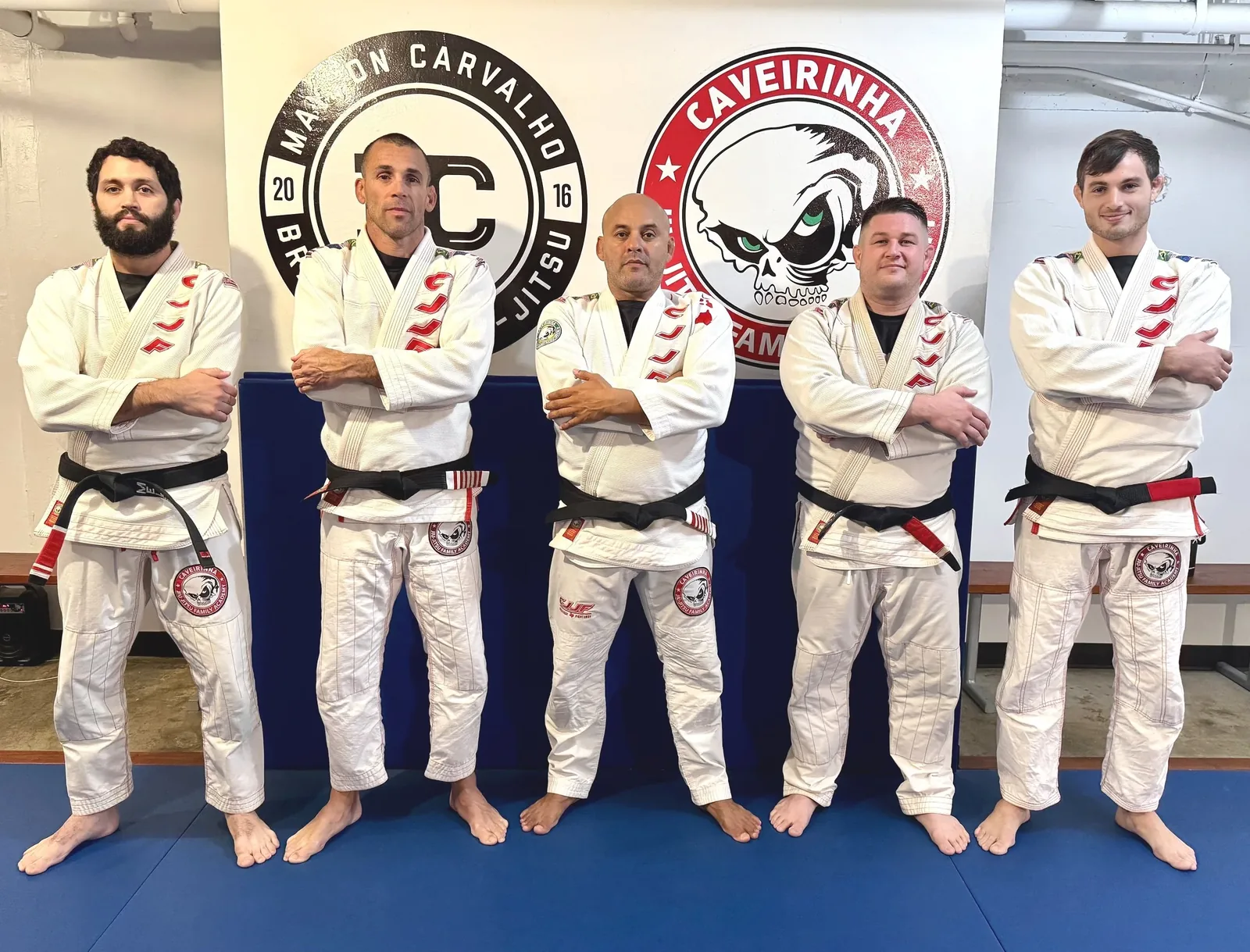
At CJJF Santa Monica the line runs Carlos Gracie → Carlos Gracie Jr. → Master Aldo Caveirinha → Professor Maycon Carvalho. Professor Maycon received his black belt from Master Aldo Caveirinha and his first degree from Master Carlos Gracie Jr. Read more about Professor Maycon and our academy.
Carlos Gracie Jr. is Carlos Gracie’s son; he co-founded the Gracie Barra team in 1986 and founded the CBJJ in 1994. Master Aldo, his black belt, founded Caveirinha Jiu Jitsu Family in Belo Horizonte, and Professor Maycon spent two years training with Carlos Gracie Jr. in Rio as a brown belt. He’s a 5th-degree black belt and the 2009 IBJJF Master 1 No-Gi World Champion, and he opened CJJF Santa Monica in January 2016. What we teach is Brazilian jiu jitsu, with the self-defense the Gracie family built it on.
What matters when you choose
The name matters less than what happens in class: qualified coaches, a real beginner program, self-defense you practice against resistance, and a room where you feel welcome. Our checklist for choosing a BJJ gym covers the rest.
Three questions to ask any school, whatever the name on the door:
- Do you practice self-defense against a partner who resists?
- Is there a beginner class, and when do beginners start live rounds?
- Who promoted the head coach to black belt?
About the academyBook a free class
Gracie jiu jitsu vs BJJ questions
Is Gracie jiu jitsu the same as BJJ?
They share the same roots. Today the names often signal a different emphasis: Gracie jiu jitsu on the self-defense curriculum, BJJ on the art as a whole, including sport.
Who founded Brazilian jiu jitsu?
It grew out of the Gracie family’s work, above all Carlos and Hélio Gracie, building on the judo Mitsuyo Maeda brought to Brazil in 1914. Carlos learned from Maeda or one of his students.
Is BJJ only a sport?
No. It’s a martial art people train for self-defense and fitness as well as competition.
Does CJJF teach Gracie jiu jitsu?
We teach Brazilian jiu jitsu in a lineage that runs from Carlos Gracie through Carlos Gracie Jr. and Master Aldo Caveirinha, with self-defense built into the fundamentals.
Is Gracie jiu jitsu better than BJJ?
Neither is better across the board. The name on the door tells you less than a class does: look for self-defense practiced against resistance if that’s your goal, and live rounds if you want to compete.
Is Gracie jiu jitsu outdated?
No. Its basics, like escaping the mount or a headlock, are still among the first things beginners learn, and the sport keeps adding new techniques on top of them.
What is lineage in BJJ?
The chain of teachers behind a black belt: who promoted your coach, who promoted theirs, and so on back to the founders. Ask any coach who gave them their black belt.
Why is it called Brazilian jiu jitsu?
Because it was developed in Brazil, from the judo Mitsuyo Maeda brought there in 1914, which Brazilians called jiu-jitsu. As the Gracie family’s art spread beyond Brazil, “Brazilian jiu jitsu” became its common name.
Sources: Wikipedia, Carlos Gracie: training under Maeda and his assistant Jacyntho Ferro in Belém, then Donato Pires dos Reis in Rio; the 1925 date and records of the time pointing to 1930. Wikipedia, Rorion Gracie: Southern California in 1978, the Hermosa Beach garage, the Torrance academy in 1989, the UFC in 1993, the 1991 video series. BJJ Heroes, Carlos Gracie Junior: Gracie Barra in 1986; the CBJJ in 1994, which later became the IBJJF. US Court of Appeals for the Ninth Circuit, Gracie v. Gracie, 217 F.3d 1060 (2000): the 1989 federal registration, the 1994 challenge, the jury’s finding and the ruling on cancellation. Ohio, Administrative Code 3773-7-01, effective March 1, 2026: Brazilian jiu-jitsu “also known as Gracie Jiu-Jitsu”. Gracie University, Training Programs: “Gracie or Brazilian Jiu-Jitsu (BJJ)”; a curriculum ordered by simplicity and usefulness in combat.