
- Gi and no-gi are the same art: the positions, escapes and most submissions are shared.
- In the gi you can grip the jacket and pants; in no-gi, grabbing clothing is a foul.
- No-gi is faster and more scramble-heavy; the gi is slower and rewards patience and grip control.
- Neither is harder overall: each has its own challenges.
- At CJJF you can try both: gi classes all week, no-gi on Fridays at 7 pm.
What is no-gi BJJ?
No-gi BJJ is Brazilian jiu jitsu trained without the gi, the jacket-and-pants uniform. Instead of a jacket and belt, you wear a rash guard (a tight athletic shirt) and shorts, or spats under shorts. Without collars and sleeves to hold, you control your partner with underhooks, overhooks, body locks and head control.
In IBJJF no-gi tournaments, the shirt has to be skin-tight and cover the torso down to the shorts, in black, white, or black and white with at least 10% of your belt color. Shorts can’t have open pockets, zippers or anything that could hurt your partner. Grabbing your own uniform or your opponent’s is a foul.
In a gi tournament, the jacket can be white, royal blue or black, and it has to fit the IBJJF’s measurements; our gi size chart covers the IBJJF gi rules.
Gi vs no-gi: the main differences
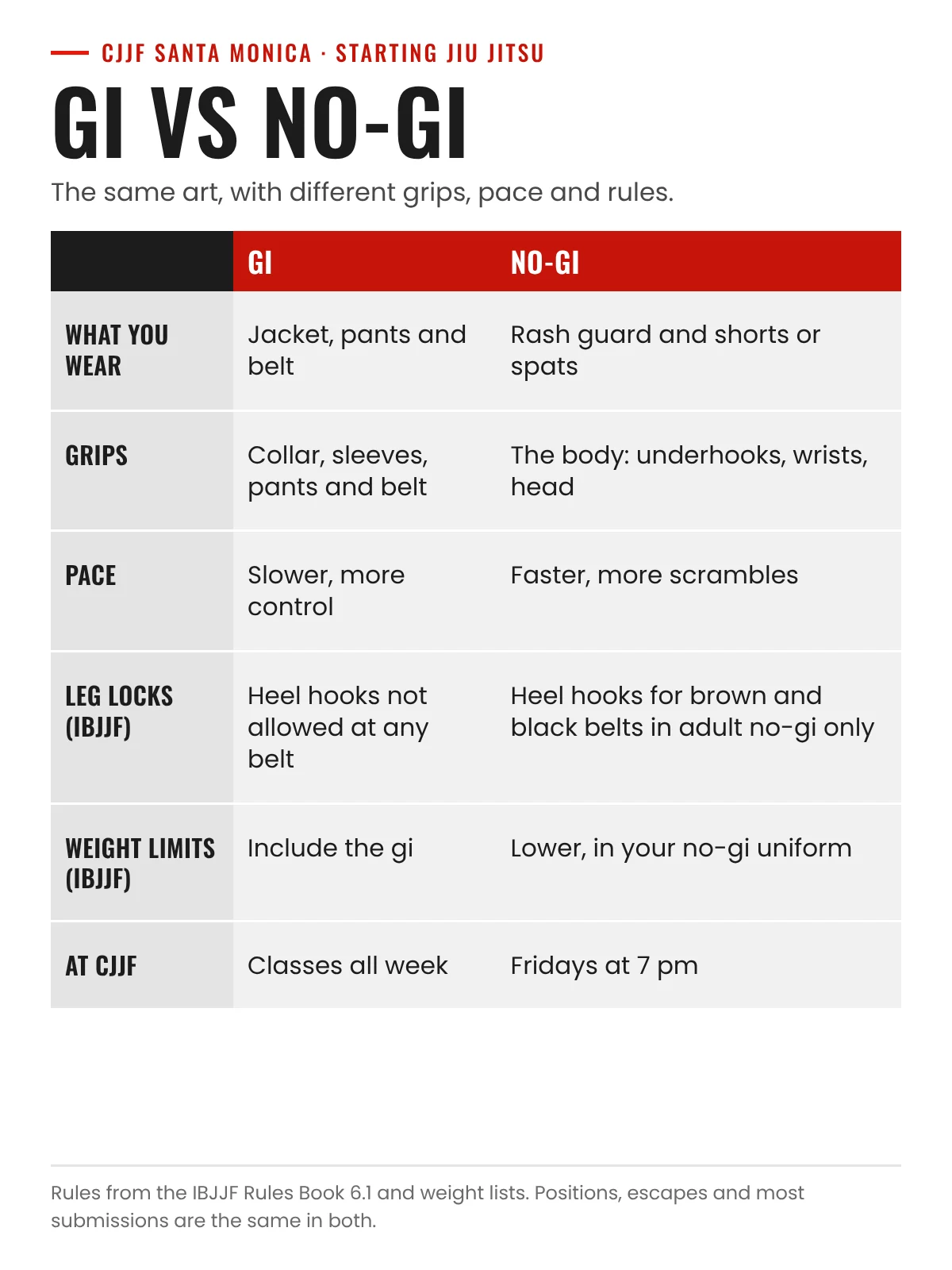
| Topic | Gi | No-gi |
|---|---|---|
| What you wear | Jacket, pants and belt | Rash guard and shorts or spats |
| Grips | Collar, sleeves, pants and belt | The body: underhooks, wrists, head |
| Pace | Slower, more control | Faster, more scrambles |
| Leg locks (IBJJF) | Heel hooks not allowed at any belt | Heel hooks for brown and black belts in adult no-gi only |
| Weight limits (IBJJF) | Include the gi | Lower, in your no-gi uniform |
| At CJJF | Classes all week | Fridays at 7 pm |
The biggest difference is grips. In the gi, a good collar or sleeve grip slows everything down and opens up chokes that use the jacket, like collar chokes. Without the gi, sweat makes holds slip, so positions are harder to keep and matches move faster.
The rules differ at higher belts too. At IBJJF events, heel hooks and knee reaping are allowed only for brown and black belts in adult no-gi. White, blue and purple belts follow the same submission rules in both. Our glossary shows the submissions allowed at each belt.
Gi or no-gi for beginners?
Start with whichever class you’ll keep coming to. The positions, escapes and basic submissions you learn in your first months are the same in both, so time in either one counts.
Some reasons to start in the gi:
- The slower pace gives you time to think, and grips help you hold positions while you learn them.
- At CJJF, most classes are in the gi.
- Collar and sleeve grips teach you to handle someone wearing a jacket.
Some reasons to start in no-gi:
- You come from wrestling or MMA, or you want to.
- You prefer a faster pace and athletic scrambles.
- You’d rather start in a rash guard and shorts.
New to grappling? At CJJF, start in a Fundamentals class on a weekday evening, then add Friday no-gi when you’re ready. You don’t need to buy a gi first: we lend one for your first class, and a T-shirt works too. Here’s what to wear to jiu jitsu for your first class.
Is gi or no-gi harder?
Neither is harder overall: each is hard in its own way.
- The gi is harder to escape: grips let your partner hold you down and control your arms, and the jacket adds chokes, like collar chokes.
- No-gi is harder to hold: without grips, positions slip, and the pace is faster, so it can feel more tiring at first.
Our coaches train and compete in both: the gi sharpens defense and grip fighting, and no-gi sharpens scrambles and body control.
Gi or no-gi for self-defense?
Both help, because both teach you to control someone, escape bad positions and get back to your feet. People argue about which is more realistic:
- For the gi: people wear clothes on the street, and gi training teaches you to use a jacket or a sleeve, and to deal with someone grabbing yours.
- For no-gi: it teaches control without anything to hold, and the faster pace is closer to a real scramble.
The skills that matter most for self-defense, like staying calm under pressure, escaping when someone is on top of you and getting up safely, are taught in both. Our guide to the best martial art for self-defense goes deeper, and CJJF builds self-defense into its Fundamentals classes.
Gi or no-gi at CJJF
You can train both. Gi classes run all week, from Fundamentals for beginners to All Levels and Advanced, and no-gi jiu jitsu runs on Fridays at 7 pm, for all levels. Professor Maycon Carvalho, our head instructor, is an IBJJF Master 1 No-Gi World Champion (2009, black belt), and his no-gi class teaches leg locks with clear tapping rules and a controlled pace.
Your first class is free, in either.
No-gi classesBook a free class
Gi vs no-gi questions
Is gi or no-gi better for MMA?
No-gi is closer to MMA, where fighters wear shorts and gloves instead of a jacket, so its grips and pace carry over more directly. The gi still builds the positions and escapes MMA fighters use on the ground.
Is an open mat gi or no-gi?
It depends on the gym, and some open mats are both. Ask before you go, or pack a gi and a rash guard. Here’s more on what a BJJ open mat is.
Can I train no-gi as a beginner?
Yes. At CJJF the Friday no-gi class is for all levels. If you’re new to grappling, Fundamentals during the week is still the easiest place to learn the basics.
Do I need a gi to start BJJ?
No. At CJJF we lend you a gi for your first class, and a T-shirt and athletic shorts work too. If you keep training, our BJJ gi size chart helps you pick one.
What do you wear for no-gi?
A rash guard and shorts, or spats under shorts, with no pockets or zippers. For IBJJF no-gi tournaments, the rash guard has to be black, white, or black and white with some of your belt color.
Are the weight classes different in gi and no-gi?
Yes. At IBJJF events the no-gi limits are lower, and you weigh in wearing your no-gi uniform instead of a gi. For example, a man’s middleweight limit is 181.6 lb in the gi and 175.6 lb in no-gi. Our article on IBJJF weight classes has every division.
Sources: IBJJF, Rules Book 6.1 (June 2024): 8.1.3 (gi colors), 8.1.16 (no-gi uniform), the no-gi foul for grabbing the uniform, and the Technical Fouls and Illegal Moves chart (heel hooks and knee reaping only for brown and black belts in adult no-gi). IBJJF, Weight List: Jiu-Jitsu (gi), in pounds and Jiu-Jitsu No Gi, in pounds: adult and masters limits.