
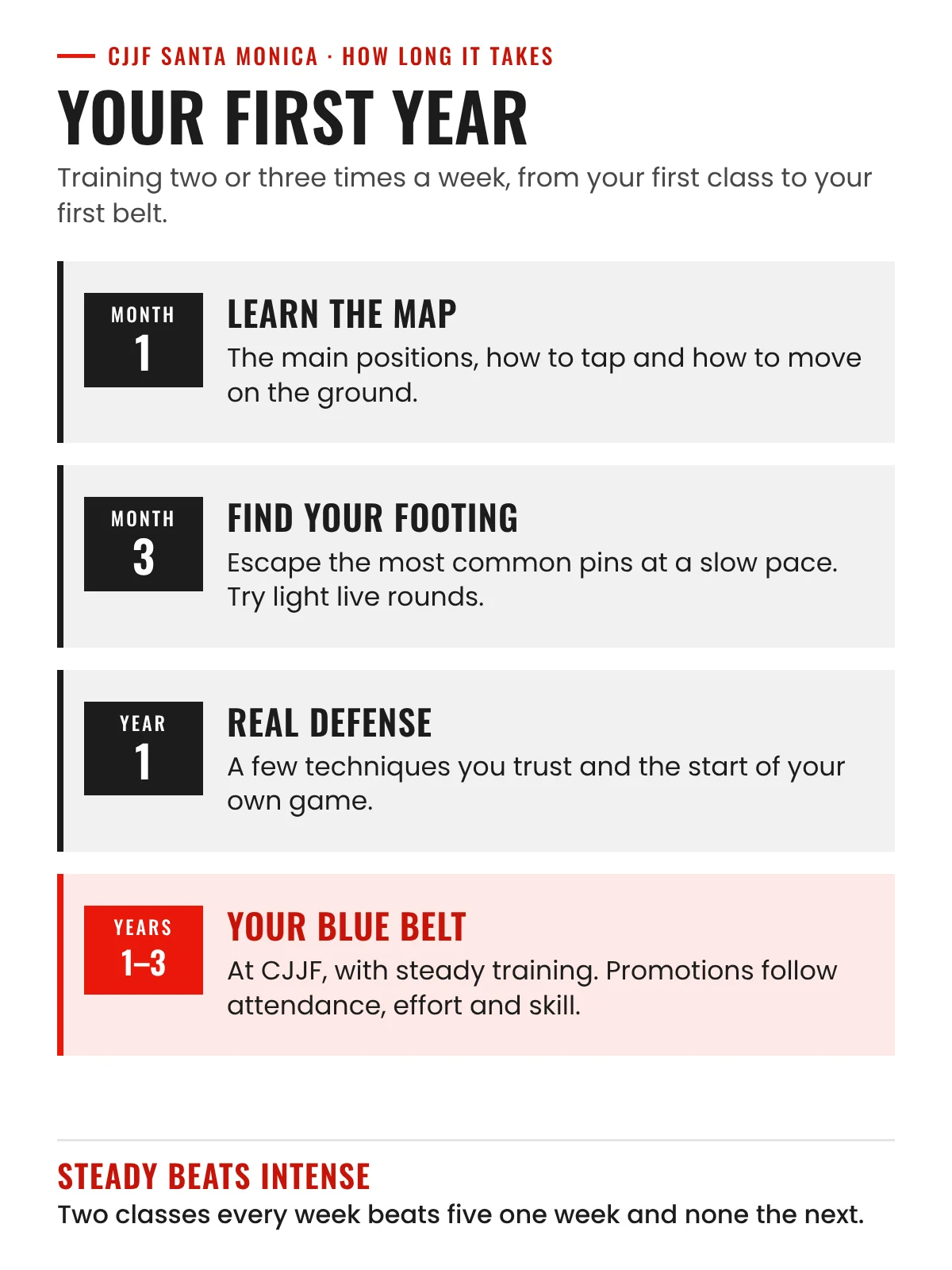
- Month one: the main positions, how to tap and how to move on the ground.
- Three months: common escapes at a slow pace and your first light live rounds.
- Your first year: real defense and a few techniques you trust.
- A blue belt usually takes one to three years at CJJF. The IBJJF sets 16 as the minimum age.
- Spread your training out and sleep well: both help a movement skill stick, in the studies below.
Your first month
Your first weeks are about learning the map: the main positions (guard, mount, side control and the back), how to tap, and how to move on the ground. Everything feels new, and that’s normal. Most beginners leave each class with one thing they can repeat.
For the first day itself, here’s what to wear and expect in your first class.
Three months
With two or three classes a week, by about three months most people:
- Know the main positions and what to do in each.
- Can escape the most common pins at a slow pace.
- Have tried light live rounds.
- Feel at home in class and know the routine.
Your first year
After a year of steady training you’ll have real defense, a few techniques you trust and the start of your own game. You’ll still get caught by more experienced partners. Everyone does, at every belt.
How long does it take to get a blue belt?
There’s no fixed date. At CJJF, a blue belt usually takes one to three years of steady training, and promotions depend on attendance, effort and skill, not the calendar.
The IBJJF, whose rules most academies follow, sets 16 as the minimum age for a blue belt. Its minimum times start at blue: at least two years there before purple (IBJJF graduation system, via Wikipedia).
From blue to black, here’s how long each BJJ belt takes.
How often should you train BJJ?
Two classes a week is a good start, and three once your body is used to it. What matters most is that the weeks don’t have gaps: steady practice is how the movements stick.
Learning research backs the steady approach. A review of 11 randomized trials found that trainees who spread their practice over several sessions kept their skills better than those who crammed it into one (Cecilio-Fernandes and colleagues, 2018). The trainees were learning surgery, not jiu jitsu, but both are complex movement skills.
In hours, two one-hour classes a week add up to about 100 hours on the mat in a year, and three to about 150.
Sleep matters too. In a 2002 study, people who practiced a typing sequence in the evening were about 20% faster after a night’s sleep; people retested after 12 hours awake improved by about 2% (Walker and colleagues, 2002). Rest days aren’t lost days.
A 90-day plan for adult beginners
- Weeks 1–2: two Fundamentals classes a week. Learn the positions, how to tap, and how to fall and move safely.
- Weeks 3–6: keep two classes a week. Focus on escapes from mount and side control, and start light positional rounds.
- Weeks 7–12: add a third class if you’re recovering well. Try light live rounds and link two techniques together.
Pick fixed days and put them in your calendar like a meeting. Fundamentals runs Monday and Wednesday at 6 pm, Tuesday and Thursday at 7 pm, and Friday at 6 pm.
Starting after 40? Take it a little slower: here’s your first 12 weeks after 40.
Is jiu jitsu hard to learn?
At first, yes. The positions and the words are new, and everyone taps you. That’s normal, and it passes.
What makes it learnable is how a class is built: one or two techniques shown slowly, drilled with a cooperative partner, then positional practice at a pace you choose before any live rounds. If progress ever feels slow, here’s how to keep going when it gets hard.
What changes your timeline
- How often you train. Steady weeks add up; long gaps set you back.
- Past grappling. Wrestlers and judoka start ahead. The IBJJF doesn’t let judo black belts or people who wrestled at college level enter tournaments as white belts (IBJJF Rules Book 6.1, rule 5.5).
- Your goal. Some people train to compete, others for fitness or self-defense. Every goal works; at CJJF, competing is always optional.
- Injuries. Time off pauses everything, which is why tapping early and choosing calm partners matter.
What helps you learn faster
- Consistency. Two classes every week beats five one week and none the next.
- Questions. Ask the coach to show you again. That’s what they’re there for.
- Notes. Write down one thing you learned after each class.
- Rest. Sleep and rest days are when your body adapts.
- Patience with yourself. Getting tapped is how everyone learns.
Adult BJJ classesBook a free class
Questions about learning jiu jitsu
Can you learn jiu jitsu in 3 months?
You can learn the basics: the main positions, escapes and a few techniques. Getting good takes longer, and keeps going for years.
How often should a beginner train?
Two classes a week to start, and three once your body is used to it.
How long does it take to get a blue belt?
Usually one to three years of steady training. It depends on attendance, effort and skill.
How long does it take to get good at BJJ?
Holding your own in class usually comes within the first year of steady training. Against experienced partners it takes years, and it keeps growing at every belt.
How long does it take to get a purple belt?
Under IBJJF rules you spend at least two years at blue belt first. That’s a minimum, not a schedule. Here’s the full belt timeline.
Is training once a week enough?
You’ll still progress, just more slowly, and it’s harder to remember last week’s technique. Two classes a week is a better start if your schedule allows.
How long does it take to learn jiu jitsu for self-defense?
Useful basics, like breaking grips and getting back up, come in your first few months; staying calm under pressure takes longer. More in how long it takes to learn self-defense.
How long is a jiu jitsu class?
At CJJF, 60 minutes: a warm-up, technique, drilling and positional practice, with optional live rounds once you’re ready. Arrive 10 minutes early.
Is it too late to start as an adult?
No. Many people start in their 30s, 40s and 50s. See starting jiu jitsu after 40.
Sources: IBJJF graduation system (minimum ages and times at each belt), via Wikipedia, Brazilian jiu-jitsu ranking system. IBJJF, Rules Book 6.1 (June 2024), rule 5.5. Cecilio-Fernandes D, Cnossen F, Jaarsma DADC, Tio RA, Avoiding Surgical Skill Decay: A Systematic Review on the Spacing of Training Sessions, Journal of Surgical Education, 2018. Walker MP, Brakefield T, Morgan A, Hobson JA, Stickgold R, Practice with sleep makes perfect: sleep-dependent motor skill learning, Neuron, 2002.