

- Visit during a beginner class and watch before you sign anything.
- Look for a black belt head coach who can tell you who promoted them.
- Most US gyms charge $120 to $200 a month for unlimited classes; big cities like Los Angeles, $200 to $250.
- In California, a gym contract has to give you five business days to cancel.
- The best gym is the one you’ll keep going to: close by, at times you can make.
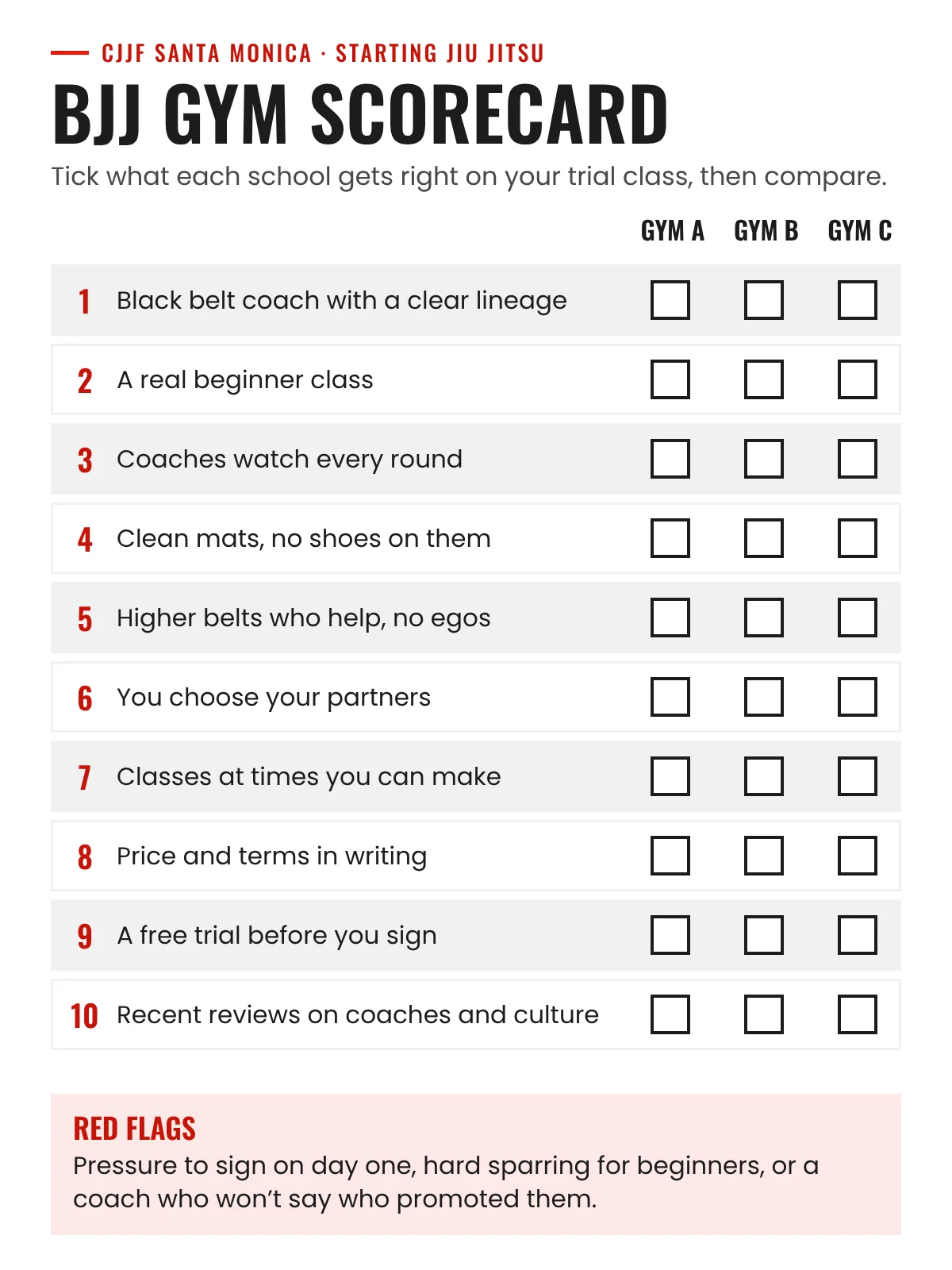
10 checks for choosing a BJJ gym
- Coaches and lineage. Who teaches the classes, what belt they hold and who promoted them. A black belt instructor with a lineage you can trace is a good sign.
- A real beginner program. A Fundamentals class with a curriculum, not just rolling.
- Safety. Coaches watch the rounds, beginners aren’t thrown into hard sparring, and taps are always respected.
- Clean mats. Cleaned daily, no shoes on the mat, clean changing areas.
- Culture. Higher belts who help, no ego, respect for everyone on the mat.
- Partner choice. You can choose partners and ask for someone your size.
- A schedule you can keep. Classes at times you can make every week.
- Clear prices. The monthly price and any contract terms, in writing.
- A free trial. You should be able to try a class before you sign anything.
- Honest reviews. Recent reviews that talk about the coaches and the culture. Read a range, not just the star rating.
New to all of it? Here’s what a BJJ class looks like, so you know what you’re judging. For check 1, here’s what BJJ lineage means, and for check 3, how a good academy keeps you safe.
What BJJ costs
Prices vary by city and gym, but there are ranges. A 2026 pricing guide for academy owners from the gym software company Gymdesk puts most unlimited memberships at $120 to $200 a month, $90 to $120 in rural areas, and $200 to $250 in major metros such as Los Angeles, New York and San Francisco. Drop-in classes run about $25 to $35 in big cities (Gymdesk).
When you compare, ask what the price includes: every class or only beginner classes, open mats, no-gi, and kids’ classes if you’re a family. Count the extras too: a sign-up fee at some gyms, your own gi after the first class or two (how to find your gi size), and tournament fees if you compete.
Contracts: your right to cancel in California
Many gyms sell month-to-month memberships; others offer 6- or 12-month contracts, often at a better monthly rate. If you sign a contract in California, the state’s law on gym contracts, which covers training in a physical skill, gives you these protections (California Civil Code 1812.85):
- Five business days to change your mind. You can cancel until midnight of the fifth business day after you sign, not counting Sundays and holidays, by mail, by email from the address the gym has on file, or in person. The contract has to say so next to your signature.
- Your money back within 10 days, minus any classes you’ve already used.
- Three years at most. A gym contract can’t run longer than three years, and its minimum term has to be printed above your signature (Civil Code 1812.84).
- Longer windows for big contracts. Contracts of $1,500 or more give you 20 to 45 days to cancel.
Before you sign anything, ask about the freeze policy for injuries and travel, and how much notice you need to give to cancel.
This is general information about California’s rules for gym contracts, not legal advice. For a question about your own contract, ask a lawyer licensed in California.
On your trial class
Arrive a little early and watch. Notice how coaches treat beginners, how students treat each other, and whether rounds look controlled. Ask your questions after class, when the coach has time.

Three things worth watching closely:
- Does a coach show beginners the technique up close and correct them?
- In live rounds, are partners matched by size and experience?
- Does anyone, coach or student, talk to you after class?
Not sure what to wear? Here’s what to wear to your first jiu jitsu class.
Red flags
- Pressure to sign a long contract on your first day.
- No beginner class, or hard sparring for newcomers.
- Dirty mats or shoes on the mat.
- Coaches who won’t say who promoted them.
- Belts that seem to come with a fee rather than skill.
- Injuries brushed off, or rounds that get out of hand while nobody steps in.
Questions to ask
- Who teaches the beginner classes?
- When do beginners start live rounds?
- What does a month cost, and is there a contract?
- Can I pause my membership if I travel or get hurt?
- Do you have classes for my schedule, and for my kids?
- Who promoted the head coach to black belt?
- For kids’ classes: have the coaches had a background check and SafeSport training?
That last question isn’t fussy. Before the IBJJF registers an academy, it requires a registered black belt as head instructor, and a background check within the past 12 months and SafeSport training within the past 24 months for the head and assistant instructors (IBJJF academy registration).
Try us against the list
Choosing in Santa Monica? Our head coach, Professor Maycon Carvalho, is a black belt under Master Aldo Caveirinha. Fundamentals runs five evenings a week, we clean the mats daily, you choose your partners in every class, and your first class is free. See membership and prices.
Our line runs from Carlos Gracie through Carlos Gracie Jr. (our Gracie lineage), adult classes run Monday to Saturday (class schedule), and we lend you a gi for your first class.
Booked a Friday evening trial class. The whole experience was smooth and welcoming – you only need to bring a water bottle. The class was taught by 2 black belt professors, who were present to provide feedback on technique.
Kelly C., Google review
About the academyBook a free class
Questions about choosing a BJJ gym
What should I look for in a BJJ gym?
Qualified coaches, a real beginner program, safe training, clean mats and a culture where you feel welcome.
How much does a BJJ gym cost?
Prices vary by city and gym: a 2026 industry guide puts most US gyms at $120 to $200 a month for unlimited classes, and big cities at $200 to $250. Ask for the monthly price and any contract terms in writing before you join.
Should I choose the gym closest to home?
Often, yes. The best gym is the one you’ll keep going to, and a short trip makes that easier.
Is it OK to try several gyms?
Yes. Most offer a free trial, so try a few before you decide.
Is $200 a month a lot for BJJ?
Not in a big city. Gymdesk’s 2026 guide puts major metros such as Los Angeles at $200 to $250 a month for unlimited classes. Compare what’s included, not just the number.
Can I cancel a gym contract in California?
Yes, until midnight of the fifth business day after you sign, not counting Sundays and holidays, by mail, email or in person, and the gym has to refund you within 10 days. After that, check the contract’s cancellation terms. General information, not legal advice.
Does a famous name or lineage make a gym better?
Not on its own. Lineage tells you who stands behind a coach; a class tells you how they teach, so watch one before you decide. Here’s what BJJ lineage means.
What should I wear to a trial class?
A T-shirt and athletic pants without zippers, or a rashguard and shorts for no-gi. Some gyms lend you a gi; at CJJF we do. Here’s what to wear to jiu jitsu.
Sources: Gymdesk, BJJ Pricing Models, February 4, 2026: a pricing guide for academy owners: monthly ranges by market, drop-in rates, contracts and family plans. California Civil Code, 1812.85 and 1812.84: the five-business-day right to cancel, refunds within 10 days, the three-year limit and longer windows for contracts of $1,500 or more; 1812.81 defines a contract for health studio services. IBJJF, Academy Registration Guide: a registered black belt head instructor; background checks within 12 months and SafeSport training within 24 months for the head and assistant instructors.