

- The blue belt blues are a slump in motivation after the first belt, not an injury or a diagnosis.
- The next belt is far away: the IBJJF requires at least two years at blue belt before purple.
- Across martial arts gyms, nearly one in five new members quits within 90 days, and members who train more often cancel less.
- No study has measured how many people reach black belt, so treat the numbers you see online with care.
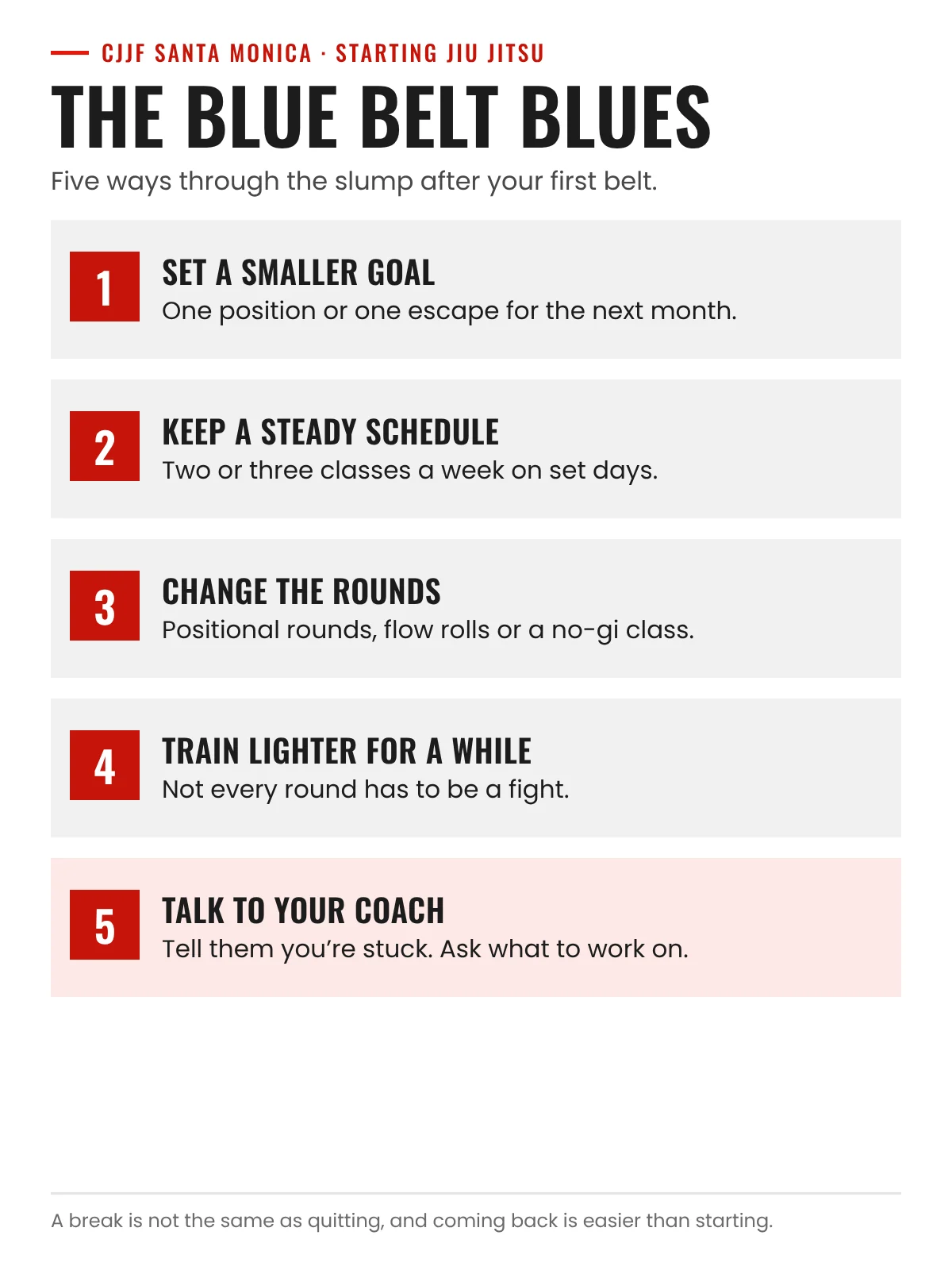
- A break is not the same as quitting, and coming back is easier than starting.
What are the blue belt blues?
The blue belt blues is grapplers’ slang for a slump that often follows the first promotion. It isn’t a medical term or an injury. It’s the stretch when training stops feeling new, the next belt feels a long way off, and you start wondering whether to keep going.
Blue belt is a natural place for it. The first belt rewards showing up: everything is new, and you improve every month. After it, progress is harder to see. The newer white belts you used to handle start catching you, people expect more of a blue belt, and purple is years away. Under the IBJJF’s graduation system, you need at least two years at blue belt before you can be promoted to purple, and you have to be at least 16 to wear it.
Why people quit BJJ
People stop training for many reasons, and they usually overlap. Some of the ones grapplers describe:
- Slower progress. The fast improvement of the first year flattens out.
- Expectations. A blue belt feels like it should win more rounds, and losing to newer students stings.
- Injuries. Time off with an injury breaks the habit, and coming back feels hard.
- Life. New jobs, kids, moves and schedules that no longer fit.
- Burnout. Going hard every round, every class, wears people down.
- Cost and time. Training takes money and evenings, and other priorities compete for both.
- The room. A gym where hard rounds are the norm or nobody notices you’re missing makes leaving easier.
Most of these can be changed. Goals can be smaller, schedules adjusted, rounds made lighter and injuries treated before they become a reason to stop.
How many people quit? What the numbers say
There’s no study of how many people quit BJJ, at blue belt or any other point. The best numbers we found come from gym software data across martial arts schools:
- Nearly one in five new members quits within 90 days, and most cancellations come early (Gymdesk’s 2026 benchmark of 4,594 gyms, mostly martial arts and combat sports).
- Of memberships that ended, the typical one lasted about three months.
- Training more often goes with staying longer: over 24 months, 44.2% of memberships of members who rarely trained were canceled, against 23.2% of members who trained three or more times a week.
These figures cover all martial arts, not just BJJ, and they describe memberships, not students who switched gyms. You’ll also see claims online about what share of beginners reach black belt. We couldn’t find a study that measured it, so we don’t repeat them.
How to stay motivated in BJJ
Seeing progress helps motivation. These help:
- Set a smaller goal. One position or one escape for the next month, not “get better.”
- Keep a steady schedule. Pick two or three classes a week on set days, so training becomes a habit.
- Change the rounds. Positional rounds, flow rolls or a no-gi class make training new again.
- Train lighter for a while. Not every round has to be a fight. Easier rounds let you try things and recover.
- Talk to your coach. Tell them you’re stuck. A coach can see things you can’t, and a private lesson can unlock a part of your game.
Helping newer students helps too: explaining a technique shows you how much you already know. And if you like a target, a first tournament gives your training a date; our guide to your first BJJ tournament explains how to prepare.
Burnout and plateaus
A plateau is when you’re training but not improving. Burnout is when you dread training you used to enjoy. Plateaus often mean it’s time to change what you practice: a new position, a different partner, a question for your coach. Burnout often means it’s time to change how hard you train: lighter rounds, fewer classes, or a short break.
Sleep, recovery and nagging injuries matter here too. If something hurts every class, see a doctor before it becomes the reason you stop. Our article on BJJ injuries and how to avoid them covers the common ones.
Should you quit, or take a break?
If you’ve stopped enjoying training, a break is often a better first step than quitting. A few weeks off can show you whether you miss it. Tell your coach, so the door stays open.
Some good reasons to step away for a while: an injury that needs time, a big change at work or at home, or training that has become a chore. Some signs you’ll want to come back: you still watch matches, you think about positions, and you miss the people.
Coming back to BJJ
Coming back is easier than starting: much of what you learned returns with practice. Start with fundamentals or easy rounds for the first couple of weeks, tell your partners you’re returning, and don’t measure yourself against your old rounds right away.
How CJJF helps students keep going
At CJJF, Fundamentals runs five evenings a week, so missing a class doesn’t mean losing a week, and Live Training adds short live rounds right after class when you want more. Advanced classes (with coach approval) and Competition Training on Saturdays give experienced students a next step, and live rounds are optional. Private lessons, one-on-one, are there when you want help with one part of your game. And if you’ve drifted away, you’re welcome back: talk to a coach about how to restart.
Class scheduleBook a free class
Blue belt blues questions
Is the blue belt blues real?
It’s grapplers’ slang, not a diagnosis, but the slump it describes is common: progress feels slower after the first belt and expectations go up. No study has measured it, so it’s best understood as a pattern people describe, not a rule.
How long does a blue belt take?
Two parts: getting a blue belt, and how long you stay at blue. At CJJF, steady students usually earn a blue belt in one to three years. Under the IBJJF’s rules, you then spend at least two years at blue before purple. Our article on how long it takes to get a blue belt has more.
What percentage of people get a black belt in BJJ?
Nobody knows: we couldn’t find a study that measured it, and the figures you see online come without a method. What we do know: under IBJJF rules the fastest path from blue belt to black is four and a half years, and getting to black belt often takes around ten years of steady training.
Should I quit BJJ?
Only you can decide, but try a break, a lighter schedule or a talk with your coach first. If you still don’t miss it after a few weeks off, it’s fine to move on.
How do I get motivated to train again?
Start smaller than you think: one class a week, one goal, an easy round. Motivation tends to come back once training feels like progress again.
Sources: Gymdesk, Martial Arts and Combat Sports Benchmark, 2026 Edition (June 2026; 4,594 active gyms, mostly martial arts and combat sports): nearly one in five new members quit within 90 days; typical length of ended memberships; cancellations by attendance over 24 months. IBJJF graduation system (minimum ages and times at each belt), via Wikipedia, Brazilian jiu-jitsu ranking system.