

- Jiu jitsu trains strength, cardio and mobility at once, against a partner who pushes back.
- An hour burns roughly 300 to 1,000 calories, depending on your weight and how much of it is live rounds.
- Hard rounds are serious cardio: in one study, a six-minute round ended with advanced grapplers using about 12 to 13 times their resting energy.
- It builds strength and endurance. For bigger muscles or top-end cardio, add lifting or some running.
- Two classes a week go a long way toward the CDC’s weekly activity guidelines.
What jiu jitsu works
- Strength. Grip, core, hips, back and legs all work against a resisting partner, from every angle.
- Cardio. Live rounds come in short, hard bursts with rest between, much like interval training.
- Mobility. Hip escapes, bridges and guard work keep your hips and shoulders moving through their full range.
- Balance and coordination. You learn to stay balanced while someone tries to move you.
New to the sport? Here’s what Brazilian jiu jitsu is and how it works.
How many calories does jiu jitsu burn?
It depends on your weight and how hard the hour is. The 2024 Adult Compendium of Physical Activities, a reference researchers use, rates slower-paced martial arts practice at 5.3 METs (5.3 times your resting energy use) and moderate-pace martial arts, jujitsu included, at 10.3 (Compendium). Multiplied by your weight in kilograms, that gives calories per hour:
| Your weight | Technique and drilling | Live rounds |
|---|---|---|
| 130 lb (59 kg) | About 310 calories | About 610 calories |
| 160 lb (73 kg) | About 380 calories | About 750 calories |
| 190 lb (86 kg) | About 460 calories | About 890 calories |
| 220 lb (100 kg) | About 530 calories | About 1,030 calories |
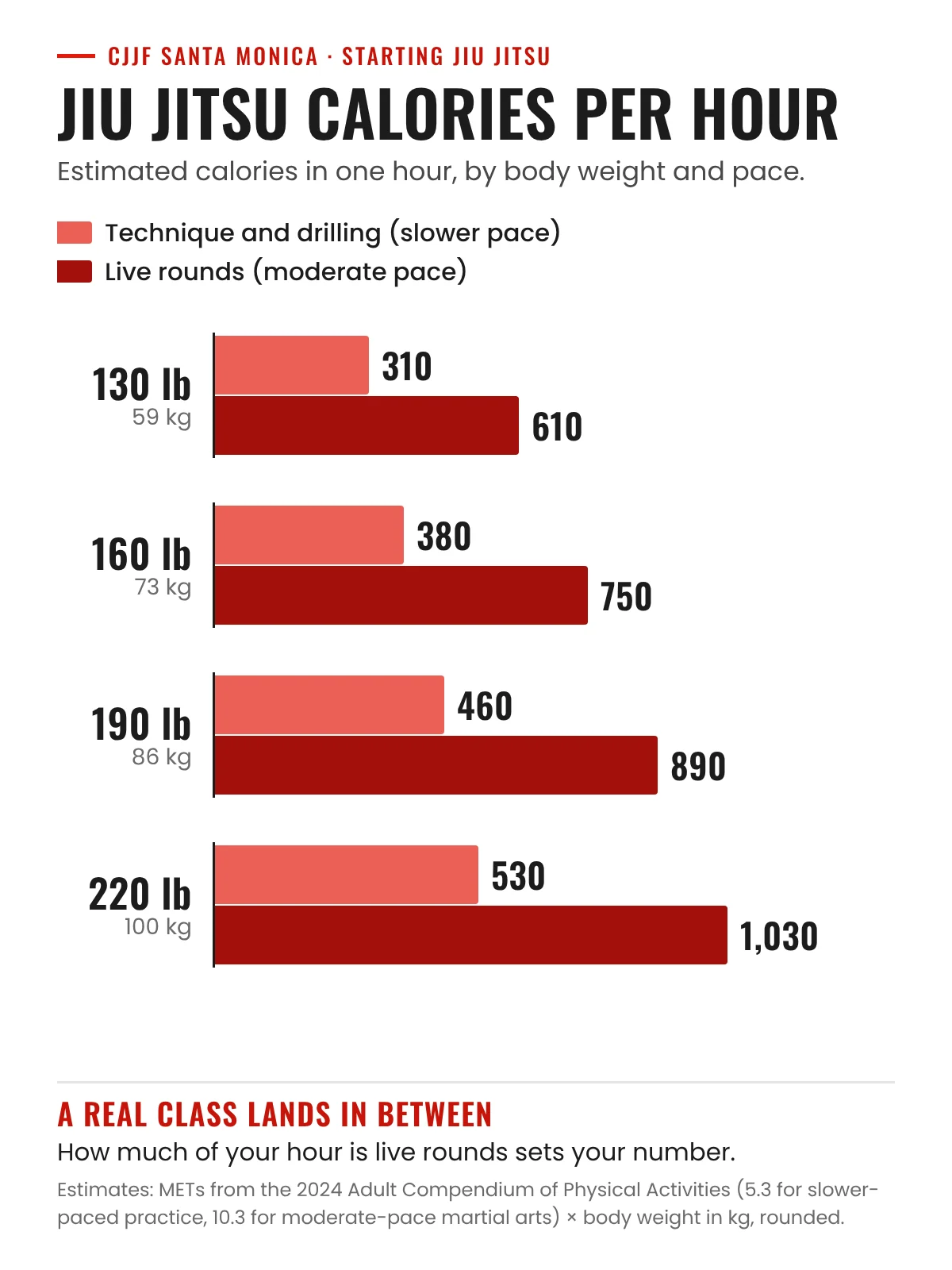
A class mixes both, so most land in between. Hard rounds can run above the table: in a 2021 study of ten advanced grapplers, a six-minute no-gi round ended at an oxygen uptake of about 44 mL per kilogram per minute, roughly 12 to 13 times resting (PLOS ONE). Treat any single number, your watch’s included, as a rough guide.
How a class feels
A class moves through different intensities. The warm-up gets you breathing hard; drilling a technique is steady and controlled; positional practice and live rounds are the hard part. Beginners control their own intensity: you can go lighter, rest, or sit out a round.

Is jiu jitsu good cardio?
Yes, the interval kind. Rounds mix bursts of effort with slower moments, and in the study above the authors estimated that about three quarters of a round’s energy came from aerobic metabolism, the rest from short anaerobic bursts.
Rolling has limits as a cardio plan, though. A 2019 study started from the finding that jiu jitsu athletes have only moderate aerobic fitness despite their hard training; six weeks of added interval training raised theirs by about 8% (Øvretveit, 2019). If cardio is a goal of its own, add a run or a bike ride on a rest day.
Does jiu jitsu build muscle?
It builds strength you can use, especially in your grip, core, hips and back, and the endurance to keep using it. Bigger muscles and maximal strength come faster from lifting: in a 2018 study, grapplers who added heavy strength training to their jiu jitsu improved their strength (Øvretveit and Tøien, 2018).
The CDC recommends muscle-strengthening activity at least two days a week for adults (CDC). Short lifting sessions on two of your non-class days cover it.
Jiu jitsu or the gym?
A gym workout lets you train one thing at a time with exact control. Jiu jitsu trains many things at once while your mind is busy solving a problem with a partner. For many people that’s the difference: the hour goes fast, and they keep coming back. Plenty of students do both, and strength training pairs well with jiu jitsu.
Fitness is only part of it. Here are the other benefits of jiu jitsu, from focus to self-defense.
Jiu jitsu for weight loss
Jiu jitsu burns a lot of energy, as the table above shows, and can be part of losing weight, especially when you train regularly. Results depend on how often you train, what you eat and how you sleep, so we won’t promise numbers. Talk to your doctor before starting if you have health concerns.
How often to train
Two classes a week builds fitness steadily for most beginners. Add a third once your body adapts. Recovery counts: sleep, water and rest days are when you get fitter.
For the bigger picture, the CDC’s guidelines for adults are 150 minutes of moderate or 75 minutes of vigorous activity a week, plus muscle-strengthening on at least two days. Two classes a week go a long way toward the first. Starting later in life? Here’s how to start jiu jitsu after 40.
The downsides
- Injuries happen. Tap early, train with sensible partners and start in Fundamentals. Here’s how safe jiu jitsu is.
- It isn’t a complete program for every goal. For maximal strength or top-end endurance, add lifting or running.
- Close contact means hygiene matters. Shower after training and wash your gi after every class. Here’s how to wash a BJJ gi.
Start in Fundamentals
No fitness test, no experience needed. Fundamentals runs Monday and Wednesday at 6 pm, Tuesday and Thursday at 7 pm, and Friday at 6 pm. Your first class is free.
Adult BJJ classesBook a free class
Jiu jitsu workout questions
Is jiu jitsu a full-body workout?
Yes. Grip, core, hips, back and legs all work, along with cardio and mobility.
How many calories does a jiu jitsu class burn?
Roughly 380 to 750 an hour for a 160-lb adult: closer to 380 in a technique-heavy class, closer to 750 when most of the hour is live rounds. Here’s the table by body weight.
Can you get in shape just doing jiu jitsu?
Many people do, training two or three times a week. Adding some strength training helps, but it isn’t required to start.
Is jiu jitsu good cardio?
Yes, interval-style: live rounds mix hard efforts with slower moments. If cardio is a goal of its own, a run or bike ride on a rest day helps.
Does jiu jitsu build muscle?
It builds strength and muscular endurance, especially in your grip, core, hips and back. For bigger muscles, add strength training two days a week.
Does BJJ burn belly fat?
It burns energy all over your body, so it can help you lose fat, including around your waist, as part of losing weight overall. What you eat matters as much as how often you train.
Is jiu jitsu better than the gym?
They do different jobs. The gym trains one thing at a time with exact control; jiu jitsu trains strength, cardio and skill at once, and many people find it easier to keep doing. Plenty of students do both.
How many days a week should I do jiu jitsu?
Two classes a week is a good start for most beginners; add a third once your body adapts. Here’s how often to train to keep learning.
Do I need to be fit before I start?
No. Classes build the fitness you need, and you can rest whenever you need to.
Sources: 2024 Adult Compendium of Physical Activities, Sports: code 15425, martial arts at a slower pace, novice practice, 5.3 METs; code 15430, martial arts at a moderate pace (jujitsu named), 10.3 METs. Pessôa Filho and others, Energetics contribution during no-gi Brazilian jiu jitsu sparring, PLOS ONE, 2021: ten advanced grapplers, two six-minute rounds; end-of-round oxygen uptake about 44 mL/kg/min; about 77% aerobic by the authors’ estimate. Øvretveit, Aerobic interval training improves maximal oxygen uptake and reduces body fat in grapplers, Journal of Sports Medicine and Physical Fitness, 2019: VO2max up about 8% after six weeks. Øvretveit and Tøien, Maximal strength training improves strength performance in grapplers, Journal of Strength and Conditioning Research, 2018. CDC, Adult Activity: An Overview: 150 minutes moderate or 75 minutes vigorous a week, plus muscle-strengthening on at least two days.