
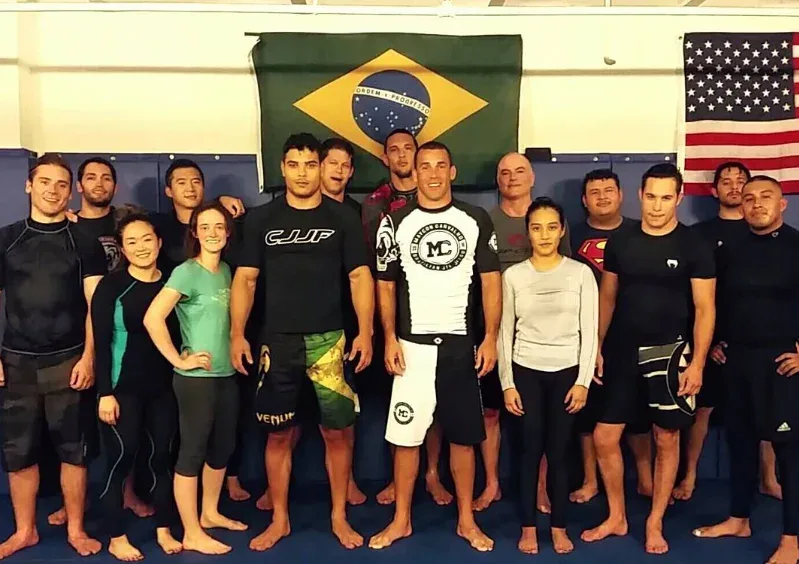
- Jiu jitsu trains strength, cardio and mobility at once, against a partner who pushes back.
- A 2020 review of 14 martial arts studies found a small lift in well-being and a medium drop in anxiety and low mood.
- You practice self-defense against real resistance, so it holds up under stress.
- You can’t learn jiu jitsu alone, and the people are a big reason students stay.
- It’s worth it if you can train two or three times a week for a few months. Your first class is free.
Physical benefits of jiu jitsu
Jiu jitsu works your grip, core, hips, back and legs against a resisting partner, with cardio that comes in short, hard bursts and mobility from moving on the ground. Our guide to jiu jitsu as a workout goes deeper.
An hour burns roughly 380 to 750 calories for a 160-lb adult, depending on how much of it is live rounds. Here’s the calorie table by body weight.
Mental benefits of jiu jitsu
It’s hard to think about work while someone is trying to pass your guard. Every position is a puzzle, and solving it takes all your attention. For many people that makes it the most absorbing hour of the week, and they leave class with a clearer head.
Confidence tends to come from small, regular wins: an escape that finally works, a round where you stayed calm under pressure. And because everyone taps, black belts included, losing a round stops feeling like failing.
What research says about jiu jitsu and mental health
Research on jiu jitsu itself is young, so most of the evidence comes from martial arts in general. Here’s what it shows so far:
- Well-being, anxiety and low mood. A 2020 review of 14 martial arts studies found a small lift in well-being and a medium-sized drop in symptoms such as anxiety and depression (Moore and others).
- Aggression. The same review found no clear change in aggression.
- Service members and veterans with PTSD. In a 2019 pilot study, they trained jiu jitsu for 40 sessions over five months, and their PTSD, depression and anxiety symptoms eased and they drank less. It was small, with no comparison group, and the authors call for larger trials (Willing and others).
- Adults over 50. A 2024 review of 13 studies and 514 people over 50, in arts such as karate and taekwondo, found sharper thinking and less anxiety and depression (Sullivan and others).
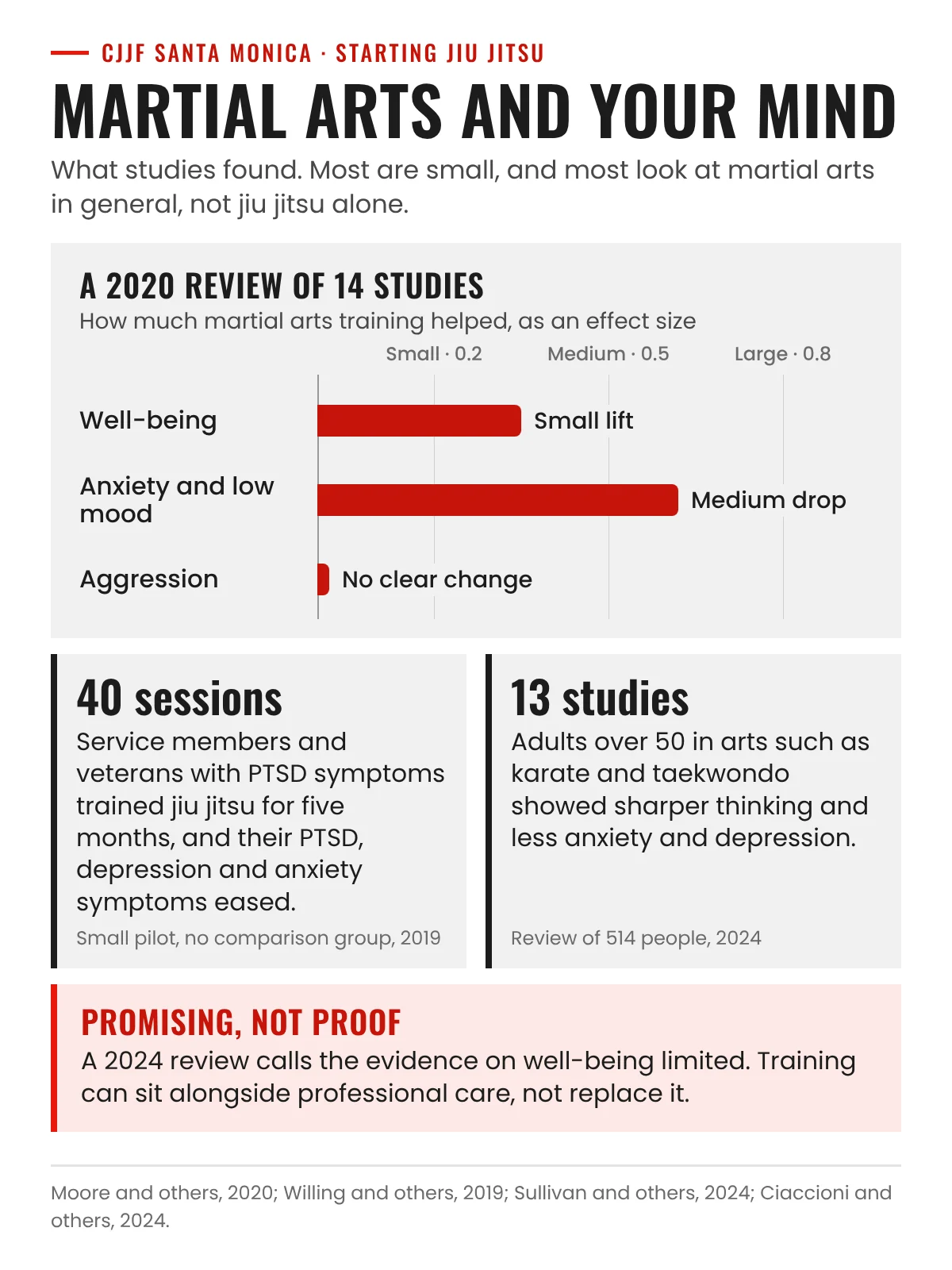
Promising, not proof: a 2024 review of adult studies calls the evidence on well-being limited (Ciaccioni and others). Jiu jitsu isn’t a treatment. If you’re dealing with anxiety, depression or trauma, training can sit alongside care from a professional, not replace it.
Self-defense you can trust
You practice escapes and control against a partner who resists, at a safe pace, so the skills hold up under stress. Our honest comparison of martial arts for self-defense explains why.
Community
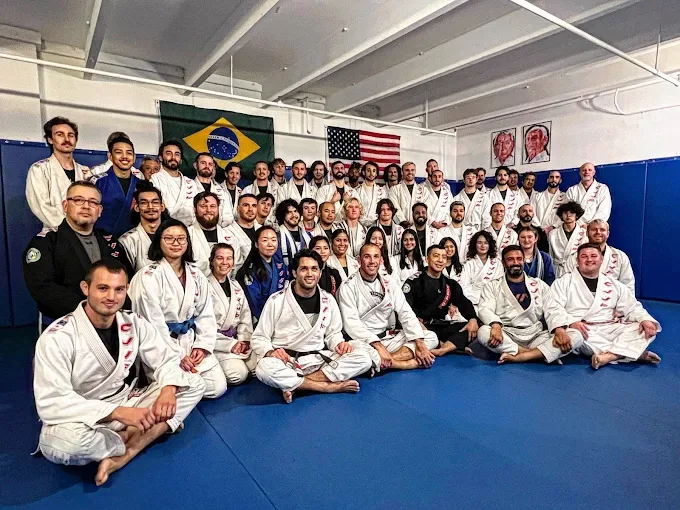
You can’t learn jiu jitsu alone. Your training partners help you improve, and you help them. You meet people of every age and background, and many become friends.
“It’s so great seeing people of all ages come here and train hard.” Ana A., Google review
Habits that carry over
Some call this the jiu jitsu philosophy. Jiu jitsu grew out of judo, and judo’s two founding principles still describe it well: maximum efficient use of energy, and mutual welfare and benefit (Wikipedia). On the mat, that means technique over force, and looking after the partners you learn from. Off the mat, it shows up as:
- Consistency. Belts take years, so you learn to show up.
- Humility. Everyone taps, including black belts.
- Resilience. You lose a round, figure out why, and try again.
- Goals you can see. Stripes and belts mark real progress.
- Care for others. You can’t improve without partners, so you look after them.
Is jiu jitsu worth it?
For most people who can train two or three times a week, yes. Here’s the trade, side by side:
| What you get | What it asks of you |
|---|---|
| A full-body workout that doesn’t feel like one | Two or three classes a week, for months |
| Self-defense practiced against real resistance | Patience: belts take years |
| A clearer head after class | Some bumps, mostly sprains and strains |
| Friends who train with you | Close contact, so hygiene matters |
| Confidence, and humility | A membership and a gi |
The details are in the downsides of jiu jitsu for fitness and the real injury risks. The surest way to know if it’s worth it for you is a class, and your first one is free.
For kids
Kids build focus, confidence and respect, and learn to handle conflict without hitting anyone. See our kids classes, or read jiu jitsu or karate for your child.
Weighing it for your child? Read is jiu jitsu worth it for kids?, our guide for parents.
What it won’t do
Jiu jitsu won’t make you invincible, and it won’t replace a doctor’s advice for a health condition. Progress is slow and injuries can happen; our guide to training safely covers how to keep the risk low. The benefits come from training regularly, two or three times a week, over months and years.
Adult classesBook a free class
Questions about jiu jitsu benefits
What are the main benefits of jiu jitsu?
Full-body fitness, self-defense that works against resistance, focus and stress relief, confidence, and a community of training partners.
Is jiu jitsu worth it?
For most people who can train two or three times a week for a few months, yes: you get fitness, self-defense, a clearer head and friends. It asks for time, patience and a few bumps along the way. Here’s the trade, side by side.
Is jiu jitsu good for your mental health?
Many people find training helps them switch off and handle stress, and it adds routine and community to the week. Studies of martial arts link training to better well-being and less anxiety and low mood, though most are small. It isn’t a replacement for professional care.
Is jiu jitsu good for anxiety?
It can help. Training gives your mind one thing to focus on, and a 2020 review of martial arts studies found a medium-sized drop in symptoms such as anxiety and depression. It isn’t a treatment: if anxiety is affecting your life, talk to a professional, and tell your coach if anything in class feels like too much.
How long until I notice the benefits?
Fitness and confidence often improve within the first few months of steady training. Skills take longer, which is part of the appeal. In one review of adults over 50, how long people kept training mattered more than how often.
Why is jiu jitsu so addictive?
Every round is a puzzle against a live opponent, so there’s always something to fix next time, and you can feel yourself improving. Add the people you train with, and it’s easy to look forward to all week.
Why do so many people quit jiu jitsu?
The first months are humbling: everyone taps you and progress is hard to see. Injuries, busy schedules and comparing yourself with others add up. Here’s how to keep going when it gets hard.
Is jiu jitsu good for older adults?
Yes, with a sensible pace. Here’s how to start jiu jitsu after 40.
Sources: Moore, Dudley and Woodcock, The effect of martial arts training on mental health outcomes: a systematic review and meta-analysis, Journal of Bodywork and Movement Therapies, 2020: 14 studies; a small effect on well-being, a medium effect on symptoms such as anxiety and depression, no significant effect on aggression. Willing and others, Brazilian Jiu Jitsu Training for US Service Members and Veterans with Symptoms of PTSD, Military Medicine, 2019: a pilot, 40 sessions over five months, one group with no comparison; less PTSD, depression, anxiety and alcohol use. Sullivan and others, Older Persons Participation in Hard Martial Arts: Opportunities to Improve Psychological Well-Being?, International Journal of Exercise Science, 2024: 13 studies, 514 people over 50; better thinking skills, less anxiety and depression; length of training mattered more than frequency. Ciaccioni and others, Martial arts, combat sports, and mental health in adults: a systematic review, Psychology of Sport and Exercise, 2024: limited evidence on well-being; more consistent links with perception and impulse control. Wikipedia, Judo: judo’s two principles, maximum efficient use of energy and mutual welfare and benefit.